On this day in military history…
On 5 March 1940 the leadership of the Soviet Union made one of the most consequential and brutal decisions of the Second World War. The Executive Committee of the Communist Party of the Soviet Union, under the authority of Joseph Stalin, approved a proposal from Lavrentiy Beria, head of the NKVD, the Soviet secret police, to execute thousands of Polish prisoners of war and political detainees who had fallen into Soviet hands after the invasion of Poland in September 1939. This order led directly to what became known as the Katyn Massacre, one of the most infamous crimes committed by the Soviet regime during the war.
After Germany invaded Poland on 1 September 1939, the Soviet Union invaded the eastern part of the country on 17 September under the secret provisions of the Molotov–Ribbentrop Pact. Polish forces caught between two invading powers were quickly overwhelmed. Tens of thousands of Polish soldiers, officers, policemen, and members of the state administration were captured by the Red Army. The Soviet authorities separated ordinary soldiers from officers and members of the Polish intelligentsia, viewing the latter as dangerous representatives of the Polish state and national identity.
Three main prisoner-of-war camps were established for these captured Polish officers: Kozelsk, Starobelsk, and Ostashkov. Kozelsk held mainly army officers and members of the Polish intelligentsia. Starobelsk contained many reserve officers, academics, and professionals. Ostashkov was used primarily for police officers, gendarmes, prison guards, and members of the border guard service. These prisoners represented a broad cross-section of Poland’s educated and leadership classes, including doctors, engineers, professors, lawyers, priests, and civil servants. Many were reserve officers who had been mobilized during the German invasion but whose civilian professions had placed them among the most educated segments of Polish society.
In early April 1940 the execution process began. On 3 April the first transport of prisoners left the Kozelsk camp under the pretense that they were being transferred elsewhere. Instead, they were taken to the Katyn Forest near Smolensk in western Russia. There, NKVD executioners shot them individually in the back of the head. The killings were systematic and industrial in scale. Prisoners were brought in small groups, their hands tied, and executed with a pistol shot at close range before being buried in large prepared pits.
Similar procedures were carried out for prisoners from the other camps. Those from Starobelsk were transported to Kharkiv, where they were executed in the basement of the NKVD headquarters. Their bodies were buried in mass graves in nearby forested areas. Prisoners from Ostashkov were taken to the NKVD prison in Kalinin, now known as Tver, where they were executed before being buried in mass graves in Mednoye.
Current historical estimates indicate that 14,546 Polish prisoners of war were executed as part of this operation. In addition, the Soviet authorities executed 7,305 political prisoners who had been held in prisons across western Ukraine and western Belarus after the Soviet occupation of eastern Poland. These prisoners included political activists, landowners, intellectuals, and individuals suspected of opposing Soviet rule. Altogether, more than 21,000 Polish citizens were murdered in this coordinated campaign.
The execution method was brutally consistent. Victims were shot in the back of the head with German-made Walther pistols, which were favored by the NKVD for their reliability. The use of these weapons later became part of Soviet attempts to shift blame for the killings onto Germany. Each execution was carefully recorded by the NKVD, and the operation was conducted with bureaucratic efficiency.
For decades the Soviet Union denied responsibility for the massacre. In 1943, after German forces occupied the Smolensk region, they discovered the mass graves in the Katyn Forest and announced the findings to the world. The Germans invited international observers and the Red Cross to examine the site. Evidence suggested the killings had taken place in 1940, when the area was under Soviet control. The Soviet government responded by accusing Nazi Germany of carrying out the executions after invading the Soviet Union in 1941. This claim became the official Soviet position for nearly half a century.
After the war, the issue remained highly sensitive. In communist Poland, discussion of Katyn was suppressed, and anyone publicly accusing the Soviet Union risked persecution. The Soviet narrative blaming Germany was even presented during the Nuremberg Trials, though it was not ultimately accepted by the tribunal due to insufficient evidence.
Only in 1990 did the Soviet government officially acknowledge responsibility. Mikhail Gorbachev admitted that the NKVD had carried out the executions and released some archival documents confirming the decision made by Stalin and the Soviet leadership. In 1992 additional documents, including Beria’s original memorandum proposing the executions, were handed over to Poland by Russian President Boris Yeltsin.
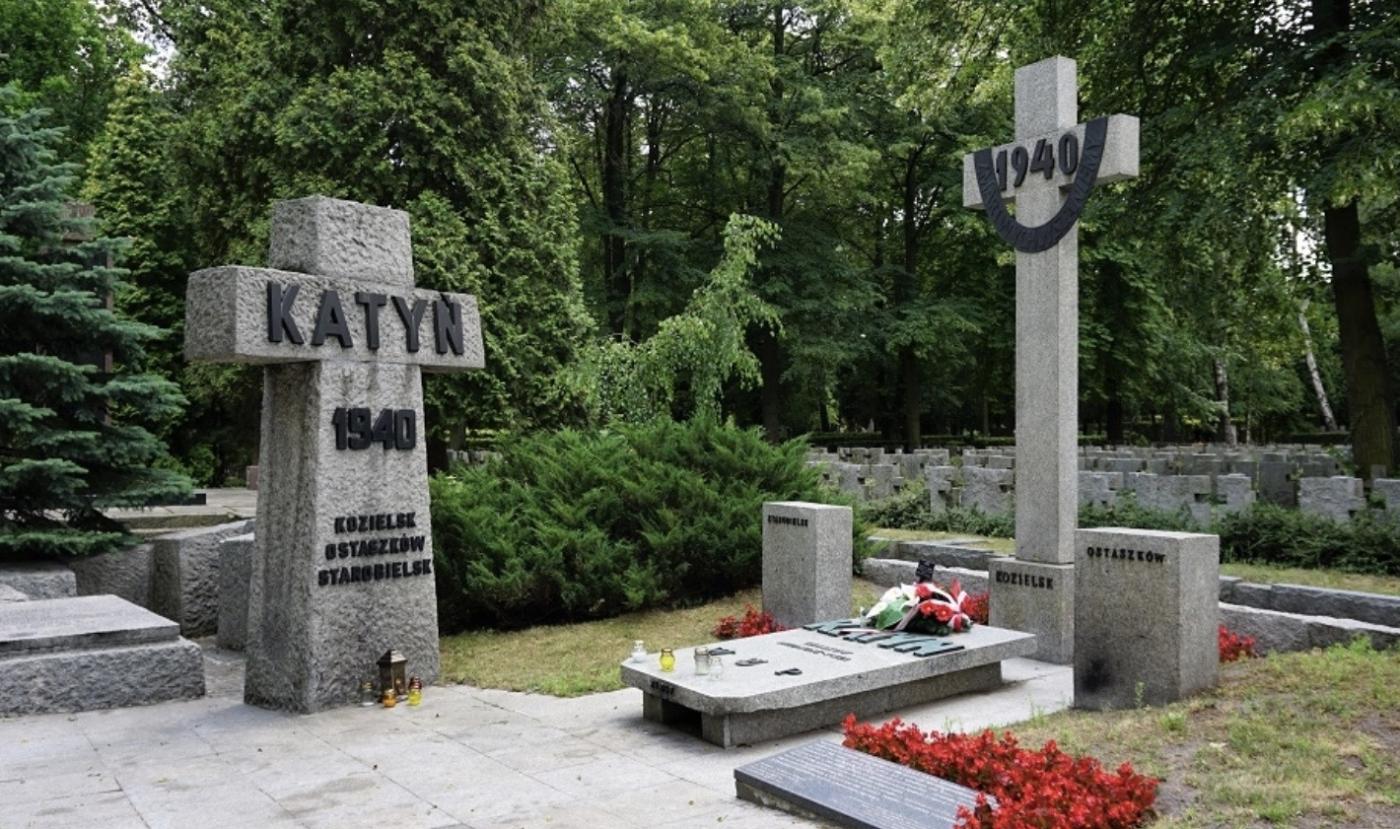
The physical sites connected with the massacre later became places of remembrance. Mass graves from the Kozelsk prisoners were found in the Katyn Forest near Smolensk. The victims from Starobelsk were buried near Kharkiv in Ukraine. Those from Ostashkov were buried in Mednoye near Tver in Russia. In 2000 official Polish Military Cemeteries were established at these locations to commemorate the victims. These cemeteries serve as solemn memorials and contain thousands of engraved plaques bearing the names of the murdered officers.
The fate of many political prisoners executed in the Soviet republics of Ukraine and Belarus is less well documented. Historians know the names of roughly half of those killed in Ukraine. One of the confirmed burial places is located in Bykovnia near Kyiv, where a military cemetery commemorating the victims was opened in 2012. Another possible burial site is believed to be Kuropaty near Minsk in Belarus, though the identities of those buried there remain largely unknown.
The massacre also had devastating consequences for the families of the victims. In April 1940 the Soviet authorities deported approximately 60,000 relatives of the murdered officers and prisoners to remote regions of North Kazakhstan and Siberia. These deportations were intended to remove any remaining social networks associated with the Polish elite and to weaken Polish national resistance.
Among those killed were individuals from many religious and ethnic backgrounds, including Polish Jews. One of the most prominent Jewish victims was Baruch Steinberg, the Chief Rabbi of the Polish Army since 1933. Steinberg had been associated with the Polish independence movement from an early age and served in the Polish Military Organization. He also participated in the defense of Lvov during the Polish-Ukrainian conflict after the First World War. After being captured by the Soviets, he was held in Kozelsk and later executed at Katyn in April 1940.
Research by historian Benjamin Meirtchak indicates that at least 438 victims of Jewish origin were among those murdered. Of these, 231 were killed in Katyn, 188 in Kharkiv, and 19 in Tver. Many were reserve officers who in civilian life worked as doctors, pharmacists, engineers, lawyers, and academics. Their deaths illustrate how the massacre targeted Poland’s professional and intellectual classes regardless of religious background.
Even less is known about Jewish victims among the political prisoners executed in Soviet Ukraine. Historians estimate that more than 200 Jews appear on the list of 3,435 individuals executed there, based on their names and family origins. These individuals included barristers, merchants, community activists, and members of Jewish political organizations. Some were also reserve officers who had not been captured as soldiers but were later arrested by the NKVD.
One notable civilian victim was Wiktor Chajes, a Jewish independence activist and Deputy Mayor of pre-war Lvov. Chajes had also founded the Jewish Museum in the city and was an important cultural figure. His execution illustrates how the Soviet campaign targeted not only military personnel but also prominent members of civil society.
The Katyn Massacre had profound long-term consequences for Poland. By eliminating thousands of officers and educated leaders, the Soviet authorities effectively decapitated a large portion of the country’s military and intellectual elite. Many historians argue that this loss significantly weakened Poland’s ability to rebuild its institutions after the war.
Today Katyn remains one of the most painful symbols in Polish historical memory. Each year commemorations are held at the burial sites and memorials across Poland and Eastern Europe. The massacre is widely recognized as a war crime and an act of political repression carried out by the Soviet state.
The discovery of personal items in the graves, such as identity tags, religious medallions, letters, and diaries, has helped historians reconstruct the identities and final moments of many victims. These artifacts serve as poignant reminders of the individuals behind the statistics—men who were officers, professionals, fathers, and sons whose lives ended in the forests and prison basements of the Soviet Union in the spring of 1940.