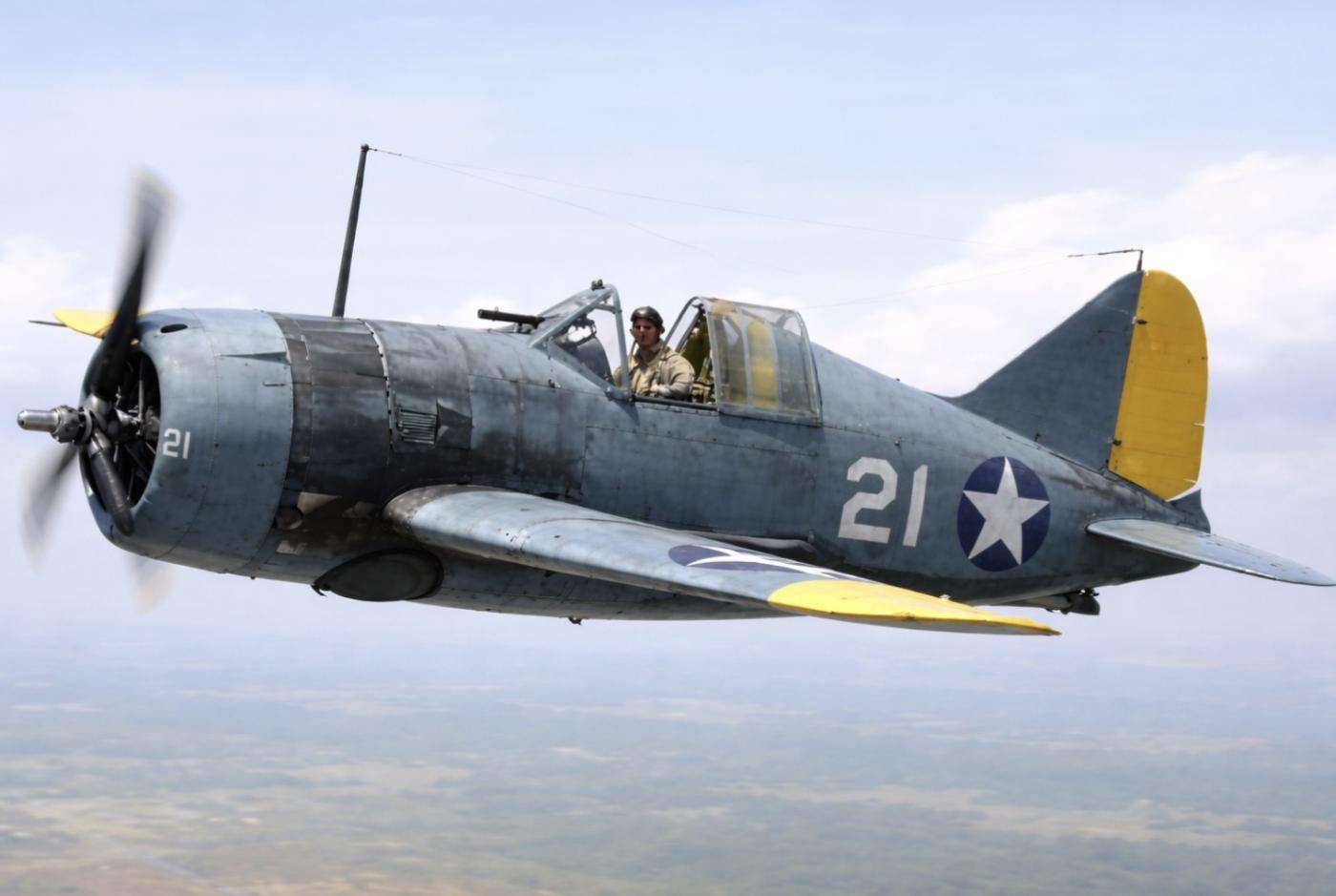
Brewster Buffalo F2A
The Brewster F2A was an American single-engine carrier-based fighter aircraft developed in the mid-1930s. It was one of the first monoplane fighters used by the United States Navy and represented a major step forward from the older biplane fighters previously operating from aircraft carriers. Although it later gained a poor reputation in some theatres, especially early in the Pacific War, the aircraft was an important transitional design showing how rapidly fighter technology was advancing before and during the Second World War.
The aircraft was designed by the Brewster Aeronautical Corporation, a small American aircraft manufacturer located in Long Island City, New York. The company had previously produced aircraft floats and aviation components rather than complete combat aircraft. In 1935 the U.S. Navy issued a requirement for a modern carrier fighter that would replace the existing biplane designs. Brewster responded with its Model 139 design, created by a team of engineers including Dayton Brown. The design competed against aircraft from Grumman and Seversky and was eventually selected by the Navy.
The prototype first flew on 2 December 1937. At the time it was considered a modern aircraft. It featured an all-metal structure, a fully enclosed cockpit, retractable landing gear, and a low-wing monoplane layout. These features were becoming standard for land-based fighters but were still relatively new in naval aviation. The aircraft was also fitted with an arrestor hook to allow it to land safely on aircraft carriers.
Production began in 1938 and the fighter entered U.S. Navy service in 1939. Around 509 aircraft were built in total. These included the F2A-1, F2A-2, and F2A-3 versions used by the U.S. Navy and Marine Corps, as well as export versions designated B-239 and B-339 for other countries. The type served with several air forces including those of the United States, Finland, Britain, the Netherlands East Indies, Australia, and New Zealand.
Its main purpose was to act as a carrier-based interceptor and fleet defense fighter. The aircraft’s role was to protect naval fleets and carriers from enemy bombers and fighters. It could be launched from carriers to intercept incoming aircraft or provide air cover during naval operations.
Power came from a Wright R-1820 Cyclone radial engine producing between 950 and 1,200 horsepower depending on the model. This engine allowed the fighter to reach a maximum speed of about 311 miles per hour, or roughly 500 kilometers per hour. The aircraft had a service ceiling of about 34,000 feet and a range of approximately 965 miles.
Armament consisted mainly of machine guns. Early versions carried two .50 caliber Browning machine guns in the nose with additional .30 caliber guns in the wings. Later versions increased the armament to four .50 caliber machine guns. The aircraft could also carry small bombs under the wings for limited ground-attack duties.
The fighter had a wingspan of around 35 feet, a length of about 26 feet, and a height close to 12 feet. Empty weight was roughly 4,000 pounds and fully loaded weight exceeded 6,500 pounds depending on the version. Its short fuselage and large radial engine gave it a rounded appearance that pilots easily recognized.
When it first entered service the aircraft was considered capable and faster than earlier U.S. Navy biplane fighters such as the Grumman F3F. However, aircraft design improved quickly in the late 1930s and early 1940s. Within a few years it was being outperformed by newer fighters like the Japanese Mitsubishi A6M Zero and the American Grumman F4F Wildcat.
One of the most interesting aspects of this fighter’s history is that its reputation varied greatly depending on where it was used. In the Finnish Air Force it became one of the most successful fighters of the early war. Finland received a version called the B-239, which was lighter and lacked some naval equipment used on American carrier aircraft. Finnish pilots used it against Soviet aircraft during the Continuation War and achieved impressive success, claiming hundreds of aerial victories while suffering relatively few losses in air combat.
In Southeast Asia the aircraft performed far less effectively. British, Dutch, and Australian forces operated the export B-339 version against Japanese aircraft during the fighting over Malaya, Singapore, and the Dutch East Indies in 1941 and 1942. In those battles it struggled against highly maneuverable Japanese fighters such as the Zero and the Nakajima Ki-43 Oscar. The export models were heavier and often flown by pilots with limited training or outdated combat tactics.
The aircraft also saw combat with the United States Marine Corps during the Battle of Midway in June 1942. Marine Fighting Squadron VMF-221 operated several F2A-3 fighters alongside the Grumman F4F Wildcat while defending the island. During the battle the unit suffered heavy losses while intercepting Japanese attack formations, further damaging the aircraft’s reputation in American service.
Despite its shortcomings, the design played an important role in naval aviation development. It demonstrated the advantages of modern monoplane fighters operating from aircraft carriers and influenced later designs. It also highlighted the need for lighter airframes, more powerful engines, and improved combat tactics.
The Brewster company itself struggled during the war. Production problems, management difficulties, and labor disputes affected the company’s performance. In 1942 the U.S. Navy took control of Brewster Aeronautical Corporation due to concerns about quality and efficiency. The company later produced the SB2A Buccaneer dive bomber, but it never became a major aircraft manufacturer and stopped producing aircraft by the end of the war.
Today only a few examples of this fighter survive. One restored Finnish B-239 is preserved at the Finnish Aviation Museum near Helsinki. The aircraft was recovered from a frozen lake in Russia during the 1990s and carefully restored.
The Brewster F2A remains an important aircraft in aviation history. It marked the transition from biplane naval fighters to faster all-metal monoplanes and illustrates the rapid technological changes that occurred during the years leading up to the Second World War. Its very different combat record in different countries makes it one of the most debated fighter aircraft of the early war years.