On this day in military history…
Operation Chariot took place on 28 March 1942 during the Second World War and is widely regarded as one of the most daring and successful commando raids ever carried out. The objective of the raid was the destruction of the Normandie dry dock at the port of Saint-Nazaire on the French Atlantic coast. This dock was the only facility on the Atlantic seaboard capable of accommodating Germany’s largest battleships, particularly the powerful German battleship Tirpitz. If Tirpitz had been able to use the dock for repairs it could have operated much more freely against Allied shipping in the Atlantic. Destroying the dock would force any large German warship needing major repairs to return to Germany, limiting its ability to threaten convoys.
The plan was conceived in early 1942 when British intelligence realized the danger posed by Tirpitz. The operation was planned by Lord Louis Mountbatten, the Chief of Combined Operations, whose command was responsible for developing commando raids against German-occupied Europe. The detailed operational planning was carried out by Captain Robert Ryder of the Royal Navy and Lieutenant Colonel Charles Newman, commanding officer of No. 2 Commando. Ryder would command the naval forces delivering the raiders while Newman would lead the commandos on the ground.
The plan itself was ingenious and audacious. The centerpiece involved an obsolete American-built destroyer, HMS Campbeltown. The ship had originally been the USS Buchanan before being transferred to Britain in 1940. Engineers modified the vessel extensively to resemble a German Möwe-class torpedo boat so it might pass German defenses in darkness. More importantly, the ship was packed with about four and a half tons of delayed-action explosives hidden inside her bow. The intention was to ram the destroyer directly into the gates of the Normandie dock, leaving the explosives to detonate hours later.
The raiding force consisted of 611 men in total. About 346 were Royal Navy personnel responsible for navigating and supporting the operation, while 265 were British commandos, primarily from No. 2 Commando along with smaller detachments from other commando units. Their tasks were to destroy dock machinery, pumping stations, lock mechanisms, electrical equipment, and other vital infrastructure around the dock area once the Campbeltown had rammed the gate.
The raiders were transported across the English Channel by a small flotilla of motor launches, motor gun boats, and a motor torpedo boat escorting Campbeltown. These vessels carried demolition teams who would land at various points in the harbor and carry out their assignments before attempting to withdraw. The operation relied heavily on surprise and speed. The ships approached the Loire estuary flying German naval flags and using captured recognition signals to delay suspicion as long as possible.
The flotilla sailed from Falmouth on the evening of 26 March 1942. As they approached the French coast during the early hours of 28 March, German coastal batteries began to challenge the approaching ships. For a short time the deception worked, but eventually German defenses realized the attack was hostile and opened heavy fire from shore batteries and anti-aircraft guns.
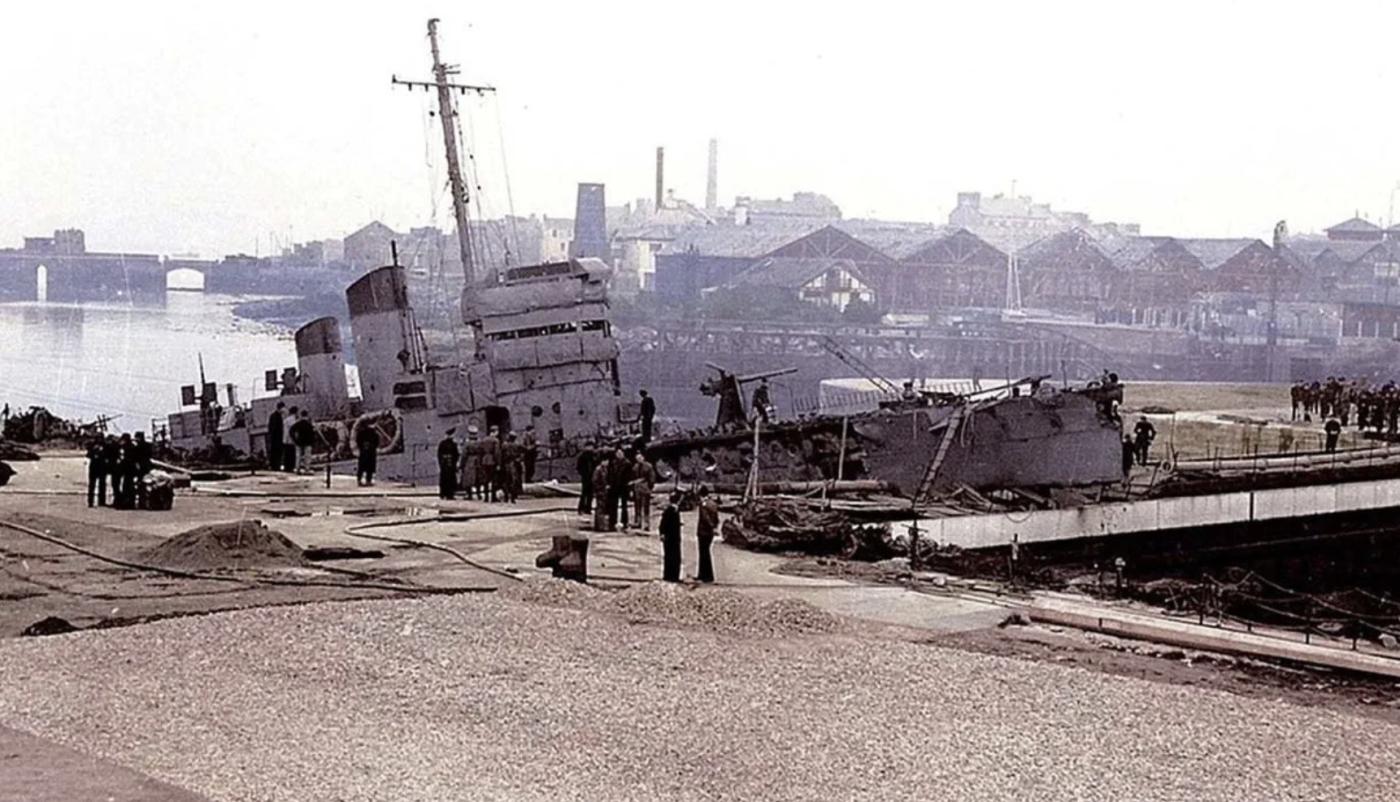
At approximately 1:34 a.m. on 28 March 1942, HMS Campbeltown rammed the massive steel caisson gate of the Normandie dock at around 20 knots. The impact drove the destroyer deep into the gate structure, exactly as planned. Commando demolition teams quickly disembarked and spread throughout the dock area under intense enemy fire. They placed explosives on pumping machinery, winding gear, bridges, and power installations. Meanwhile the small motor launches in the harbor were subjected to devastating fire from German guns positioned around the port.
The fighting inside Saint-Nazaire became extremely intense. The commandos fought street battles with German defenders while carrying out their demolition tasks. Several motor launches were destroyed by gunfire and many of the naval crews were killed or wounded. The original plan had been for the raiders to withdraw by sea once their work was complete, but many of the boats had been sunk or damaged.
As a result, a number of commandos attempted to escape overland through occupied France, hoping to reach Spain. Most were eventually captured after running out of ammunition or becoming surrounded by German troops. A small number did manage to evade capture with help from the French Resistance.
The most dramatic moment of the raid came later that morning. The explosive charges hidden inside Campbeltown had been fitted with delayed fuses designed to detonate hours after the ramming. At about 10:35 a.m., while German officers and engineers were inspecting the stranded destroyer, the massive charge detonated. The explosion destroyed the dry dock gate completely and caused severe damage throughout the surrounding dock area, killing a large number of German personnel gathered nearby. Later that day additional torpedoes fired earlier from a motor torpedo boat also exploded, adding to the confusion and destruction.
The destruction of the Normandie dock was a major strategic success. The dock remained unusable for the rest of the war, effectively preventing Tirpitz or any other large German capital ship from using Saint-Nazaire as a repair base. This significantly reduced the threat such ships posed to Allied Atlantic convoys.
The cost of the raid was extremely high. Of the 611 men who took part, 169 were killed and more than 200 were taken prisoner. Only about 228 men managed to return to Britain. Despite these heavy losses, the raid achieved all its primary objectives and was celebrated as a remarkable example of courage and determination.
The bravery displayed during Operation Chariot was recognized with a large number of decorations. Five Victoria Crosses were awarded for actions during the raid. The recipients were Lieutenant Colonel Charles Newman, Commander Robert Ryder, Able Seaman William Savage, Sergeant Thomas Durrant, and Leading Seaman William Beattie. Many other participants received Distinguished Service Orders, Military Crosses, and other awards for gallantry.
Operation Chariot quickly became legendary in British military history because of its bold planning and the willingness of the raiders to undertake what many knew was an extremely dangerous mission with uncertain chances of survival. The use of a sacrificial destroyer packed with explosives, combined with close-quarters fighting inside a heavily defended port, made the raid one of the most dramatic special operations of the war. Military historians often describe it as the greatest commando raid of all time due to its strategic impact, extraordinary bravery, and the sheer audacity of the plan.