On this day in military history…
Stalag Luft III was one of the most famous prisoner-of-war camps of the Second World War and became the setting for one of the most daring escape attempts ever carried out by Allied prisoners. The escape, which took place during the night of 24–25 March 1944, later became known as the Great Escape. It was the result of months of planning, engineering, and cooperation between hundreds of prisoners determined to challenge their captivity and disrupt the German war effort.
The camp had been built by the German Luftwaffe in March 1942 near the town of Sagan in eastern Germany, an area that is now part of Poland and known today as Żagań. Its location had been carefully chosen. The sandy soil in the region made tunnelling difficult because the sand collapsed easily and could be spotted by guards if it appeared on the surface. The Germans designed the camp specifically to make escape attempts extremely difficult. Barracks were raised slightly above the ground so that guards could see if prisoners attempted to dig underneath them, and microphones were sometimes placed in the ground to detect tunnelling activity. Multiple barbed-wire fences surrounded the compounds and watchtowers overlooked the perimeter. Armed guards patrolled constantly and searchlights swept the grounds at night.
The camp held captured Allied air force officers, mainly from the Royal Air Force and the United States Army Air Forces, though there were also Canadians, Australians, Poles, Czechs, New Zealanders, and several other Allied nationalities. Because they were officers they were not required to work, which meant they had time to organise escape plans. At its peak the camp held around 10,000 to 11,000 prisoners divided into several compounds of wooden huts. Although conditions were harsh, the Luftwaffe generally attempted to follow the rules of the Geneva Convention regarding treatment of prisoners.
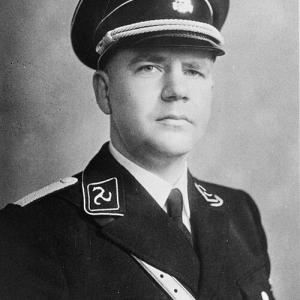
The commandant of the camp was Oberst Friedrich Wilhelm von Lindeiner-Wildau, a senior Luftwaffe officer. Although responsible for maintaining strict security, he was regarded by many prisoners as a professional soldier who did not favour cruelty. Even so, security was extensive and a large number of German guards and personnel were responsible for watching the camp day and night from towers, patrols, and administrative positions.
Among the prisoners was Royal Air Force Squadron Leader Roger Bushell, a determined and experienced escape organiser. Bushell had already tried to escape from German captivity several times earlier in the war and had been recaptured each time. Inside Stalag Luft III he secretly became the leader of the escape organisation within the camp. He was known by the code name “Big X” and oversaw a large network of prisoners involved in escape planning.
The senior British officer in the compound authorised the planning of escape attempts, which was considered a duty of captured officers because it forced the enemy to divert manpower away from the front lines. Bushell proposed an ambitious plan that was far more daring than anything attempted before. Instead of trying to free a handful of prisoners, he planned to organise the escape of more than 200 men at once.
To increase the chances of success, three tunnels were planned simultaneously. These were given the names Tom, Dick, and Harry. The idea was that if one tunnel was discovered by the guards they might assume it was the only one and stop searching, allowing another tunnel to continue unnoticed. Hundreds of prisoners became involved in the operation, which lasted more than a year. Some men dug the tunnels while others forged identity papers, created maps, altered military clothing into civilian outfits, or built compasses and travel equipment.
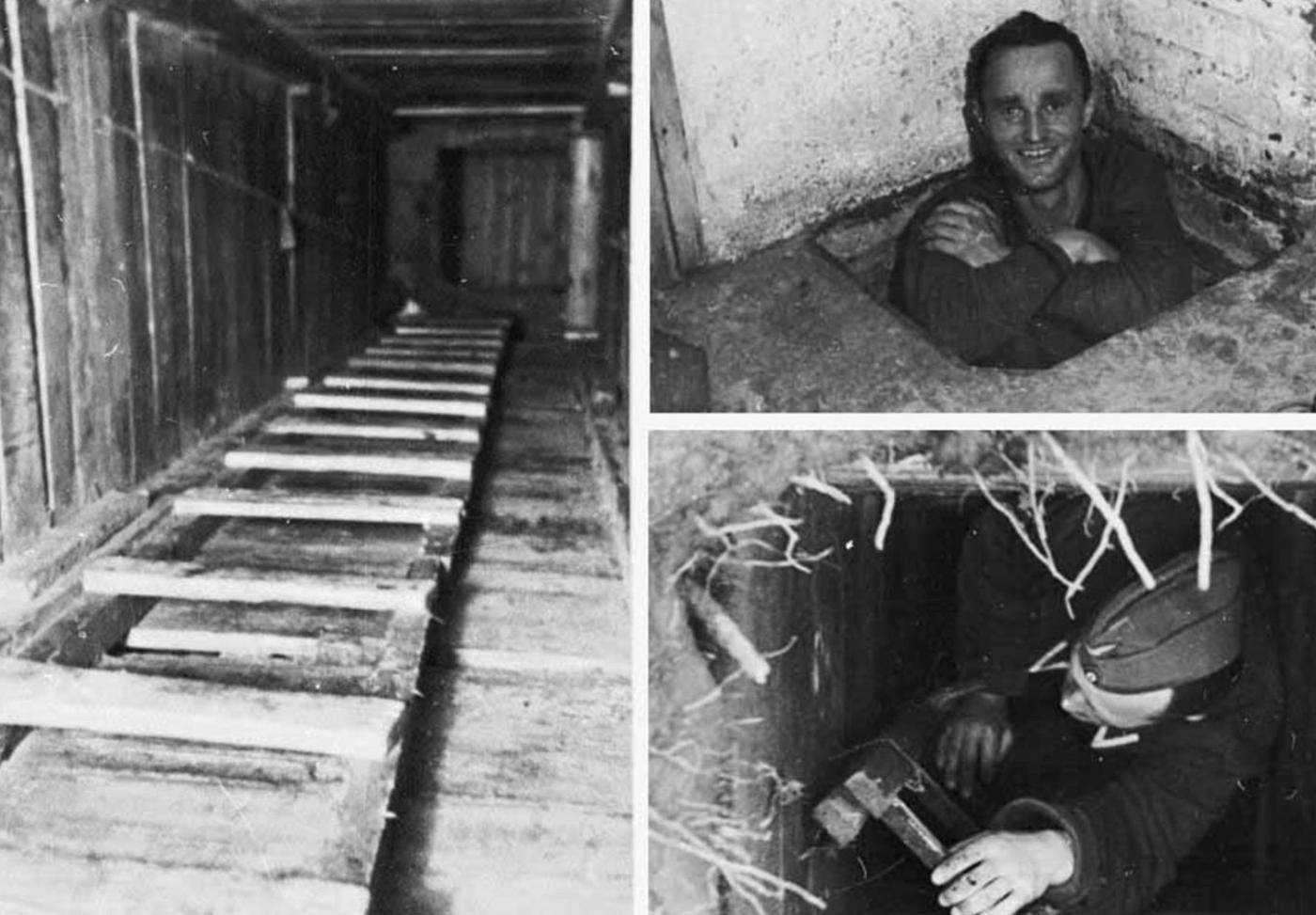
The tunnels themselves were remarkable feats of engineering carried out in secret under extremely difficult conditions. Each tunnel was dug about thirty feet below the surface to avoid detection by German listening devices. The main tunnel that would eventually be used, Harry, stretched for roughly 350 feet. Because it was so deep and narrow, the prisoners had to install ventilation pipes to provide fresh air and electric lighting made from stolen wiring taken from the camp’s power system. Wooden supports were constructed to stop the sand collapsing, and small trolley carts ran along improvised rails so sand could be removed more easily.
One of the biggest problems was disposing of the huge amounts of sand produced by the digging. The prisoners solved this by hiding small bags of sand inside their trousers and releasing it slowly while walking around the compound. Over time the sand was scattered across gardens, paths, and open areas so it would not attract attention. At the same time secret workshops inside the barracks produced forged travel permits, identity papers, railway passes, and civilian clothing so that escapees could attempt to travel across Germany without being recognised as prisoners.
Eventually the Germans discovered one of the tunnels, Tom, during a routine inspection, which was a serious setback. The second tunnel, Dick, had already been repurposed mainly for storage of supplies and soil. That left only the third tunnel, Harry, for the final escape attempt. Despite the risk of discovery, Bushell decided to proceed.
On the night of 24 March 1944 the escape began. Prisoners crawled through the narrow tunnel one at a time, emerging through a hidden exit beyond the camp’s perimeter fence. However, a miscalculation meant the tunnel ended slightly short of the nearby trees that were meant to hide the exit. Instead of emerging in dense cover, the escapees had to cross open snow-covered ground before reaching the forest. This slowed the process considerably.
Originally more than 200 men had been selected to escape, but the slow pace meant that far fewer could get out before daylight. By the time the seventy-sixth prisoner emerged, a guard noticed suspicious activity and the escape was discovered. The alarm was raised immediately and the camp went into lockdown.
When the Germans inspected the camp afterwards they were astonished by the scale of the operation and the amount of equipment that had been secretly taken from the barracks to construct the tunnels. They discovered that 4,000 wooden bed boards had been removed and used to shore up the tunnel walls and ceilings to prevent collapse. Many other items had also been quietly taken and adapted by the prisoners. Investigators found that 90 complete bunk beds had been dismantled, along with 635 mattresses. Furniture had also disappeared, including 52 large twenty-man tables, 10 single tables, 34 chairs, and 76 benches. Other equipment used in the construction included 69 lamps for lighting, 246 water cans used to remove sand, 30 shovels, around 1,000 feet of electric wire to provide power for lighting inside the tunnel, about 600 feet of rope, and 3,424 towels which had been used for insulation, sand disposal, and makeshift tools. The discovery revealed just how extensive and carefully organised the escape preparations had been.
German authorities quickly organised a massive manhunt. Police, soldiers, railway officials, and civilians were alerted across Germany and occupied Europe. Trains, roads, and border crossings were monitored closely. Many of the escapees attempted to travel using forged papers, disguises, and railway journeys, hoping to reach neutral countries such as Switzerland or Sweden. Others attempted to reach ports where they might find ships returning to Britain.
Despite the careful planning, most of the men were recaptured within a few days. Only three of the seventy-six who escaped managed to reach freedom. These were Flight Lieutenant Bram van der Stok of the Netherlands, who travelled through France into Spain and eventually returned to Britain, and the two Norwegian airmen, Flight Lieutenant Jens Müller and Flight Lieutenant Per Bergsland, who managed to reach Sweden after a long and dangerous journey through Germany.
The escape caused fury within the Nazi leadership. Adolf Hitler was extremely angry that so many prisoners had managed to break out of a supposedly secure camp. At first he reportedly ordered that every recaptured prisoner should be executed. Senior officers argued that such a mass execution would violate international law and damage Germany’s reputation, but Hitler insisted that harsh punishment was necessary.
Eventually it was decided that fifty of the recaptured officers would be shot as an example. The Gestapo carried out the killings, claiming falsely that the prisoners had been shot while attempting to escape again. In reality the men were deliberately murdered after being taken away in small groups to remote locations.
Among those killed was Roger Bushell, the organiser of the escape. The executions shocked Allied governments and later became one of the most infamous war crimes committed against prisoners during the war. Twenty-three of the recaptured prisoners were returned to the camp, while others were sent to different prisons.
After the war the killings were thoroughly investigated. Several members of the Gestapo and other German officials involved in the murders were tracked down, tried for war crimes, and executed.
Although the Great Escape did not free large numbers of prisoners, it became one of the most remarkable acts of resistance carried out by Allied prisoners during the Second World War. More than six hundred men had contributed to the operation in some way, and the escape forced the Germans to devote enormous resources to the search and investigation. The story of the escape remains one of the most extraordinary episodes of courage, ingenuity, and determination in wartime captivity.