On this day in military history…
Operation Michael was the opening blow of the German Spring Offensive of 1918 during the First World War. It began on the morning of 21 March 1918 and became one of the most dramatic and deadly days in the history of the British Army. On that single day approximately 37,000 British soldiers were killed, wounded, or captured, making it the second most costly day of the war for Britain after the first day of the Battle of the Somme in 1916. The attack marked Germany’s last major attempt to win the war on the Western Front before American forces arrived in overwhelming numbers.
By early 1918 the strategic situation had changed dramatically. Russia had collapsed after the Russian Revolution of 1917 and had signed the Treaty of Brest-Litovsk with Germany. This allowed Germany to move large numbers of troops from the Eastern Front to the Western Front. German High Command believed this created a short window of opportunity before American forces could arrive in strength. General Erich Ludendorff, effectively the chief strategist of the German army, decided to launch a massive offensive designed to break the stalemate of trench warfare and defeat the Allies before the United States could tip the balance.
The plan for the first phase of this offensive was called Operation Michael. Ludendorff’s aim was to split the British and French armies by attacking the British Fifth Army along the Somme sector between Arras and La Fère. If the attack succeeded it could push the British forces back toward the Channel ports, potentially forcing Britain out of the war or at least separating the British and French armies so they could not support each other effectively.
The German forces involved were enormous. Around 76 German divisions were committed to the offensive with approximately 6,000 artillery pieces and thousands of mortars. The attack was led by German Army Groups under Crown Prince Rupprecht of Bavaria. The main armies involved included the German 17th Army under General Otto von Below, the German 2nd Army under General Georg von der Marwitz, and the German 18th Army under General Oskar von Hutier. Hutier in particular had developed new infiltration tactics that would be central to the offensive.
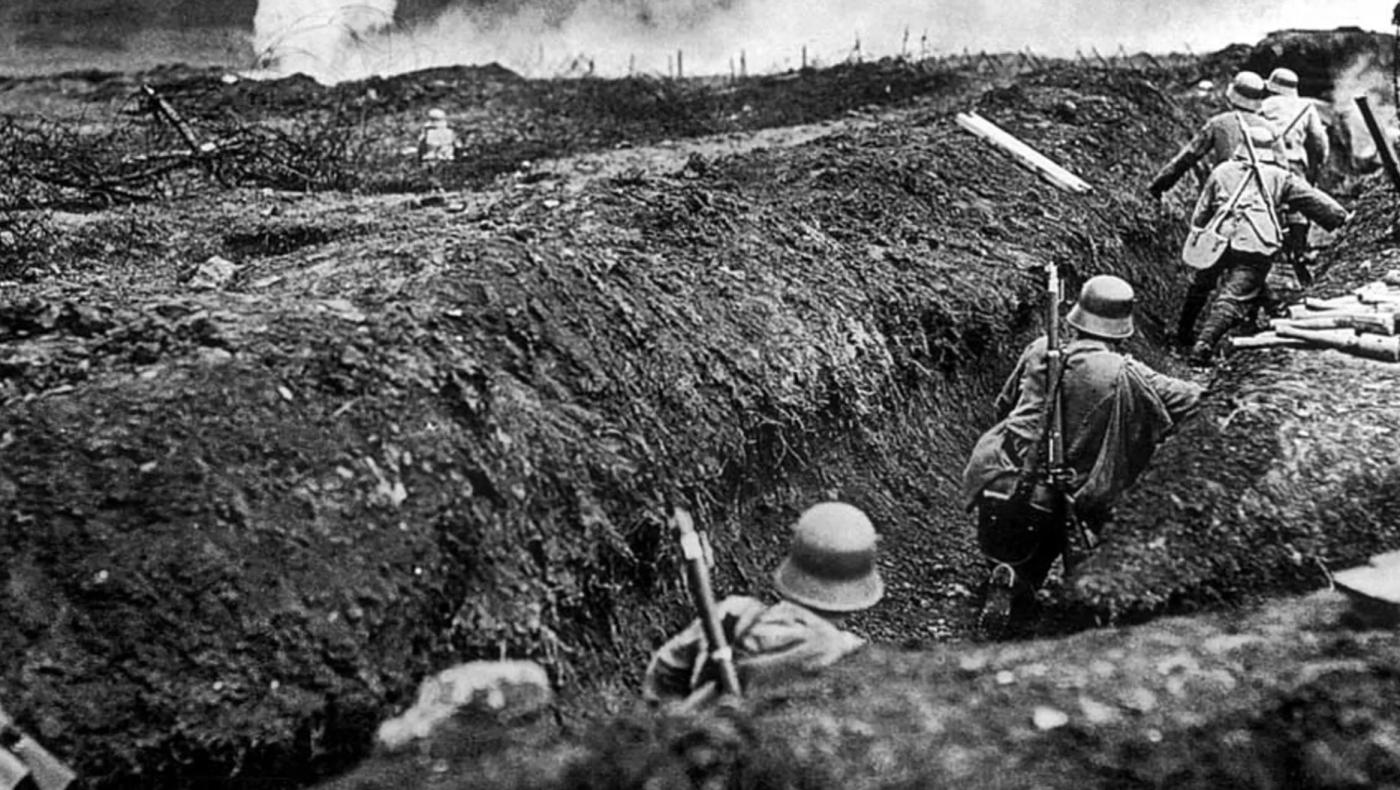
These tactics relied on specially trained stormtrooper units known as Stoßtruppen. Instead of advancing in large waves as had been common earlier in the war, these troops moved in small, flexible groups designed to bypass strongpoints and penetrate deep into enemy positions. Heavy machine-gun nests and fortified trenches were left for follow-up units to eliminate while the stormtroopers pushed forward toward artillery positions, command posts, and supply lines.
At 4:40 a.m. on 21 March 1918 the offensive began with one of the most intense artillery bombardments of the entire war. Over one million shells were fired in about five hours. The Germans used a mixture of high explosive and gas shells including mustard gas and phosgene. The bombardment targeted British artillery batteries, headquarters, communication lines, and frontline trenches. The goal was not only destruction but also confusion and paralysis of British command.
Dense fog covered much of the battlefield that morning, particularly across the Somme valley. This fog became one of the defining features of the attack. While it helped conceal the German advance, it also created chaos for both sides. Soldiers often could not see more than a few metres ahead, and units became separated as the fighting unfolded.
Opposing the German offensive was primarily the British Fifth Army commanded by General Sir Hubert Gough. This army held a long and vulnerable stretch of the front that had previously been occupied by French forces. When the British took over this sector earlier in 1918 they had not yet completed the full defensive system typically used on the Western Front. The trenches were less developed and the defensive depth was weaker than in other sectors.
Within the Fifth Army were several British corps including III Corps under Lieutenant-General Richard Butler, XVIII Corps under Lieutenant-General Ivor Maxse, and XIX Corps under Lieutenant-General Walter Watts. Divisions involved included the 12th (Eastern) Division, 18th (Eastern) Division, 30th Division, 36th (Ulster) Division, 50th (Northumbrian) Division, and many others. British forces were also supported by units from the Royal Field Artillery, Royal Engineers, and machine gun battalions.
To the north the British Third Army commanded by General Sir Julian Byng also faced heavy attacks, particularly around Arras and Cambrai. Although the main German thrust targeted Gough’s Fifth Army, pressure along the wider front was intended to pin British forces and prevent reinforcements from moving quickly.
One factor that contributed to the high number of casualties was the sheer scale and precision of the German artillery barrage. German gunners used advanced techniques such as predicted fire, which allowed them to strike targets accurately without ranging shots that would warn the defenders. British artillery positions were heavily targeted and many guns were destroyed before they could effectively respond.
Another reason for the losses was the vulnerability of the British defensive layout. The British had developed a system of defence in depth during the later years of the war, consisting of forward zones, battle zones, and rear zones. In the Fifth Army sector this system was incomplete. Many forward positions were thinly held and some units were spread across a wide front with limited reserves behind them.
Communication also broke down rapidly. Telephone wires were cut by artillery fire, runners were often killed or lost in the fog, and commanders struggled to understand what was happening along the line. This meant that many units fought isolated battles without clear orders or support.
The fog itself added to the confusion and deadly nature of the fighting. German stormtroopers could suddenly appear within British trenches before defenders even realized they were close. Machine gun teams and small assault groups infiltrated behind the front lines and attacked headquarters, artillery crews, and supply columns.
Many British units fought extremely hard despite being overwhelmed. Some battalions held their positions for hours even when surrounded. Others attempted organized withdrawals but were cut off by advancing German forces. In several cases entire battalions were captured after exhausting their ammunition.
By the end of the first day the Germans had advanced up to eight kilometres in some areas, an enormous gain compared with the typical few hundred metres of earlier Western Front battles. However this success came at significant cost to the Germans as well. German casualties were also extremely heavy, though not as high as those of the defenders that day.
The collapse of parts of the Fifth Army’s line led to intense criticism of General Hubert Gough. Some Allied commanders believed his army had been too thinly deployed or had failed to hold its ground. Gough was eventually removed from command and replaced by General Sir Henry Rawlinson. Historians later argued that the Fifth Army had been placed in an extremely difficult position and that the scale of the German attack would have overwhelmed most forces.
The shock of Operation Michael forced the Allies to rethink their command structure. Within days the Allied governments agreed to place overall coordination of the Western Front under the French general Ferdinand Foch. This decision created a unified Allied command for the first time in the war, which would later prove critical in resisting further German offensives and launching the Allied counteroffensives later in 1918.
Although Operation Michael achieved dramatic early gains, it ultimately failed to achieve its strategic objectives. German forces advanced deeply but became overstretched and exhausted. Supply lines struggled to keep up with the rapid movement, and many troops paused to loot British supply dumps left behind during the retreat. Meanwhile Allied resistance stiffened as reinforcements arrived.
The Spring Offensive continued for several weeks with additional operations launched in other sectors, but the momentum gradually faded. By summer 1918 the Allies had regained the initiative, beginning a series of offensives known collectively as the Hundred Days Offensive that eventually forced Germany to seek an armistice in November 1918.