On this day in military history…
On 18 March 2003 the final political and military steps toward the invasion of Iraq were set in motion when the President of the United States, George W. Bush, announced that the Iraqi government had failed to comply with international demands to disarm. This moment marked the immediate prelude to the opening air strikes against Baghdad and the beginning of the Iraq War. The crisis had been building for months, and the decision to begin military action followed years of tension between Iraq and the United States that dated back to the 1991 Gulf War.
In the years after the Gulf War, Iraq under Saddam Hussein was required by the United Nations to dismantle its weapons of mass destruction programs and allow inspections to verify compliance. UN weapons inspectors had worked inside Iraq throughout the 1990s, but their work was often obstructed, and in 1998 the inspection program collapsed after Iraq halted cooperation. The United States and Britain responded that year with a short bombing campaign known as Operation Desert Fox, but the Iraqi government remained in power and the broader issue was unresolved.
After the terrorist attacks on the United States on 11 September 2001, the administration of George W. Bush adopted a far more aggressive strategy toward states it believed might threaten American security. Iraq was soon identified as a major concern. Bush and several senior officials argued that Saddam Hussein’s government possessed chemical and biological weapons and was attempting to acquire nuclear capability. American and British intelligence agencies also suggested that Iraq could potentially provide such weapons to terrorist groups, although the strength of this evidence was widely debated.
In 2002 the United States began pushing for international support to force Iraq to comply with weapons inspections. The United Nations Security Council passed Resolution 1441 in November 2002, giving Iraq a “final opportunity” to cooperate fully with inspectors from the United Nations Monitoring, Verification and Inspection Commission and the International Atomic Energy Agency. Inspectors returned to Iraq and conducted hundreds of inspections through late 2002 and early 2003. While they did not uncover active weapons programs, the United States and Britain argued that Iraq was still concealing prohibited materials.
The diplomatic situation became increasingly tense as early 2003 approached. The United States, the United Kingdom, Spain and a small group of allies argued that Iraq was violating UN resolutions and that military force might be necessary. Several other major countries, including France, Germany and Russia, opposed immediate military action and called for more time for inspections. Large public protests against the possibility of war occurred around the world, including some of the largest demonstrations in modern history in cities such as London, Rome and Madrid.
Despite the disagreement within the United Nations, the United States and Britain continued assembling a large military force in the Persian Gulf. By March 2003 more than 250,000 American troops and around 45,000 British troops were positioned in Kuwait and nearby areas. Additional forces from Australia and Poland were also committed. This coalition force was designed to carry out a rapid invasion aimed at removing Saddam Hussein from power.
On 17 March 2003, after diplomatic efforts at the United Nations failed to produce a new resolution explicitly authorizing force, George W. Bush delivered a televised address from the White House. In that speech he declared that Saddam Hussein and his sons, Uday and Qusay Hussein, had 48 hours to leave Iraq or face military action. Bush argued that the Iraqi government possessed weapons of mass destruction and that removing Saddam Hussein was necessary to protect global security and enforce UN resolutions.
The Iraqi government rejected the ultimatum. Saddam Hussein remained in Baghdad and appeared on Iraqi television stating that Iraq would resist any invasion. Iraqi forces began preparing defenses around key cities, particularly Baghdad, while coalition forces completed final preparations along the Kuwaiti border.
On 19 March 2003 in Washington, which was already the early hours of 20 March in Iraq, George W. Bush gave the formal order for military operations to begin. The opening attack was triggered by intelligence reports suggesting that Saddam Hussein and senior Iraqi leaders might be meeting at a specific location in Baghdad. Hoping to eliminate the Iraqi leadership at the very start of the conflict, the United States launched a limited but precise air strike against the target.
Two American F-117 Nighthawk stealth aircraft dropped 2,000-pound precision-guided bombs on the suspected location, while cruise missiles were also launched from ships in the Persian Gulf. These initial strikes were aimed at what the United States believed was a leadership bunker in Baghdad’s Dora Farms district. Later investigations suggested that Saddam Hussein was not present at the location and had survived the attempt.
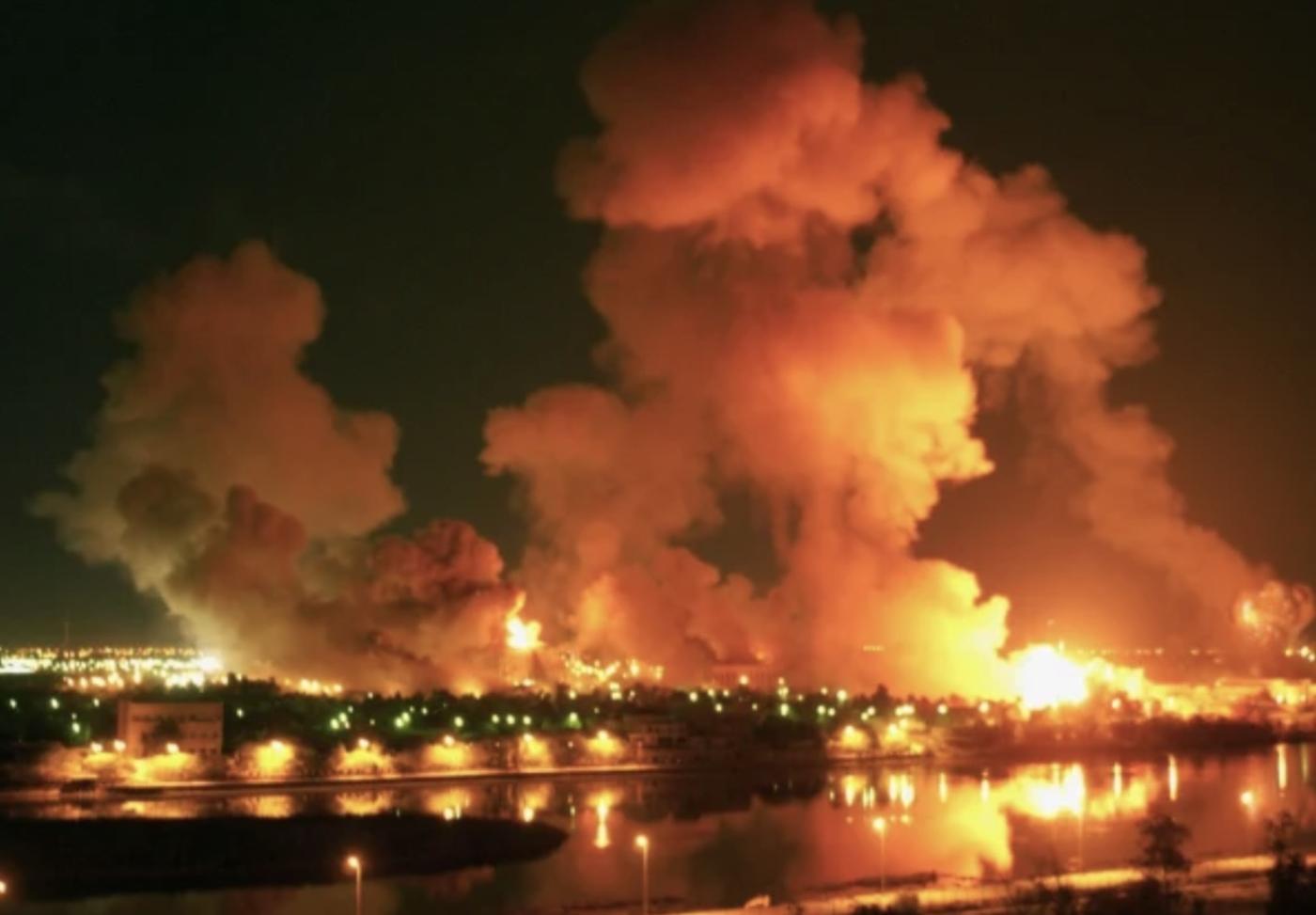
This first strike marked the beginning of the military campaign that soon expanded into a massive bombardment of Baghdad and other Iraqi cities. Within hours, coalition aircraft and missiles were hitting air defense systems, command centers, military bases and government facilities across Iraq. The larger air campaign became known as “shock and awe,” a strategy designed to overwhelm Iraqi forces through intense and highly visible displays of military power.
The phrase “shock and awe” referred to a doctrine called rapid dominance. Its objective was to paralyze the enemy’s ability to resist by destroying key infrastructure and demonstrating overwhelming technological superiority. Hundreds of cruise missiles were fired from American and British naval vessels, while bombers and fighter aircraft conducted continuous strikes on strategic targets. Baghdad’s skyline was repeatedly illuminated by explosions as air defenses fired back against incoming aircraft and missiles.
Television viewers around the world watched live broadcasts from Baghdad as the bombing intensified. Satellite news networks such as CNN, BBC and Al Jazeera showed dramatic images of anti-aircraft fire streaking into the night sky while explosions erupted across the city. These images became some of the most widely recognized visuals of the early 21st century.
Meanwhile, coalition ground forces began advancing from Kuwait into southern Iraq. American Army and Marine units quickly moved north toward major cities such as Basra, Nasiriyah and Najaf, while British forces focused on securing Basra and the surrounding region. The invasion progressed much faster than many analysts had expected, partly because Iraqi command structures were disrupted and many units surrendered or retreated.
Baghdad itself became the central objective of the campaign. Coalition forces pushed rapidly toward the capital while air strikes continued to target Iraqi government buildings, communications networks and military positions. By early April 2003 American forces had reached the outskirts of the city. On 9 April 2003 U.S. troops entered central Baghdad, and images of a large statue of Saddam Hussein being pulled down in Firdos Square became a symbolic moment widely interpreted as the collapse of his regime.
Although the invasion quickly toppled Saddam Hussein’s government, the larger consequences of the war became far more complex. No active weapons of mass destruction programs were found after the invasion, which became a major controversy and led to intense political debate in the United States, Britain and other countries that supported the war. Iraq soon descended into a prolonged insurgency and sectarian violence that lasted for many years.