On this day in military history…
On 18 March 1940, deep within the quiet grounds of Bletchley Park in Buckinghamshire, a machine that would become one of the most important tools of the Second World War finally entered operational service. The machine was known as the Bombe, an electromechanical device designed to help break the German Enigma cipher system. Its operation marked a turning point in Britain’s secret war of intelligence against Nazi Germany. Although the event passed unnoticed by the public at the time, the moment represented the culmination of months of intense mathematical work, engineering innovation, and cooperation between scientists, codebreakers, and industry.
The challenge that led to the Bombe’s creation was the German military’s reliance on the Enigma cipher machine. Enigma looked similar to a small typewriter but internally it was an extremely sophisticated encryption device. It used several rotating electrical rotors that scrambled letters into different ones each time a key was pressed. Because the rotors moved with every keystroke, the substitution changed constantly, producing an incredibly complex cipher. On top of that, operators selected different rotor orders, starting positions, and plugboard connections each day. The result was a staggering number of possible combinations—so many that solving them manually would have taken far longer than the time available before the information became useless.
The foundations for attacking Enigma had already been laid before the war by a group of Polish mathematicians working for Polish intelligence. During the early 1930s they made remarkable progress in understanding how Enigma worked and devised mechanical aids to help identify its settings. In July 1939, only weeks before Germany invaded Poland, Polish intelligence officers met secretly with British and French representatives and passed on their discoveries. Among the items they shared were their methods for reconstructing Enigma machines and the concept of a mechanical device to help search through possible rotor settings.
Once the war began, Britain’s codebreaking operations were centred at Bletchley Park. The Government Code and Cypher School had moved there shortly before the conflict began. Alan Turing, a young mathematician from Cambridge already known for his pioneering theoretical work on computing machines, joined the organisation in September 1939. He was assigned to the group responsible for attacking German Enigma communications.
Turing quickly realized that the Germans had strengthened their encryption procedures since the Polish breakthroughs. New operating methods and additional complexity meant that the earlier Polish techniques would no longer be sufficient on their own. The only realistic solution was to create a more powerful mechanical system capable of testing huge numbers of possible Enigma settings automatically.
His design built upon the Polish idea but expanded it greatly. The machine would simulate multiple Enigma machines working together. By feeding in logical assumptions about fragments of a message—called “cribs”—the device could test possible rotor configurations and eliminate those that produced contradictions. If no contradiction was found, the machine would stop and indicate a possible solution that codebreakers could investigate further.
Turning Turing’s theoretical design into a physical machine required considerable engineering skill. The task was given to the British Tabulating Machine Company in Letchworth. Under the leadership of engineer Harold “Doc” Keen, the company began constructing the first prototype. The machine was complex, filled with rotating drums that represented Enigma rotors, intricate wiring circuits, and electrical detection systems that could recognise impossible letter substitutions.
The development process moved quickly but still required months of design, testing, and adjustment. Work began in late 1939, and by early 1940 the first machine had been completed and installed at Bletchley Park. After roughly half a year of development and refinement, the Bombe officially entered service on 18 March 1940.
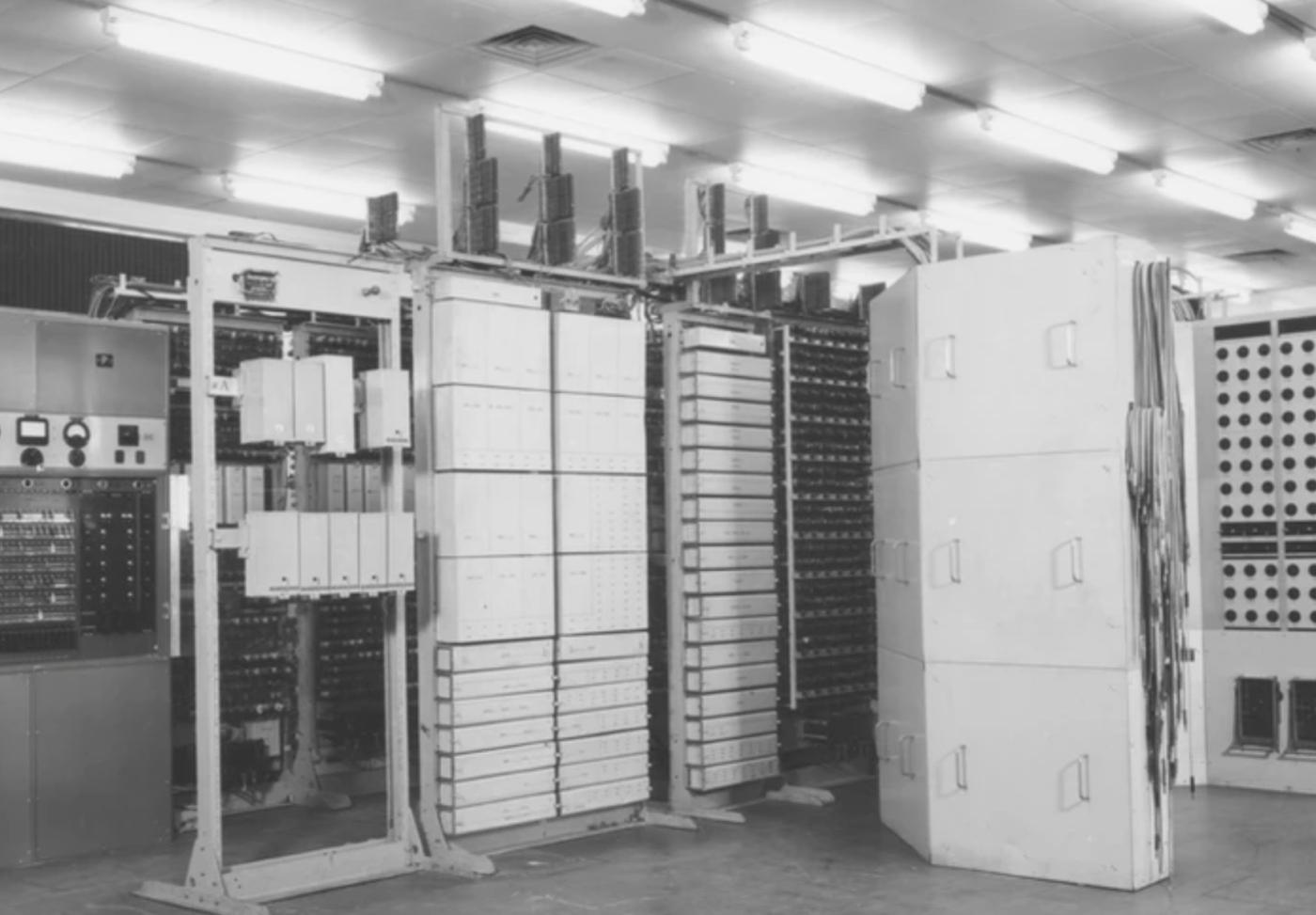
The machine itself was large, loud, and impressive. Several feet tall, it contained rows of spinning drums mounted in vertical frames. When running, the drums rotated rapidly as the machine tested thousands of Enigma rotor combinations. Electrical circuits checked each possibility for logical consistency based on the crib that had been set up by the codebreakers. If the machine encountered a contradiction it continued searching. When a combination passed the test, the machine halted and the potential setting was examined manually on a replica Enigma machine.
Many of the people who operated the Bombes were members of the Women’s Royal Naval Service, often called “Wrens.” These operators were responsible for preparing the machine runs, wiring the correct test patterns, and monitoring the equipment as it worked through its calculations. The machines produced constant mechanical noise as they ran, creating an atmosphere more like an industrial workshop than an academic research centre.
The unusual name “Bombe” had an interesting origin that predated the British machine itself. The Polish cryptologists who had first built a similar device in the 1930s had called their machine a “bomba kryptologiczna,” or cryptologic bomb. Several explanations have been offered for the name. One popular story suggests it was chosen because the ticking and mechanical noise of the machine reminded the designers of a time bomb. Another story claims the name came from an ice cream dessert called “bomba” that one of the mathematicians was eating when the machine’s concept was first discussed. Whatever the true origin, British codebreakers adopted the shortened name “Bombe” for Turing’s improved design in honour of the Polish invention that had inspired it.
Although the first Bombe was a major breakthrough, it was only the beginning. Early successes focused mainly on Luftwaffe communications, which were slightly easier to attack because German Air Force procedures were less complex than those used by the German Navy. Even so, the information gained from these decrypts proved extremely valuable. Messages revealed operational plans, reconnaissance activity, and logistical information that could be passed to British military commanders.
The machine’s effectiveness improved further when another Bletchley Park mathematician, Gordon Welchman, introduced an important enhancement called the diagonal board. This modification allowed the Bombe to rule out impossible rotor combinations much faster, greatly increasing its efficiency. As the war progressed, more Bombes were built and installed in dedicated facilities. Entire rooms eventually filled with the machines, each one constantly searching for the day’s Enigma keys.
The intelligence derived from decrypted German messages was given the codename Ultra and became one of the most closely guarded secrets of the war. Ultra intelligence influenced Allied strategy across multiple fronts. It helped direct convoys away from German U-boat patrols in the Atlantic, revealed enemy troop movements in North Africa, and provided insights into German operational planning throughout the conflict.
Historians generally agree that the work carried out at Bletchley Park shortened the war in Europe significantly, possibly by two to four years. The Bombe machines were central to that success, representing one of the earliest practical uses of automated logical machines to solve complex problems.