On this day in military history…
Operation Plunder was the codename for the Allied crossing of the River Rhine in western Germany near the end of the Second World War. It was the largest single river crossing operation in modern military history and marked the final major barrier protecting the industrial heart of Germany from Allied forces advancing from the west. The operation took place on 23–24 March 1945 and was carried out by the British 21st Army Group under the command of Field Marshal Bernard Montgomery. Its success opened the way for the rapid Allied advance into northern Germany and hastened the collapse of Nazi resistance in the west.
By early 1945 the Allied armies had advanced across France and Belgium and reached the Rhine, the last major natural defensive line before the interior of Germany. German forces had already destroyed most bridges across the river in an attempt to slow the Allied advance. The Rhine itself presented a formidable obstacle. In many places it was several hundred metres wide, with strong currents and marshy floodplains on the eastern side that made large-scale assault crossings extremely difficult.
Earlier in March 1945, American forces unexpectedly captured the Ludendorff Bridge at Remagen intact. This allowed the United States First Army to establish a bridgehead across the Rhine earlier than expected. Despite this surprise success further south, the northern crossing remained crucial for Montgomery’s plan to bring overwhelming force into northern Germany. Operation Plunder was therefore designed as a carefully prepared assault involving massive artillery support, amphibious equipment and coordinated airborne operations.
The main crossing area chosen was between the towns of Wesel and Rees in northwestern Germany. The British Second Army under Lieutenant General Miles Dempsey and the United States Ninth Army under Lieutenant General William H. Simpson were assigned to conduct the assault. These armies formed the northern part of the Allied front and were part of Montgomery’s 21st Army Group.
Preparation for the operation took weeks. Engineers assembled enormous quantities of bridging equipment, assault boats and amphibious vehicles. Thousands of artillery guns were brought forward to support the attack. The Allies also used extensive deception and camouflage measures to hide their preparations from German reconnaissance. At night huge convoys moved toward the Rhine, while smoke screens were planned to obscure the river during the crossing itself.
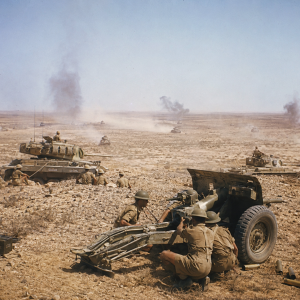
On the evening of 23 March 1945 the operation began with one of the largest artillery bombardments of the war on the Western Front. Thousands of guns opened fire along the riverbank, targeting German defensive positions on the eastern side of the Rhine. The bombardment was accompanied by air strikes from Allied bombers and fighter aircraft that attacked strongpoints, supply routes and communication centres behind the German lines.
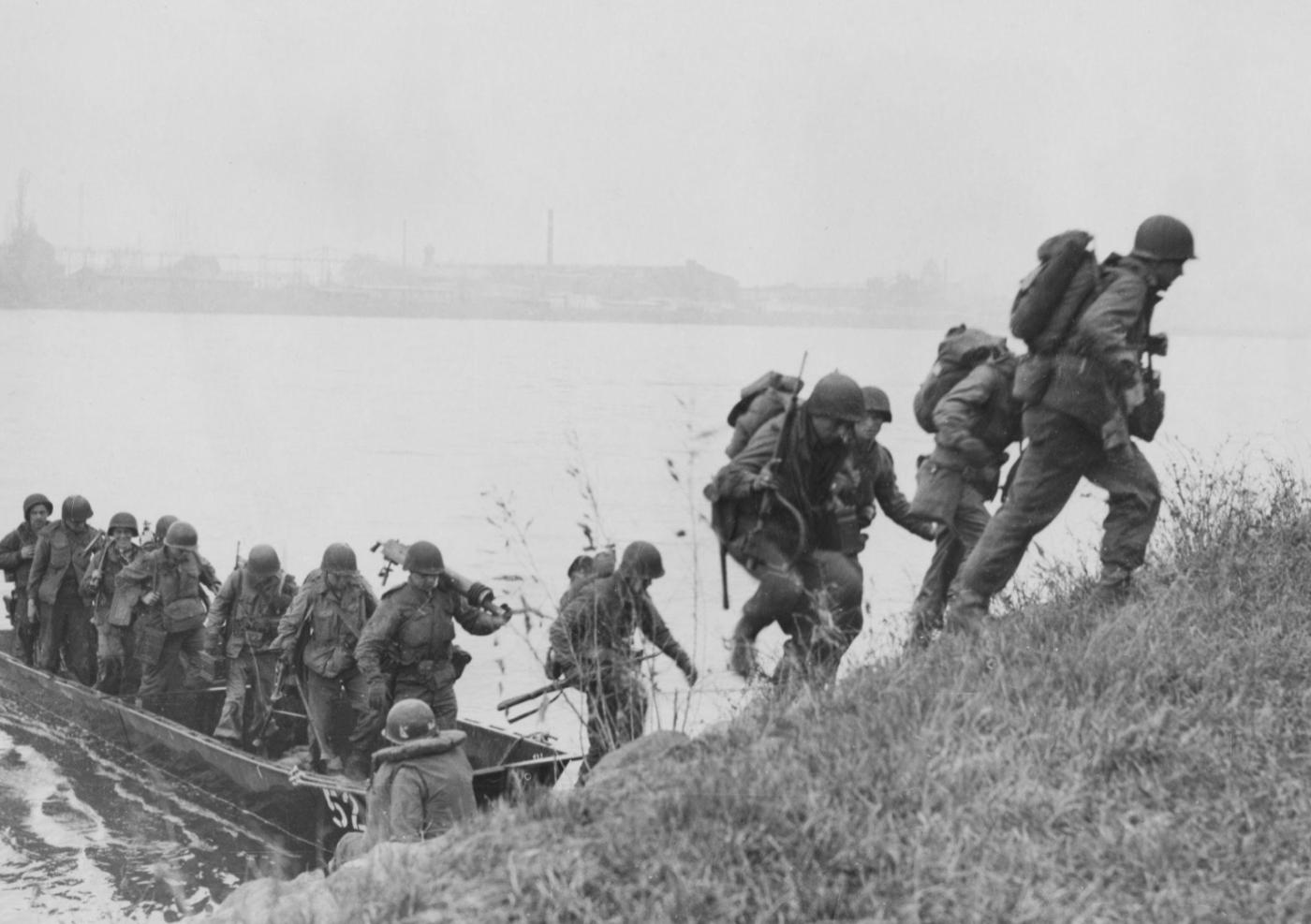
Soon after the bombardment began, Allied infantry units started crossing the river in assault boats and amphibious vehicles. British and Canadian units crossed near Rees and Wesel while American units crossed further south near Rheinberg. Amphibious vehicles known as “Buffalos” and “DUKWs” played an important role in ferrying troops and supplies across the water. Engineers worked continuously under fire to construct pontoon bridges and ferry systems that could carry tanks and heavy vehicles.
At the same time as the river crossing, a large airborne assault took place behind German lines. This airborne operation was called Operation Varsity and occurred on the morning of 24 March 1945. It involved the British 6th Airborne Division and the U.S. 17th Airborne Division. Over 16,000 airborne troops were dropped or landed by gliders east of the Rhine near Hamminkeln. Their mission was to seize key road junctions, villages and bridges, and to prevent German forces from counterattacking the river crossing.
Operation Varsity was one of the largest single-day airborne operations in history. Hundreds of transport aircraft and gliders filled the skies over the Rhine valley. Although the airborne troops encountered strong resistance and suffered heavy casualties, they successfully captured their objectives and linked up with ground forces advancing from the river.
The German defenders were primarily elements of Army Group H under General Johannes Blaskowitz. By this stage of the war German forces were severely weakened. Many units were understrength and lacked heavy equipment and air support. Despite these disadvantages German troops still fought fiercely in many areas, particularly around towns and defensive strongpoints near the river.
By the end of 24 March Allied forces had successfully established several bridgeheads east of the Rhine. Engineers rapidly built multiple pontoon and Bailey bridges across the river, allowing tanks, artillery and supply vehicles to cross in large numbers. Within days hundreds of thousands of troops and thousands of vehicles had moved across the Rhine.
The scale of Operation Plunder was enormous. Nearly a million Allied soldiers were involved in the broader Rhine crossing operations in March 1945. The river assault itself involved thousands of boats and amphibious vehicles, supported by more than 5,000 artillery pieces and massive air support. It was the most heavily supported river crossing operation of the entire war.
One interesting aspect of the operation was the extensive use of specialized equipment developed earlier in the war. Amphibious vehicles such as the Buffalo tracked landing vehicle were originally designed for operations in the Pacific but proved extremely effective in European river crossings. Engineers also used innovative bridging techniques to rapidly create heavy-duty bridges capable of supporting tanks within hours of the initial assault.
Another notable feature was the intense use of smoke screens. Smoke generators were placed along the western bank of the Rhine to obscure Allied movements from German observation. This helped protect the assault forces during the critical early stages of the crossing.
Wesel, one of the key towns near the crossing site, was heavily bombed before the assault. On 16 February 1945 the town was subjected to a devastating air raid by Allied bombers that destroyed most of the city. The destruction was intended to eliminate German defensive positions and supply centres in preparation for the Rhine crossing.
The success of Operation Plunder allowed Allied forces to advance rapidly into northern Germany. Within weeks they had captured major cities such as Hamburg and Bremen and linked up with Soviet forces advancing from the east. German resistance in the west collapsed quickly after the Rhine barrier was breached.
Operation Plunder was one of the final major offensive operations of the war in Europe. Less than seven weeks after the Rhine crossing, Germany surrendered unconditionally on 8 May 1945.