On this day in military history…
The attack on the railway viaduct at Bielefeld on 14 March 1945 stands as one of the most notable precision bombing operations carried out by the Royal Air Force in the closing phase of the Second World War. It was also the first operational use of Britain’s largest conventional bomb, a weapon created specifically to destroy heavily fortified targets that had proven resistant to earlier methods of attack. By early 1945 the Allied advance into Germany had placed enormous pressure on the German transport network, and the railway system remained essential for moving troops, supplies and equipment to the front. Among the most important links was the large masonry viaduct spanning the Schildesche valley near the city of Bielefeld, which formed a crucial part of the line connecting the Ruhr industrial region with other areas still under German control.
This viaduct had already been subjected to numerous bombing attempts. Conventional high-explosive bombs had caused damage but failed to bring down the structure. Its robust design, with multiple arches and strong masonry construction, allowed it to absorb near misses and even direct hits without complete collapse. The repeated failure of standard bombing methods led British planners to select it as an ideal target for a new type of deep-penetration weapon designed to destroy targets by undermining their foundations rather than merely shattering their surfaces.
The concept behind this weapon was developed by the British engineer Barnes Wallis, whose earlier work included the famous bouncing bomb used against German dams in 1943 and the Tallboy deep-penetration bomb introduced later in the war. Wallis believed that a bomb capable of penetrating deep into the ground before exploding would create shockwaves similar to a minor earthquake, causing structures to collapse from below. This principle, known as the earthquake effect, aimed to achieve maximum destruction of key targets while reducing the need for large numbers of aircraft and repeated attacks.
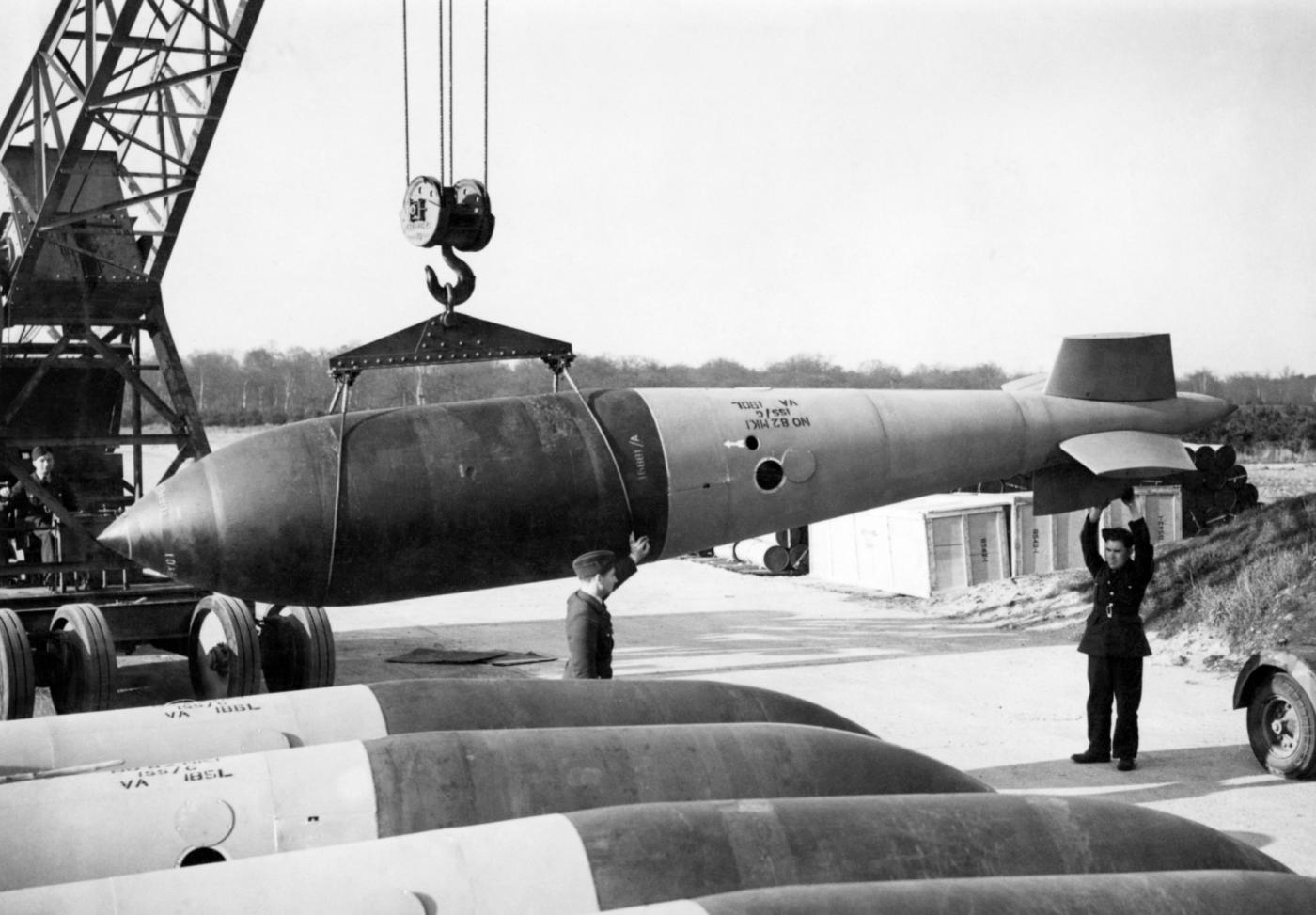
Development began in 1943 and required considerable engineering effort. The bomb ultimately produced weighed around 22,000 pounds, making it the heaviest conventional bomb deployed by the Allies during the war. Its steel casing was exceptionally thick and strong, designed to withstand the stresses of being dropped from high altitude and striking the ground at extremely high speed. Rather than exploding on impact, it was fitted with delayed-action fuses so that detonation would occur only after deep penetration into soil or concrete. The explosive filling consisted of Torpex, a powerful mixture more energetic than TNT and capable of generating immense blast pressure underground.
Manufacture took place in Britain, with the main responsibility falling to Vickers-Armstrong. Producing such a large and complex weapon was a slow and demanding process. Each casing had to be cast in a single piece to avoid weaknesses, then cooled gradually over a period of weeks to prevent cracking. Once machined and finished, the bomb was filled and fitted with fuses before being transported to operational units. Because of the time and resources required, only a limited number were produced. By the end of the war just over forty had been completed, and only a portion of these were used in combat operations.
To carry such a massive load required significant modification to the Avro Lancaster heavy bomber. The aircraft chosen for the task belonged to No. 617 Squadron RAF, a unit already renowned for its precision attacks and highly trained crews. Their Lancasters were extensively altered: bomb bay doors were removed to allow the weapon to protrude, internal structures were reinforced, and weight-saving measures such as reducing defensive armament were implemented. Even with these changes, the aircraft operated at the limits of their performance and required careful handling during take-off and flight. Only the most experienced crews were selected for these missions.
On 14 March 1945 the squadron prepared for the operation against the Bielefeld viaduct. Taking off from RAF Woodhall Spa in Lincolnshire, the formation included aircraft carrying the new weapon alongside others armed with Tallboy bombs to ensure the greatest possible destructive effect. The mission was flown in daylight to allow accurate visual identification of the target, a decision that increased risk but was necessary for precision delivery.
As the bombers approached Bielefeld they encountered conditions that allowed a clear view of the objective. A master bomber circled above, directing the attack and coordinating each run. One by one, the modified Lancasters approached at high altitude and released their enormous loads. The bombs fell at tremendous speed, some reaching supersonic velocity during descent. On impact they drove deep into the earth and structure before detonating.
The results were dramatic. The underground explosions generated powerful shockwaves that shook the viaduct’s foundations and caused major sections to collapse. Several arches gave way, and large portions of the structure crashed into the valley below. Additional Tallboy strikes compounded the destruction, ensuring that the railway link was completely severed. Reconnaissance photographs taken after the raid confirmed that the viaduct had been rendered unusable and beyond effective repair.
The success of this operation demonstrated the effectiveness of Wallis’s earthquake bomb concept. A target that had survived repeated conventional bombing was destroyed in a single carefully planned strike by a relatively small force. The attack also showed how specialised weapons and highly trained crews could achieve strategic results without the need for large-scale area bombing. In the final weeks of the war similar weapons were used against other hardened targets, including U-boat pens, bridges and fortified structures across Germany.
Although introduced late in the conflict and produced in limited numbers, this massive deep-penetration bomb proved capable of dealing with some of the most resilient targets in Europe. The raid on the Bielefeld viaduct remains a notable example of the evolution of precision bombing during the Second World War, combining advanced engineering, careful planning and skilled aircrew to achieve decisive results against a critical piece of enemy infrastructure.