On this day in military history…
The artillery barrage that opened on 13 March 1954 against the French fortress at Dien Bien Phu marked one of the most dramatic moments of the First Indochina War and directly led to the collapse of French power in northern Vietnam. Although the wider conflict had begun in 1946 between French colonial forces and the Viet Minh independence movement, the battle that erupted in March 1954 transformed the war from a prolonged colonial struggle into a decisive confrontation that would end with French withdrawal from Indochina.
By late 1953 the French high command, under General Henri Navarre, believed they could draw the Viet Minh into a conventional set-piece battle. They selected the remote valley of Dien Bien Phu in north-western Vietnam near the Laotian border and began constructing a heavily fortified base. The plan was to cut Viet Minh supply routes into Laos and force General Vo Nguyen Giap’s forces to attack a strong defensive position where French artillery and air power would dominate. The French assumed that the mountainous terrain surrounding the valley would prevent the Viet Minh from deploying heavy artillery.
The French garrison eventually numbered about 13,000 to 16,000 troops. These included elite French paratroopers, Foreign Legion units, North African colonial troops from Algeria and Morocco, and locally recruited Vietnamese soldiers loyal to France. The base was divided into a series of strongpoints named after women such as Beatrice, Gabrielle, Anne-Marie, Dominique, and Eliane. The French had around 24 105 mm howitzers, several 155 mm guns, mortars, tanks including about 10 light M24 Chaffee tanks flown in and assembled on site, and were supported by aircraft operating from distant airfields in Tonkin. Their strategy depended heavily on air resupply, with roughly 200 transport aircraft committed to keeping the base supplied.
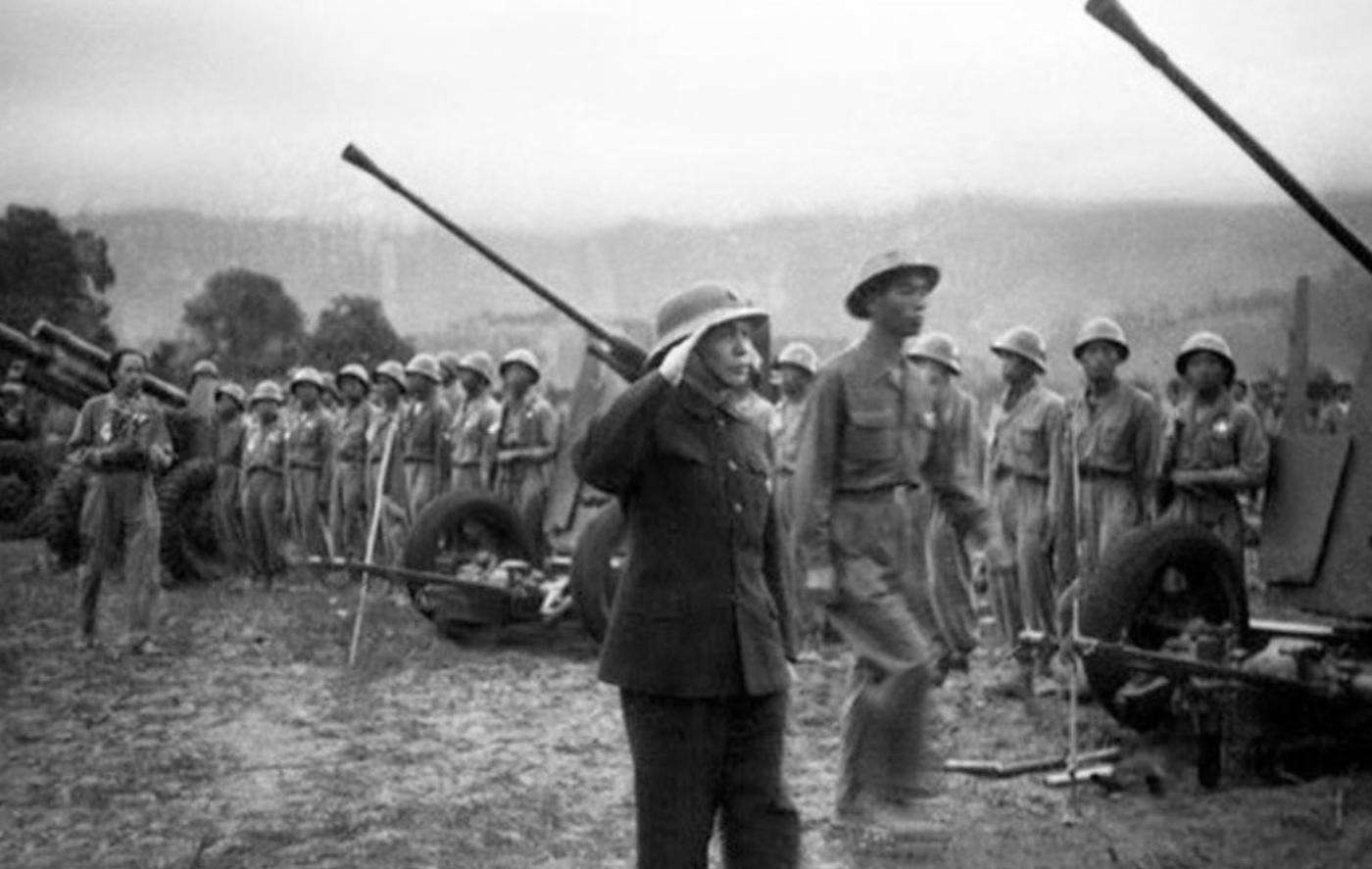
General Giap commanded approximately 50,000 to 70,000 Viet Minh combat troops for the operation, supported by tens of thousands of porters and labourers who maintained supply lines through dense jungle and mountainous terrain. The Viet Minh also brought an artillery force that astonished French intelligence. They managed to transport more than 200 artillery pieces into the hills surrounding Dien Bien Phu, including Soviet-supplied 105 mm howitzers, 75 mm pack guns, heavy mortars, and numerous anti-aircraft guns such as 37 mm cannons and heavy machine guns. Much of this equipment was hauled by hand, bicycle, or disassembled and carried through jungle tracks. One of the most remarkable logistical achievements was the use of reinforced bicycles capable of carrying loads exceeding 200 kilograms.
On the evening of 13 March 1954, at approximately 5:00 pm, the Viet Minh opened their massive artillery bombardment on the French strongpoint known as Beatrice. This sudden and accurate barrage shocked the French command, which had believed Viet Minh artillery would be limited and poorly coordinated. Instead, Giap’s gunners had carefully camouflaged their positions in caves and dugouts on the surrounding hills, making them extremely difficult to detect or destroy. Within hours, French artillery positions were hit, ammunition dumps exploded, and communications were disrupted. The commander of Beatrice was killed early in the bombardment.
That night, Viet Minh infantry launched coordinated assaults under cover of the continuing artillery fire. By the early hours of 14 March, the strongpoint Beatrice had fallen with heavy French casualties. Roughly 500 French troops were killed, wounded, or captured in the first assault alone. The following night, 14–15 March, the strongpoint Gabrielle came under intense artillery fire and infantry attack and also fell after fierce fighting. These early victories shattered the French belief that their fortified camp could withstand siege.
One of the most important effects of the opening artillery barrage was its impact on French air operations. Viet Minh anti-aircraft guns quickly made the airstrip at Dien Bien Phu unusable. French transport planes attempting to land or drop supplies faced heavy fire, and many were shot down or damaged. Without reliable air resupply, the French garrison began to run short of ammunition, food, and medical supplies. Paratroopers were dropped in as reinforcements, but many landed under fire or outside the defensive perimeter.
General Giap initially intended to overrun the base quickly but changed tactics after early heavy casualties. He adopted a methodical siege strategy, ordering his troops to dig extensive trench systems that gradually encircled the French positions. By April, Viet Minh trenches had crept to within a few dozen metres of some strongpoints. This siege warfare resembled World War I trench fighting more than jungle warfare, with constant artillery duels, night assaults, and close-quarters combat.
The French command requested massive American air intervention under a proposed plan known as Operation Vulture. Some American officials considered using up to 60 B-29 bombers from bases in the Philippines, and there were even discussions about the possible use of tactical nuclear weapons to break the siege. However, the United States ultimately decided not to intervene directly without broader allied support, which was not forthcoming.
By early May 1954 the situation for the French had become hopeless. Of the original garrison of about 16,000, thousands had been killed or wounded. Only a few thousand remained capable of fighting. On 7 May 1954, after nearly two months of siege following the initial artillery barrage of 13 March, Viet Minh forces launched a final series of assaults and overran the remaining strongpoints. The French commander, General Christian de Castries, surrendered that evening.
Casualty figures were severe. French Union forces suffered approximately 2,200 killed and around 5,000 to 6,000 wounded during the battle. More than 10,000 were captured, many of whom later died during captivity due to disease and exhaustion. Viet Minh casualties were also extremely high, with estimates ranging from 20,000 to 25,000 killed and wounded.
The fall of Dien Bien Phu had immediate political consequences. News of the defeat shocked France and undermined public support for continuing the war. At the Geneva Conference in mid-1954, France agreed to withdraw from Indochina. The Geneva Accords temporarily divided Vietnam at the 17th parallel into North Vietnam under Ho Chi Minh’s government and South Vietnam under a separate administration supported by the United States and its allies.
Several interesting facts surround the battle. The Viet Minh moved most of their heavy artillery without motor vehicles, relying on human labour and bicycles. French troops at the base created an underground hospital that was repeatedly hit by shelling. Some French positions were so close to Viet Minh trenches by the end that hand grenades could be thrown between them. War correspondents later described the battle as the first time a colonial army was decisively defeated by a nationalist revolutionary force using largely conventional tactics.
The artillery barrage of 13 March 1954 demonstrated that the Viet Minh had evolved into a sophisticated and well-equipped force capable of defeating a modern European army in a conventional siege. Its success not only destroyed the French position at Dien Bien Phu but also ensured the end of French colonial rule in Indochina and set the stage for the subsequent division of Vietnam and later conflicts involving the United States.