On this day in military history…
On 8 March 1942 the Dutch colonial government in the Netherlands East Indies formally surrendered on the island of Java, bringing to an end more than three centuries of Dutch rule in what is now Indonesia and marking one of the most decisive Japanese victories of the Second World War in Southeast Asia. The fall of Java was not a single dramatic battle but the culmination of a rapid and overwhelming campaign that began less than three months earlier, when Japan launched its sweeping offensives across the Pacific and Southeast Asia following the attack on Pearl Harbor in December 1941.
At the start of the war the Netherlands East Indies, rich in oil, rubber, and strategic resources, was one of Japan’s primary targets. The Japanese high command viewed control of these islands as essential to sustaining its war effort, particularly the oil fields of Sumatra and Borneo and the administrative and military center on Java. The Dutch colonial administration, already weakened by the German occupation of the Netherlands in Europe, was responsible for defending this vast archipelago with limited resources and an army not fully prepared for modern warfare.
In January 1942 Japanese forces began their advance into the Netherlands East Indies, capturing key oil installations in Borneo and Sumatra with speed and coordination. Their operations were supported by a powerful naval and air presence that quickly established superiority over Allied forces in the region. The Dutch were not alone in trying to resist the invasion; they joined with British, American, and Australian forces under a short-lived joint command known as ABDACOM, led by British General Archibald Wavell. However, differences in equipment, communication problems, and the rapid pace of Japanese advances made effective cooperation difficult.
One of the decisive moments came during the Battle of the Java Sea on 27 February 1942. A combined Allied naval force, led by Dutch Rear Admiral Karel Doorman, attempted to intercept the Japanese invasion fleets heading toward Java. In a chaotic and hard-fought engagement, the Allied fleet suffered devastating losses. Several cruisers and destroyers were sunk, including Dutch, British, and American ships, and Admiral Doorman himself was killed when his flagship went down. The destruction of the Allied fleet left the seas around Java largely open to Japanese transport and invasion forces.
Japanese troops began landing on Java in late February and early March 1942. They attacked from multiple directions, coming ashore in both western and eastern parts of the island. The Japanese 16th Army advanced rapidly toward Batavia (now Jakarta), while other units moved inland toward key cities such as Bandung and Surabaya. Dutch and Allied forces attempted to mount a defense, but they were outnumbered, outgunned, and cut off from reinforcement. Japanese air superiority meant that Allied positions and supply lines were constantly bombed, further weakening resistance.
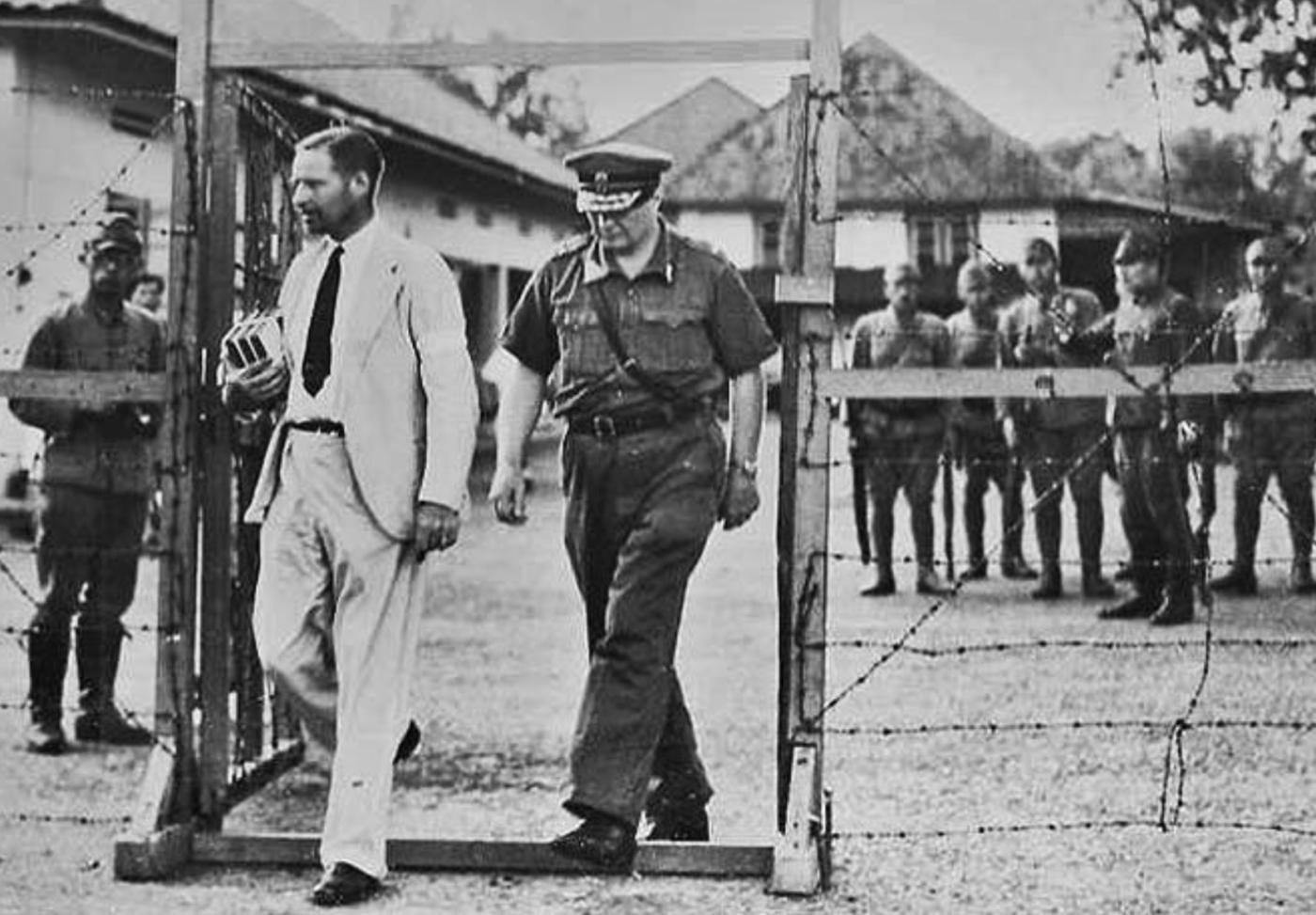
The final Dutch defensive line centered on Bandung, in the mountainous interior of West Java, where Lieutenant General Hein ter Poorten commanded the remaining Royal Netherlands East Indies Army (KNIL). The Japanese advance was relentless. Within days they had surrounded the area, capturing vital airfields and cutting communications. With Allied naval forces destroyed or withdrawn and no realistic hope of reinforcement from Australia or India, the Dutch command faced an impossible situation. Civilian authorities also feared that continued fighting would lead to unnecessary destruction and civilian casualties.
Negotiations for surrender began in early March. On 8 March 1942 Dutch and Japanese representatives met at the Kalijati airfield near Subang in West Java. Lieutenant General ter Poorten and Governor General Tjarda van Starkenborgh Stachouwer represented the Dutch colonial administration, while Lieutenant General Hitoshi Imamura represented the Japanese 16th Army. Under the terms agreed, all Dutch and Allied forces on Java would cease resistance and lay down their arms. The surrender applied not only to Dutch troops but also to British, American, and Australian forces still on the island.
The surrender on Java effectively ended organized Allied resistance in the Netherlands East Indies. It was one of the largest capitulations in Dutch military history and marked the complete Japanese occupation of Indonesia. The event also symbolized the collapse of European colonial authority across much of Southeast Asia, as Japanese forces rapidly replaced Western colonial governments with their own military administrations.
In the immediate aftermath of the surrender, Japanese authorities moved quickly to consolidate control. Dutch soldiers, along with other Allied personnel, were taken as prisoners of war. Many were sent to internment camps across Indonesia and later to other parts of Asia, including Thailand, Burma, and Japan itself. Conditions in these camps were often harsh, with shortages of food and medicine and widespread forced labor. Thousands of prisoners died during captivity, particularly those sent to work on projects such as the Burma–Thailand Railway.
European civilians, including Dutch men, women, and children who had lived in the colony, were also interned. Families were often separated, and many endured years of difficult conditions until Japan’s surrender in 1945. Indonesian civilians experienced their own hardships under Japanese rule, including forced labor known as romusha, food shortages, and strict military control. However, the Japanese occupation also disrupted the existing colonial order and encouraged nationalist sentiment by promoting limited forms of Indonesian political participation and undermining Dutch authority.
One interesting and significant consequence of the fall of Java was its impact on Indonesia’s eventual independence. Although the Japanese occupation was harsh, it weakened Dutch colonial control and allowed Indonesian nationalist leaders such as Sukarno and Mohammad Hatta to gain greater prominence. When Japan surrendered in August 1945, Indonesian nationalists quickly declared independence, leading to a struggle that ultimately ended with the Netherlands recognizing Indonesia as a sovereign state in 1949.
The surrender on 8 March 1942 thus marked not only a major Japanese victory in the Second World War but also a turning point in the history of Southeast Asia. It ended centuries of Dutch colonial rule in the region, brought years of occupation and hardship, and set in motion political changes that would eventually lead to the creation of modern Indonesia.