On this day in military history…
On 6 March 1943, in the closing phase of the North African campaign, Field Marshal Erwin Rommel launched a major attack against the British Eighth Army near the town of Medenine in southern Tunisia. The assault was intended to disrupt Allied preparations for an offensive against the Mareth Line and to regain the initiative after the Axis retreat from Libya. Instead, the battle became one of the clearest demonstrations of the growing superiority of the British Eighth Army under General Bernard Montgomery.
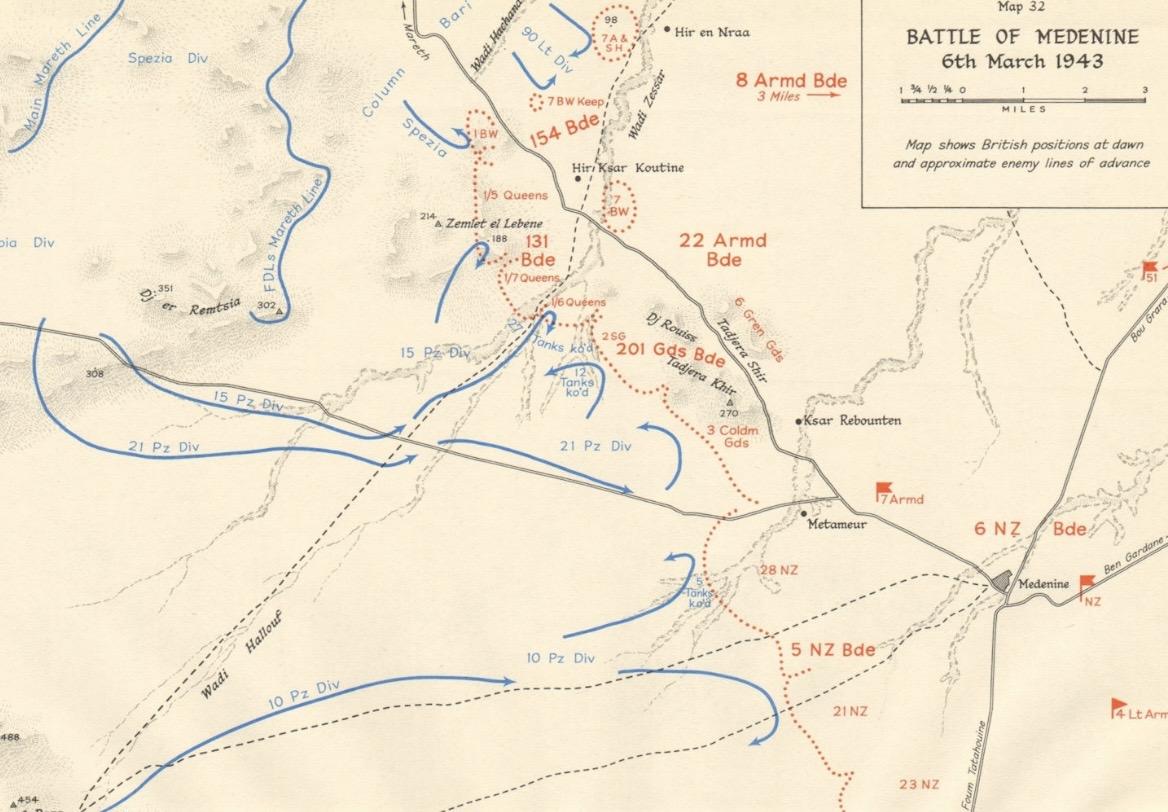
Rommel’s plan called for a concentrated armored thrust against what he believed to be an exposed sector of the British line. The Axis forces involved included elements of the German 10th and 15th Panzer Divisions and Italian armored units, fielding roughly 150 tanks for the operation. Rommel hoped to strike quickly, overwhelm forward British positions, and force Montgomery to delay or reconsider his planned assault on the Mareth Line.
However, the British were exceptionally well prepared. Thanks to effective intelligence gathering—particularly signals intelligence derived from decrypted German communications—the Eighth Army had advance warning of the attack. This allowed Montgomery to concentrate substantial anti-tank defenses in depth. Approximately 400 anti-tank guns were positioned to cover the likely avenues of approach, supported by well-sited artillery and armored reserves. The defensive layout was carefully organized, with overlapping fields of fire and strong coordination between infantry, artillery, and armor.
When the Axis attack began in the early hours of 6 March, German and Italian tanks advanced into a storm of accurately directed fire. British anti-tank gunners, equipped with 6-pounder guns and supported by heavier artillery, engaged the panzers at effective ranges. The desert terrain, offering limited cover, exposed the attacking armor to devastating fire. Repeated assaults throughout the day failed to break the British line.
By the end of the fighting, the Axis had suffered heavy losses. Approximately 52 tanks were destroyed or disabled. German casualties were significant, with around 200 men killed and roughly 400 wounded or captured. Italian units also incurred losses, though precise figures are less clear; combined Axis casualties likely exceeded 700 men. In contrast, British losses were remarkably light. The Eighth Army reported fewer than 70 total casualties, including around 20 killed and approximately 50 wounded, and only a handful of tanks damaged.
The disparity in losses reflected not only strong defensive positioning but also the transformation of the Eighth Army since its earlier struggles in North Africa. Under Montgomery’s leadership, the army emphasized meticulous planning, logistical preparation, and overwhelming firepower. Lessons learned from earlier encounters with the Afrika Korps had been absorbed. Units were better trained in anti-tank tactics, artillery coordination had become highly efficient, and morale had improved markedly after victories at El Alamein.
Another key factor was air support. Allied air forces maintained pressure on Axis movements, complicating Rommel’s ability to maneuver freely and coordinate his attack. Supply shortages, particularly of fuel and spare parts, further constrained the Axis armored formations. By March 1943, the strategic balance in North Africa had shifted decisively against Germany and Italy. The Axis forces in Tunisia were increasingly isolated, facing growing Allied strength from both the east and west following the landings in Morocco and Algeria.
The failure at Medenine was one of Rommel’s last actions in Africa before he departed for Europe due to illness and strategic disagreements with higher command. The repulse confirmed that the initiative had firmly passed to the Allies. Within weeks, Montgomery launched his assault on the Mareth Line, contributing to the eventual collapse of Axis resistance in Tunisia.