On this day in military history…
The liberation of Kuwait on 27 February 1991 marked the dramatic end of the Gulf War, bringing to a close seven months of occupation that began when Iraqi forces under Saddam Hussein invaded Kuwait on 2 August 1990. The invasion shocked the world, destabilized global oil markets, and prompted one of the largest international military coalitions since World War II. The events culminating on 27 February reshaped Middle Eastern geopolitics and demonstrated the overwhelming military capabilities of a broad multinational alliance led by the United States.
The crisis began when Iraq, burdened by massive debts after the Iran–Iraq War, accused Kuwait of overproducing oil and driving down prices, as well as slant drilling into Iraqi oil fields. Iraqi troops rapidly overran Kuwait City, forcing the Kuwaiti government and Emir Jaber Al-Ahmad Al-Sabah to flee to Saudi Arabia. Within days, Iraq declared Kuwait its 19th province. The annexation was condemned globally, and the United Nations Security Council passed a series of resolutions demanding Iraq’s withdrawal.
In response, the United States under President George H. W. Bush organized a vast coalition of 35 nations. This coalition included countries from North America, Europe, the Middle East, and Asia. Among the prominent partners were the United Kingdom, France, Saudi Arabia, and Egypt. The coalition’s initial mission, known as Operation Desert Shield, focused on defending Saudi Arabia from possible Iraqi attack and building up forces in the region.
When Iraq refused to withdraw by the UN deadline of 15 January 1991, the coalition launched Operation Desert Storm. The air campaign began on 17 January 1991 and lasted over five weeks. Coalition aircraft conducted thousands of sorties, targeting Iraqi command centers, air defenses, infrastructure, and supply lines. Advanced precision-guided munitions were used extensively, marking a new era in modern warfare and drawing global attention through real-time television coverage.
The ground offensive began on 24 February 1991. Coalition forces executed a bold maneuver known as the “left hook,” sweeping west into the Iraqi desert before turning east into Kuwait and southern Iraq. This strategy outflanked Iraqi defenses and led to the rapid collapse of Iraqi positions. Within just 100 hours of ground combat, Iraqi forces were in full retreat.
On 26 February 1991, Iraqi troops began withdrawing from Kuwait, but not without causing devastation. Retreating forces set fire to approximately 600 Kuwaiti oil wells, creating massive environmental destruction and darkening skies with thick smoke for months. The burning oil fields became one of the most enduring images of the war and required an enormous international firefighting effort to extinguish.
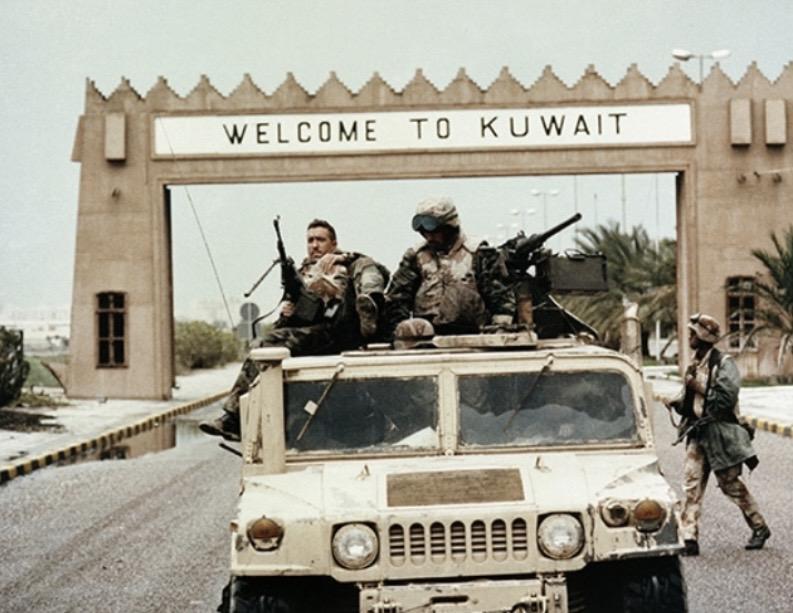
By 27 February 1991, coalition forces had successfully liberated Kuwait City. Images of Kuwaiti citizens celebrating in the streets, waving national flags, and welcoming coalition troops were broadcast around the world. On 28 February, President George H. W. Bush declared a ceasefire, stating that Kuwait had been liberated and the Iraqi army defeated.
The war was notable for its brevity and decisive outcome. Coalition casualties were relatively low compared to previous large-scale conflicts, while Iraqi military losses were substantial. The destruction of retreating Iraqi forces along the so-called “Highway of Death” between Kuwait and Iraq became a controversial episode, symbolizing both the overwhelming power and the tragic human cost of war.
Politically, the liberation restored Kuwait’s sovereignty and strengthened U.S. influence in the Persian Gulf. However, Saddam Hussein remained in power in Iraq, leading to years of sanctions, no-fly zones, and eventual conflict in 2003. The war also established a long-term U.S. military presence in Saudi Arabia, which would later become a grievance cited by extremist groups.
The liberation of Kuwait is commemorated annually on 26 and 27 February as Kuwait’s National Day and Liberation Day. These celebrations honor not only the restoration of independence but also the resilience of the Kuwaiti people during occupation. The Gulf War demonstrated the importance of international cooperation under United Nations authority and set precedents for modern coalition warfare.