On this day in military history…
By 14 February 1943 the first Chindit expedition, Operation Longcloth, had fully crossed from India into Japanese-held Burma. Brigadier Orde Wingate’s plan depended on speed, dispersion, and surprise, but above all on the assumption that his force could be supplied entirely from the air once it was behind enemy lines. The moment the columns crossed the Chindwin River, they ceased to have any practical land supply route. From that point onward, Dakota transport aircraft became the lifeline that kept the expedition alive.
The Chindit force itself was a deliberately mixed and self-contained formation. It was built around the 77th Indian Infantry Brigade, but it was not a conventional brigade in composition or employment. The bulk of the fighting troops were British infantry battalions, including units such as the King’s Regiment and the Burma Rifles, alongside Gurkha battalions whose experience of hill fighting and jungle movement was invaluable. Indian Army personnel formed a large proportion of the force, not only as infantry but as muleteers, drivers, and specialists. The brigade also included Royal Engineers detachments for demolition and bridge work, Royal Artillery sections operating lightweight weapons, and Royal Army Medical Corps staff who would have to function with minimal equipment deep in the jungle.
Crucially, the Chindits carried their own Royal Air Force personnel. RAF signallers were embedded with the columns to maintain wireless contact with air bases in India, allowing supplies to be requested, drop zones to be confirmed, and emergency evacuations to be coordinated. Without these RAF teams, air supply would have been little more than blind hope. Thousands of mules, many handled by Indian muleteers, were also an essential part of the force, carrying radios, ammunition, food, and dismantled weapons through terrain where vehicles could not go.
The Dakota aircraft that supplied the Chindits around 14 February were primarily operating from Agartala in eastern India. Agartala served as the main rear air base for the expedition. Its location allowed Dakotas to reach drop zones in northern Burma while still remaining within a manageable flying distance for repeated sorties. At Agartala, supplies were packed into parachute containers, loads were balanced carefully to suit the aircraft, and crews waited for signals from the columns confirming drop locations and timings.
The Dakotas themselves were flown by RAF transport crews, mainly from No. 31 Squadron, with support and parallel experience from No. 194 Squadron. These squadrons specialised in transport flying under difficult conditions and quickly adapted to the demands of jungle warfare. A typical Dakota crew consisted of a pilot and co-pilot, supported by a navigator and wireless operator, with additional crewmen responsible for dispatching supplies during drops. Their work demanded precision rather than heroics: accurate navigation over featureless jungle, steady flying at low altitude, and repeated exposure to heat, turbulence, and unpredictable weather.
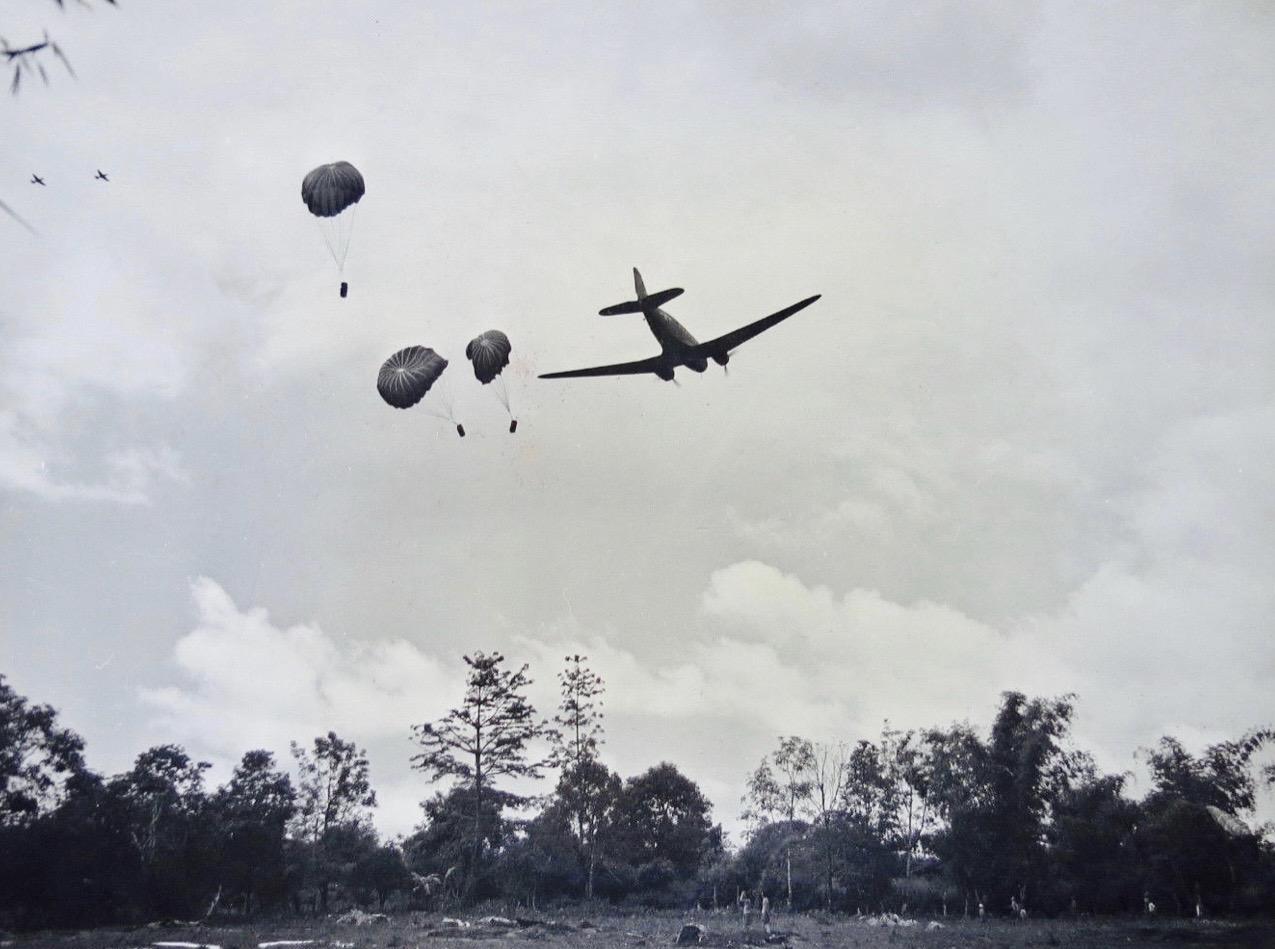
On 14 February, as the Chindit columns pushed deeper into Burma, Dakotas began dropping essential supplies to sustain them. These loads included rice, tinned food, ammunition, medical stores, spare radio batteries, and mail. Everything was packed into containers designed to survive impact and marked so that different types of supplies could be identified quickly on the ground. The drops were usually made at low level to improve accuracy, often with the aircraft making more than one pass over a drop zone.
On the ground, the procedure was drilled and urgent. Once parachutes blossomed above the jungle clearing, Chindit troops rushed to gather the loads, cut away parachutes, and move everything under cover as quickly as possible. A drop zone was a dangerous place to linger. The sound of aircraft and the disturbance of supplies could attract Japanese patrols, and the Chindits’ survival depended on vanishing back into the jungle almost immediately after a drop.
The air supply effort was not without risk. Dakota crews flew over enemy-controlled territory with little protection, relying on altitude, routing, and luck to avoid interception. Mechanical failure, navigational error, or sudden storms could be fatal in a landscape with almost no safe places to land. Even when a flight went perfectly, supplies could drift off target, land in trees, or be damaged on impact, leaving the men below short of essentials. Despite this, the system worked well enough to keep the columns moving and fighting for weeks at a time.
One of the more striking aspects of the February supply drops was how quickly air supply became routine. What had once seemed an experiment turned into a daily expectation. Wingate’s men planned their movements around projected drops, and commanders made tactical decisions knowing that food and ammunition would arrive from the sky rather than from a road or river. In some areas, daylight drops were even used deliberately to create the impression of larger Allied forces operating in certain sectors, adding a layer of deception to the purely logistical role of the aircraft.
By sustaining the Chindits after their entry into Burma, the Dakota drops of mid-February 1943 proved that long-range penetration forces could operate independently of ground supply lines. The combination of British, Indian, and Gurkha troops on the ground, supported by RAF aircrew and signallers, created a joint force unlike anything previously used by the British Army. The Dakotas lifting off from Agartala were not simply delivering supplies; they were enabling a new way of fighting in the Burma campaign, one in which jungle, distance, and enemy control of territory no longer made sustained operations impossible.