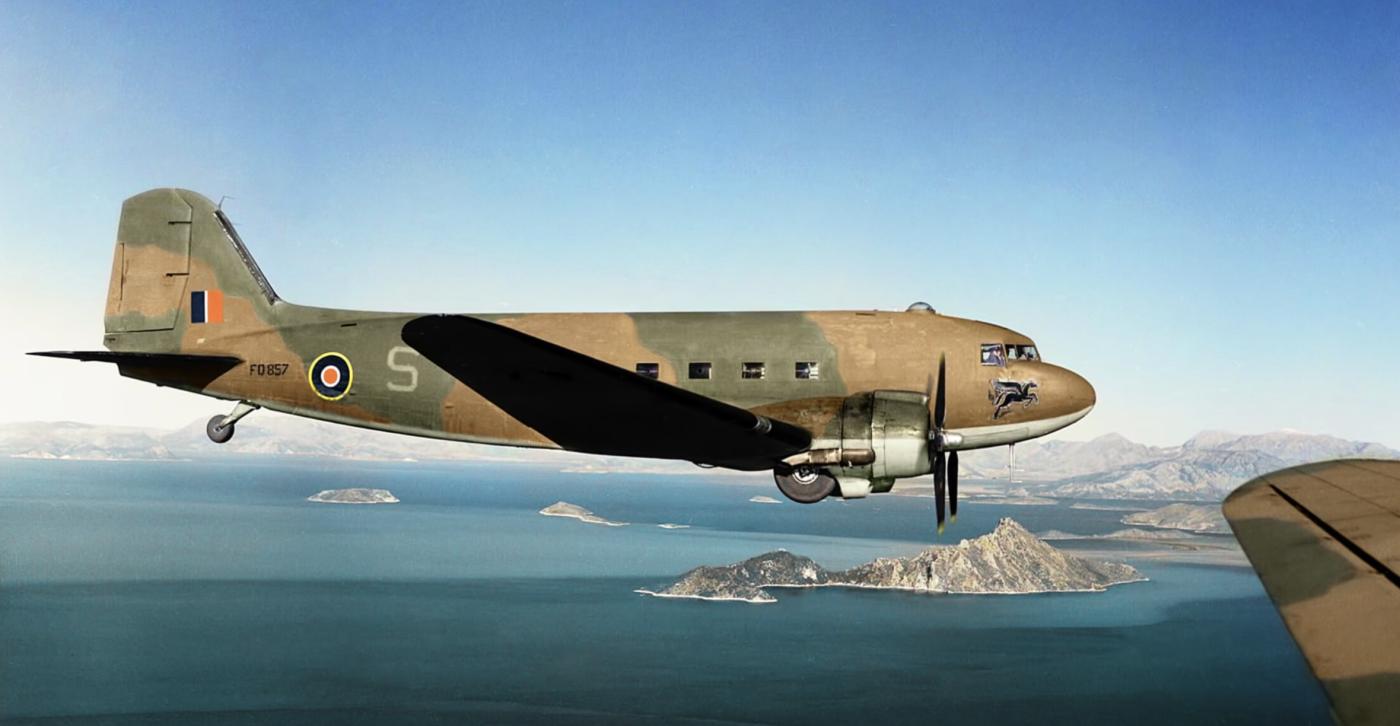
Dakota
The aircraft known to the Royal Air Force as the Dakota was the American Douglas C-47 Skytrain, itself a military development of the Douglas DC-3 civilian airliner. The DC-3 first flew in 1935 and very quickly proved to be one of the most important transport aircraft ever designed. Its combination of strength, simplicity, range and reliability meant that when the Second World War began it could be adapted for military service with remarkably few changes, yet deliver enormous strategic value.
The original DC-3 was designed by a team at the Douglas Aircraft Company, led by chief engineer Arthur Emmons Raymond and overseen by company founder Donald Douglas. It was created to meet airline demands for an aircraft that could carry a useful payload over long distances economically, rather than being dependent on mail contracts. This commercial background strongly shaped the Dakota’s wartime success, because the airframe was already optimised for endurance, load-carrying and frequent operation with minimal maintenance.
To turn the DC-3 into the C-47, Douglas made several key modifications. These included a large cargo door on the port side of the fuselage, a strengthened cabin floor, attachment points for tie-downs and seating for troops, fittings for towing assault gliders, and changes to navigation and radio equipment suitable for military operations. Structurally, the aircraft was robust enough that these additions did not fundamentally alter its flying qualities, and pilots consistently described it as stable, forgiving and easy to handle even when heavily loaded.
Production of the Dakota took place primarily in the United States at Douglas factories in Santa Monica and Long Beach, California, and at a huge plant in Oklahoma City. In pure numbers, the scale was immense. Over 10,000 C-47s were built by Douglas during the war, and when all military and civilian DC-3 variants are included, along with licensed production in the Soviet Union and Japan, total production exceeded 16,000 aircraft. This made it one of the most-produced transport aircraft in history and ensured that Dakotas were present in virtually every theatre of the war.
The RAF began receiving Dakotas in 1943, mainly through Lend-Lease, and used them extensively in Transport Command and in support of airborne forces. Their roles were wide-ranging. Dakotas carried troops to and from operational areas, transported supplies and fuel, evacuated wounded personnel, and dropped paratroopers and cargo by parachute. They were central to airborne operations such as the D-Day landings in Normandy and Operation Market Garden, where they towed Horsa and Hamilcar gliders and dropped airborne troops behind enemy lines. Outside major operations, they formed the backbone of routine but vital transport work, keeping men, equipment and mail moving across Britain, Europe, the Mediterranean, Africa and Asia.
Power was provided by two Pratt & Whitney R-1830 Twin Wasp radial engines, each producing around 1,200 horsepower. These engines were air-cooled, rugged and widely used across many American aircraft types, which simplified logistics and maintenance. The Dakota cruised at roughly 160–180 mph, with a maximum speed just over 220 mph, depending on load and variant. Its normal operational range was around 1,500 miles, which could be extended further with lighter loads or additional fuel, making it suitable for long over-water and inter-theatre flights.
In terms of carrying capacity, a typical RAF Dakota could transport about 28 fully equipped troops or roughly 6,000 pounds of cargo. It could also be configured as an ambulance aircraft, carrying stretcher cases with medical attendants, or fitted with parachute racks for airborne operations. The cabin’s flexibility was one of its greatest strengths, allowing the same airframe to perform many different tasks with minimal modification.
One of the most remarkable aspects of the Dakota was its durability. Aircraft routinely operated from rough, muddy or hastily prepared airstrips and absorbed battle damage yet continued flying. Many airframes served not just through the war but for decades afterwards, in both military and civilian roles. Some RAF Dakotas remained in service well into the 1960s, and even today a small number of DC-3 variants are still flying worldwide, a testament to the soundness of the original design.
The Dakota’s importance to the RAF and the wider Allied war effort cannot easily be overstated. While it lacked the glamour of fighters and bombers, it quietly enabled almost every major operation by ensuring that troops and supplies could be moved where they were needed, when they were needed. In doing so, it became one of the true workhorses of the Second World War and one of the most successful aircraft designs of all time.