On this day in military history…
By February 1945 Dresden was widely regarded, even within Germany, as a city that had escaped the worst of the war. Often described as the “Florence on the Elbe”, it was famous for its baroque architecture, art collections and cultural life, and it had not been subjected to the repeated heavy bombing that had devastated cities such as Hamburg or Cologne. This reputation mattered, because it encouraged the belief that Dresden was relatively safe. In the final winter of the war the city was also unusually crowded. Its normal population had been swollen by evacuees from bombed western cities, forced labourers working in local industry, and tens of thousands of refugees fleeing westwards from the advancing Red Army. When the bombing began on the night of 13 February, Dresden’s streets, cellars and shelters were packed.
The decision to attack Dresden was not the result of a single dramatic order but grew out of late-war Allied strategy. By January 1945 the Western Allies were seeking ways to use air power to assist the Soviet advance by disrupting German communications, administration and troop movements from west to east. Dresden was a major railway hub linking Berlin, Prague, Vienna and Munich, and it was also an administrative centre for Saxony with workshops, factories and depots spread throughout the city. In this context it appeared on target lists alongside Leipzig and Chemnitz as a place whose destruction might create widespread disruption at a critical moment.
At the political and strategic level the idea was discussed within the British government and air staff system. Winston Churchill supported the use of heavy bombing to strike eastern German cities as the war approached its end, believing that it could accelerate Germany’s collapse and demonstrate Allied support for the Soviet offensive. The Chief of the Air Staff, Sir Charles Portal, examined how available bomber forces could be used against transport and administrative centres in eastern Germany, and Air Chief Marshal Arthur Harris, commander of RAF Bomber Command and the leading advocate of area bombing, agreed that Dresden was a suitable target when asked for his view. The attack also sat within a broader framework of Allied cooperation: at the Yalta Conference in early February 1945 the Soviets raised concerns about German troop movements, and the Western Allies discussed air attacks to hinder them. Dresden’s fate emerged from this strategic context rather than from a desire to destroy a famous cultural city for its own sake.
The scale of the raid reflected deliberate planning. The attack opened late on the evening of Tuesday 13 February with a major RAF night operation. Around 770 Lancaster heavy bombers, supported by Mosquito aircraft in specialist roles, were dispatched against the city. The force was divided into two main waves separated by a short interval. This was a well-established tactic: the first wave was intended to smash buildings, rupture water mains and start fires, while the second wave would arrive when emergency services were already overwhelmed and fires were spreading.
The bomb load was chosen to maximise destruction. High-explosive bombs were dropped first to tear open roofs, shatter windows and collapse structures, followed by huge numbers of incendiaries designed to ignite the exposed city. In total, the RAF dropped well over 2,600 tons of bombs on Dresden during the night, roughly split between high explosives and incendiaries. The combination proved catastrophic. Fires merged rapidly into a firestorm, drawing in oxygen with such force that people were knocked over in the streets and shelter doors were torn open. Temperatures soared, and many who had survived the initial explosions were killed by heat, smoke and carbon monoxide.
On the following day, 14 February, the United States Eighth Air Force attacked Dresden in daylight. Several hundred B-17 Flying Fortress bombers were sent primarily against railway yards and transport infrastructure, although the massive smoke cloud rising from the burning city made precise visual aiming difficult. Further daylight attacks followed on 15 February. While American doctrine emphasised precision bombing, the conditions meant that bombs fell across wide areas, adding to the devastation already inflicted by the RAF night raids.
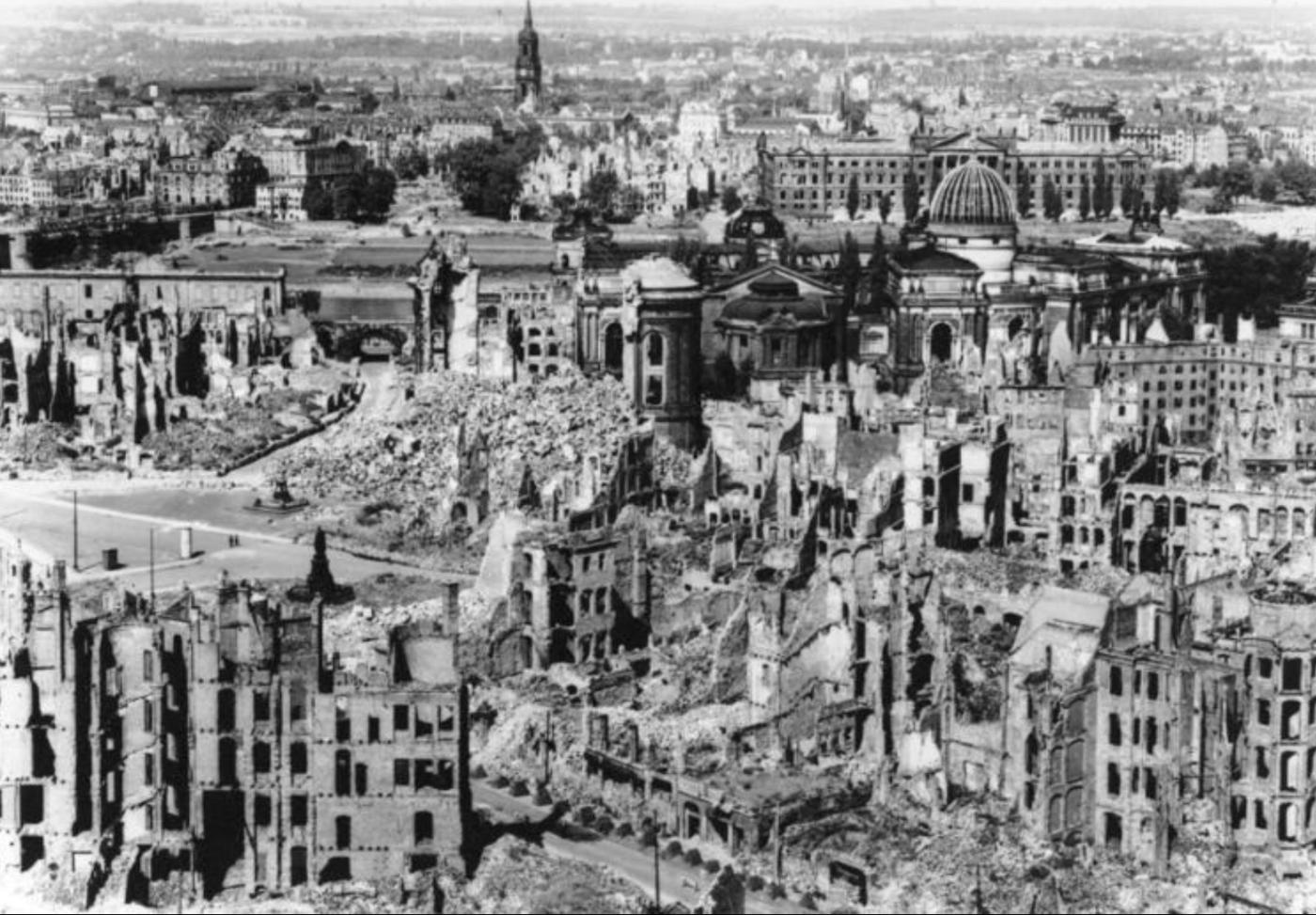
The physical damage to Dresden was immense. Large parts of the historic city centre were destroyed, including landmarks such as the Frauenkirche, the Semper Opera House and vast stretches of densely built residential districts. Transport networks were paralysed, administrative buildings wrecked, and industrial areas badly damaged. The firestorm left entire neighbourhoods reduced to ashes, with streets rendered unrecognisable.
The number of people killed has been the subject of intense debate ever since. Early Nazi propaganda claimed figures running into the hundreds of thousands, figures that lingered for decades in some popular accounts. Careful post-war research by historians and commissions examining burial records, missing persons reports and other evidence has produced much lower estimates. The most widely accepted figures today suggest that around 25,000 people were killed, though the precise number can never be known with absolute certainty given the chaos, the presence of refugees and the destruction of records.
The bombing of Dresden has been criticised on several grounds. Critics argue that the city’s military and industrial value in February 1945 did not justify the scale of destruction inflicted, particularly so late in the war when Germany’s defeat was already inevitable. The deliberate use of area bombing and incendiaries against a city packed with civilians, refugees and wounded has been cited as evidence of moral failure or even as a war crime by some commentators. Others point to the destruction of cultural heritage as a needless tragedy.
Defenders of the raid counter that Dresden was a legitimate military target by the standards of the time, with important rail connections, industries and administrative functions, and that the bombing must be judged in the context of a total war initiated by Nazi Germany itself. They also argue that Allied leaders believed, sincerely if not always accurately, that such attacks could shorten the war and reduce overall casualties by hastening Germany’s collapse.
Whether the raid achieved its aims depends on how those aims are defined. In the short term, Dresden’s transport system was severely disrupted and the city was effectively removed as a functioning centre for weeks. However, the German war effort was already close to breaking point, and it is difficult to show that the bombing of Dresden had a decisive effect on the course of the war. What it unquestionably achieved was to leave a lasting mark on historical memory. Dresden became a symbol of the destructive power of modern warfare and of the moral dilemmas posed by strategic bombing, a symbol that continues to provoke debate long after the fires of February 1945 burned out.