627 Pathfinder Squadron
No. 627 Squadron RAF was a specialist Mosquito unit whose primary wartime role lay in precision pathfinder work in support of RAF Bomber Command. Operating as part of the Pathfinder Force, the squadron’s task was to fly ahead of the main bomber stream, identify the target under night or adverse weather conditions, and mark it clearly so that the following aircraft could bomb accurately. This role placed 627 Squadron at the critical opening stage of major operations, where the success or failure of an entire raid could depend on the accuracy of a small number of aircraft.
The squadron was formed in November 1943 at RAF Oakington in Cambridgeshire and was assigned to No. 8 Group, the Pathfinder Force. No. 8 Group existed solely to improve bombing accuracy and brought together highly experienced aircrew and advanced navigation and bombing technology. Overall command of the Pathfinder Force was held by Air Vice-Marshal Don Bennett, whose emphasis on precision and strict adherence to marking plans shaped the way 627 Squadron operated. The squadron’s first commanding officer, Wing Commander Roy P. Elliott, was responsible for maintaining the high technical and operational standards expected of a pathfinder unit.
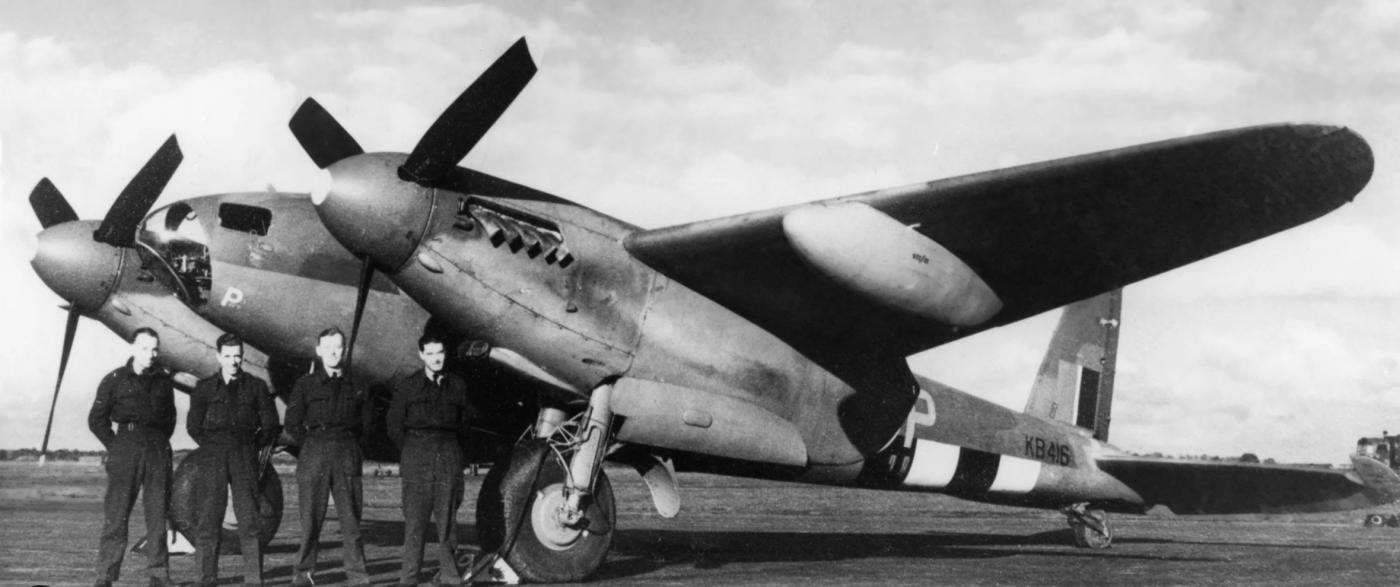
The squadron was equipped with the de Havilland Mosquito, an aircraft particularly well suited to pathfinder duties. Its high speed, long range, and manoeuvrability allowed it to penetrate defended airspace with a lower risk of interception than heavier bombers. For 627 Squadron crews, the Mosquito made it possible to reach the target quickly, carry out accurate marking, and withdraw before defences reached full intensity. However, the aircraft also demanded a high level of skill, especially when flown at night over long distances and hostile territory.
Training for Mosquito pathfinder crews was rigorous and selective. Crews were generally drawn from airmen with substantial prior operational experience, often gained on other bomber types. Conversion training focused on mastering high-speed night navigation, precise timing, and the techniques required to drop markers accurately under pressure. Crews also had to understand the broader bombing plan, since the placement and colour of their markers determined how the main force would interpret the target area.
627 Squadron made extensive use of advanced navigation and bombing aids. Systems such as Gee and Oboe allowed crews to fix their position with precision, while H2S radar could be used to identify target areas even when cloud or smoke obscured visual reference points. Oboe was particularly important for Mosquito pathfinders, as it enabled ground controllers to guide aircraft to an exact release point for their markers. Target Indicator bombs were used to mark the aiming point, producing bright coloured flares that could be clearly seen from altitude. Different colours could be employed to confirm correct marking or to correct errors if initial markers fell inaccurately.
Operationally, the squadron was active during some of the most demanding phases of the bombing campaign against Germany. From late 1943 through early 1944, its crews took part in numerous major operations against heavily defended industrial cities, ports, and transportation centres. As pathfinders, they were often among the first aircraft over the target, facing concentrated flak and the threat of night fighters while working alone or in very small groups.
The number of missions flown by individual crews reflected both the high demand for skilled pathfinders and the relative survivability of the Mosquito compared with heavier bombers. Even so, the work remained hazardous, and mistakes carried serious consequences. An inaccurately placed marker could misdirect hundreds of aircraft, while a well-marked target could dramatically improve bombing concentration and effectiveness.
The importance of No. 627 Squadron lay in its contribution to accuracy and efficiency. By ensuring that bombing was concentrated on clearly defined aiming points, the squadron helped reduce wasted effort and improved the overall effectiveness of Bomber Command operations.