On this day in military history…
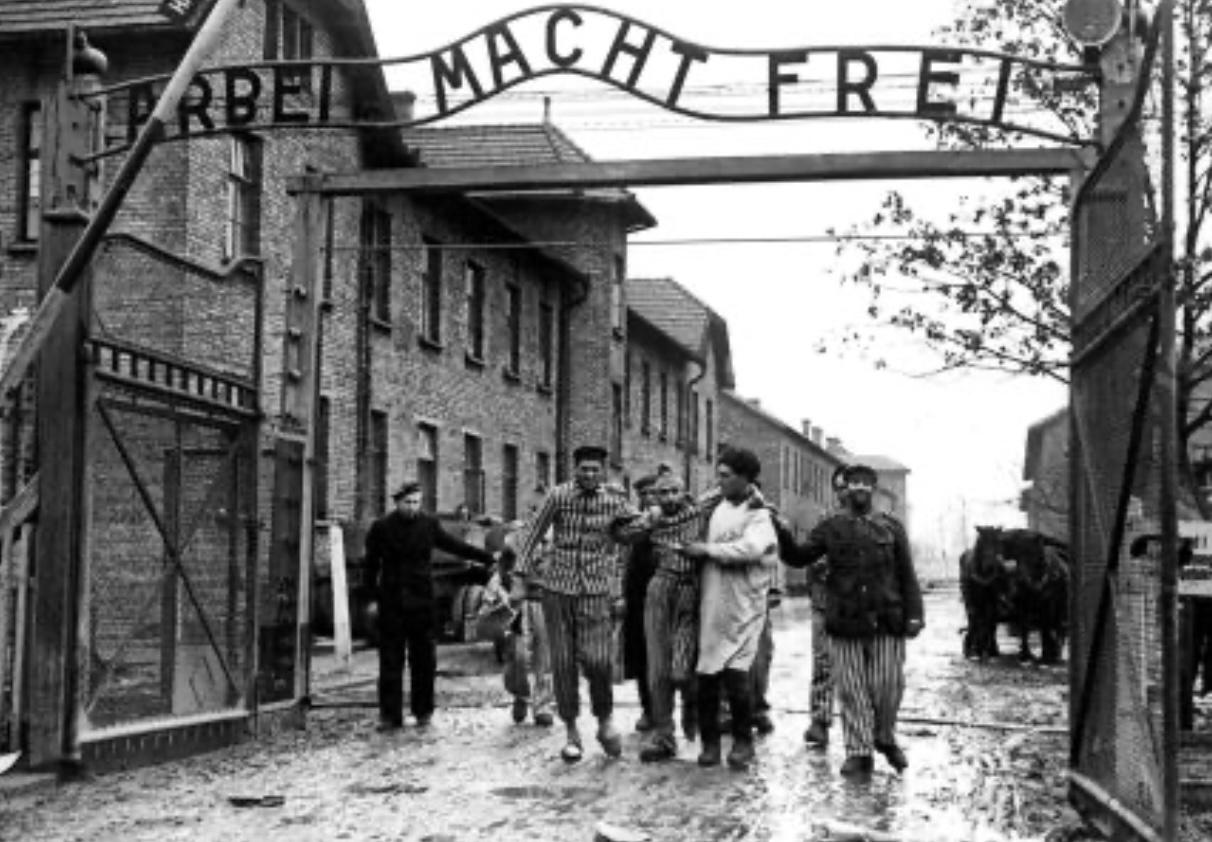
On 27 January 1945, as the Second World War moved toward its end, soldiers of the Soviet Red Army entered the Nazi concentration and extermination camp of Auschwitz in occupied Poland. What they discovered there revealed the full scale of a crime almost beyond human comprehension. Auschwitz was not simply a prison camp but the largest killing centre created by Nazi Germany, a place where mass murder had been organised with chilling efficiency.
Established in 1940 and later expanded into a vast complex of camps, Auschwitz became the centre of the Nazi plan to exterminate Europe’s Jewish population. More than one million people were murdered there, the majority of them Jews, alongside Roma and Sinti people, Polish political prisoners, Soviet prisoners of war, disabled people, and others targeted by Nazi racial and political ideology. Deportees arrived from across Europe in overcrowded cattle wagons, often after journeys lasting days. Upon arrival, selections were carried out within moments, deciding who would be sent directly to gas chambers and who would be temporarily spared for forced labour.
As Soviet forces advanced in January 1945, the Nazis attempted to conceal their crimes. Gas chambers and crematoria were destroyed, documents burned, and around 60,000 prisoners were driven westward on death marches in freezing conditions. Thousands died from starvation, exposure, or execution along the way. Left behind at Auschwitz were roughly 7,000 prisoners, most of them gravely ill, emaciated, or children who had been deemed unfit to march.
When the Red Army liberated the camp on 27 January, they found survivors in a state of extreme physical and psychological collapse. Many were close to death, suffering from starvation, disease, and exhaustion. The soldiers also uncovered overwhelming evidence of industrialised murder: mountains of shoes, suitcases bearing victims’ names, piles of eyeglasses, and tonnes of human hair stored for reuse. These silent objects testified to lives systematically stripped of dignity and existence.
Liberation did not mean immediate safety or recovery. Thousands of survivors died in the weeks that followed despite medical care, their bodies too weak to recover. In the years after the war, survivor testimonies gradually revealed the daily reality of Auschwitz: relentless hunger, random brutality, forced labour, medical experimentation, and the constant presence of death. Auschwitz came to symbolise the Holocaust itself, representing how modern systems, ideology, and obedience were used to carry out genocide.
Today, 27 January is commemorated as Holocaust Memorial Day in many countries, chosen specifically because it marks the liberation of Auschwitz. The day honours the six million Jews murdered by the Nazis and remembers other victims of Nazi persecution, as well as victims of later genocides. It is marked through remembrance ceremonies, education, survivor testimony, and reflection on the dangers of hatred, antisemitism, racism, and indifference.
The liberation of Auschwitz is remembered not only as a military event, but as a moral warning. It stands as evidence of how quickly humanity can descend into atrocity when prejudice is normalised and cruelty becomes policy. Remembering 27 January is an act of responsibility, ensuring that the victims are not forgotten and that future generations understand the consequences of silence and hatred.