Capture of Eichmann
In 1960, one of the boldest intelligence operations in modern history was carried out by Israel when Mossad agents captured one of the chief organisers of the Holocaust. As a senior SS officer in Nazi Germany, he had played a central role in arranging the deportation of millions of Jews to ghettos and extermination camps during World War II. Although he was not usually the man physically carrying out killings himself, he became one of the main administrators behind the Nazi “Final Solution,” the plan to exterminate Europe’s Jewish population.
After Germany collapsed in 1945, many top Nazis were captured, killed themselves or vanished. He managed to escape Europe using false identities and eventually fled to South America with help from Nazi sympathisers. Settling in Argentina under the name Ricardo Klement, he lived a quiet and apparently ordinary life with his family, even working for a time at a Mercedes-Benz factory near Buenos Aires.
Israel never stopped searching for major Nazi war criminals, especially because of his importance in organising deportations to death camps. The breakthrough came when German prosecutor Fritz Bauer secretly informed Israel that the fugitive was probably hiding in Argentina. Bauer feared former Nazis inside Germany might warn him if official channels were used.
Mossad sent agents to Argentina where they spent months gathering information. They rented apartments, safe houses and vehicles while carrying out constant surveillance. The operation was extremely risky because discovery could have led to arrests or attacks by Nazi supporters living in the country.
Agents carefully studied the target’s daily routine. Every evening he travelled home by bus before walking along a lonely road toward his house on Garibaldi Street. Mossad watched him closely for weeks, comparing photographs and checking family details to confirm his identity. One key clue was discovering that he and his wife celebrated the same wedding anniversary as Adolf and Vera Eichmann.
The capture took place on the evening of 11 May 1960. Several agents waited near the bus stop pretending to repair a broken-down car. As he walked past, one agent approached him while the others quickly grabbed him and forced him into a waiting vehicle. The struggle lasted only moments because the team feared attracting attention. He was then taken to a safe house and interrogated.
At first he denied who he was but eventually admitted his true identity. According to accounts from those involved, he appeared surprisingly calm and ordinary. This later influenced philosopher Hannah Arendt’s famous phrase “the banality of evil,” describing how someone responsible for terrible crimes could seem so normal.
The next challenge was getting him out of Argentina. Israel had no legal permission to extradite him, so Mossad devised an elaborate escape plan connected to an Israeli delegation visiting Argentina during national celebrations. An El Al aircraft was scheduled to return the delegation home.
He was sedated, dressed as an airline crew member and made to appear drunk or ill so airport officials would not question him too closely. Without realising who was aboard, authorities allowed the group to leave the country and fly to Israel.
On 23 May 1960, Israeli Prime Minister David Ben-Gurion stunned the world by announcing to parliament that the Nazi fugitive was in Israeli custody and would stand trial in Jerusalem. The news caused worldwide shock. Many praised Israel for finally capturing such an important war criminal, while others criticised the kidnapping as a violation of Argentine sovereignty. The dispute eventually reached the United Nations before being settled diplomatically.
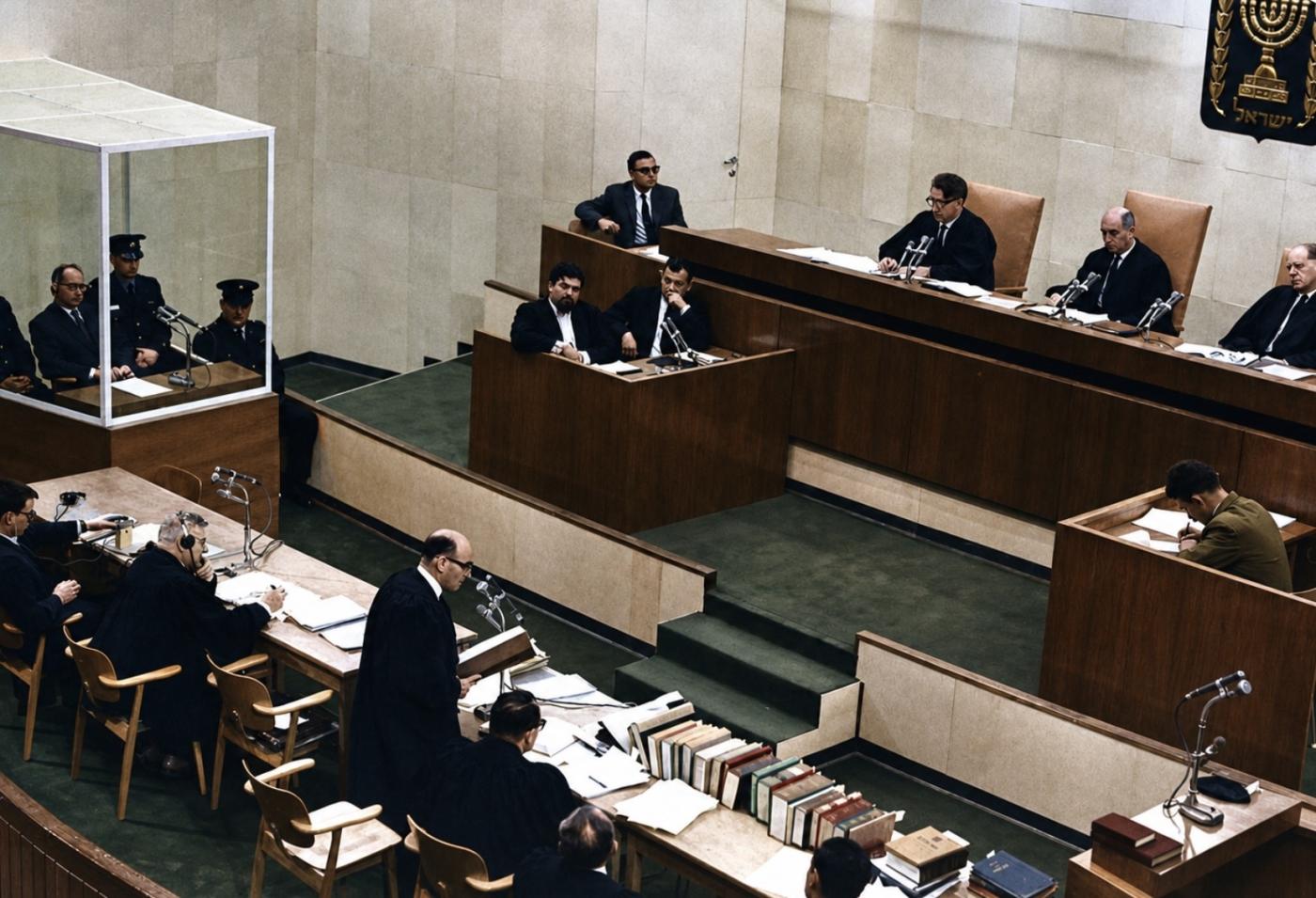
The trial began in Jerusalem on 11 April 1961 and became one of the most famous court cases of the twentieth century. The accused sat inside a bulletproof glass booth throughout the proceedings because of fears someone might try to assassinate him. Journalists from around the world packed the courtroom while millions followed events through newspapers, radio and television.
The prosecution charged him with crimes against humanity, war crimes and crimes against the Jewish people. More than one hundred Holocaust survivors gave evidence, describing deportations, ghettos, concentration camps and extermination camps in heartbreaking detail. For many people around the world, it was the first time they had heard such personal testimony from survivors themselves.
The trial had an enormous emotional impact, especially in Israel where many survivors had previously remained silent about their experiences. Younger generations suddenly heard direct accounts of Nazi atrocities, and the proceedings transformed public understanding of the Holocaust worldwide.
The defence argued that he had simply been following orders and acting as a bureaucrat carrying out instructions from superiors. Prosecutors rejected this entirely, insisting that organising the transportation of millions to their deaths made him directly responsible for mass murder.
After months of evidence and testimony, the court found him guilty in December 1961 and sentenced him to death. Appeals were rejected and a final request for clemency was denied.
Shortly after midnight on 1 June 1962, he was executed by hanging at Ramla Prison in Israel. Afterwards the body was cremated and the ashes scattered into the Mediterranean Sea outside Israeli territorial waters so no grave could ever become a shrine for Nazi supporters.
The operation remains one of Mossad’s most famous successes. It demonstrated Israel’s determination to pursue Nazi war criminals wherever they hid, even many years after World War II. The trial also became a defining moment in Holocaust history, ensuring that survivor testimony was heard across the world and forcing millions to confront the full scale of Nazi crimes.