Burma Star
The Burma Star was one of the campaign medals awarded to British and Commonwealth forces for service during the Second World War, specifically for operations in the Burma Campaign between 1941 and 1945. It represents one of the most demanding and often overlooked theatres of the war, where troops faced not only a determined Japanese enemy but also some of the harshest environmental conditions encountered by any Allied forces.
The medal was instituted by the United Kingdom in May 1945, near the end of the war, as recognition of the gruelling fighting in Burma, India, and surrounding regions. To qualify, personnel had to serve in operational areas between 11 December 1941 and 2 September 1945. This period begins with Japan’s entry into the war and ends with their formal surrender. The qualifying area covered Burma itself, as well as parts of eastern India, Bengal, Assam, and operations in China and Malaya that were directly connected to the campaign.
Eligibility required service under operational command in the designated area, typically for at least one day in an active theatre. This meant that even brief participation in combat operations or exposure to enemy action could qualify a serviceman or woman. The award was given to members of all branches of the British and Commonwealth armed forces, including the Army, Royal Navy, Royal Air Force, Indian Army, and African and colonial units. Civilian personnel under military command, such as war correspondents and certain engineers, could also qualify.
One important rule surrounding this decoration was its relationship with the Pacific Star, another campaign medal. A recipient could not be awarded both. If a person qualified for both campaigns, they would receive one medal and a clasp to indicate service in the other theatre. For example, if this award was issued first, a “Pacific” clasp could be added to the ribbon to show additional service.
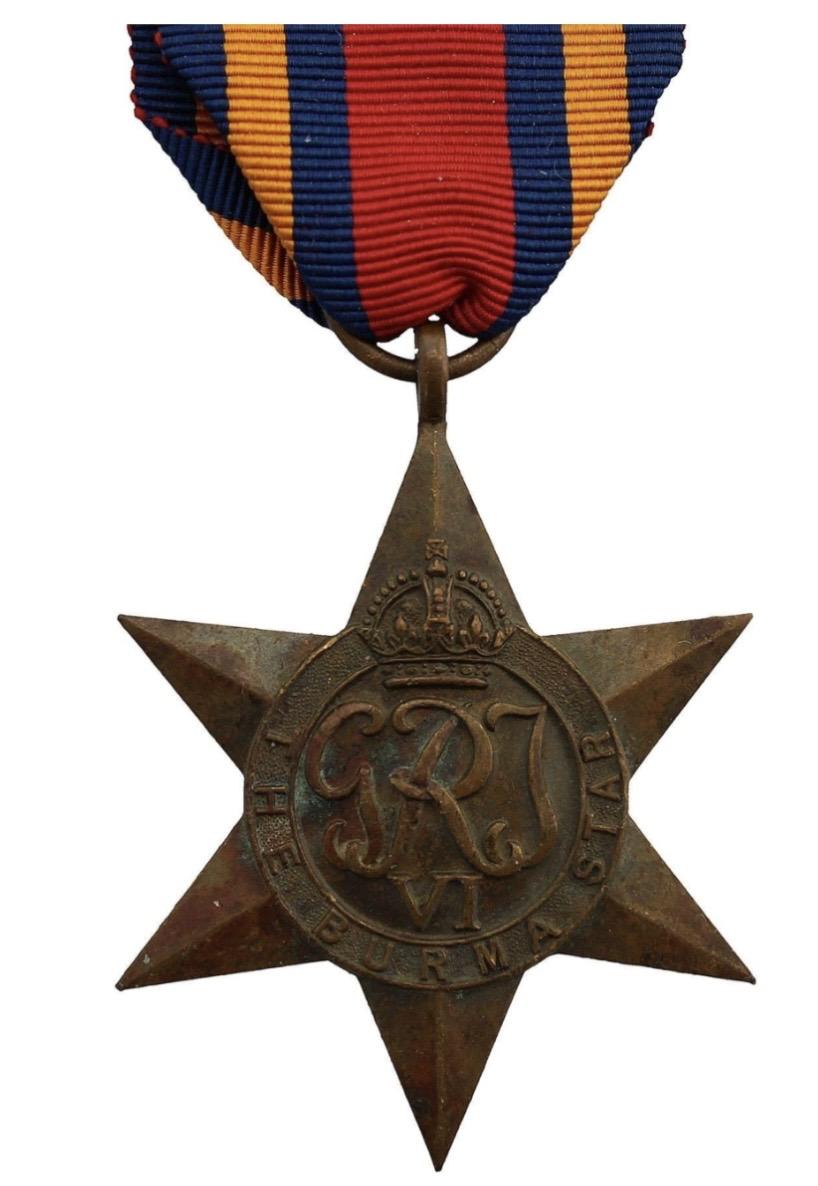
The physical design followed the standard pattern used for most British Second World War campaign stars. It is a six-pointed bronze star, measuring approximately 44 millimetres across. On the obverse side, the central design features the royal cipher of King George VI, surrounded by a circlet bearing the words “The Burma Star.” The reverse is plain, as was typical for these medals, and like most Second World War stars it was issued unnamed.
The design of the medal, along with the other campaign stars of the war, was created under the authority of the Royal Mint by Edward Carter Preston, an accomplished artist who produced several well-known British coin and medal designs during the early 20th century. His work ensured a consistent appearance across all the campaign stars, giving them a uniform identity while allowing each to be distinguished by its title.
Production was carried out by the Royal Mint, which was responsible for manufacturing British military decorations and coinage. Large numbers were struck in bronze during and shortly after the war to meet the demand for awards to the many thousands of qualifying personnel across the British Empire and Commonwealth.
The ribbon is distinctive and symbolic. It consists of a central dark blue stripe, flanked by narrow white stripes, with broader red stripes on either side. The blue represents the Royal Navy, the red represents the Army, and the light blue edges represent the Royal Air Force. The white stripes in the centre symbolise the importance of the campaign’s supply routes, particularly the vital air supply missions over “The Hump” into China.
The Burma Campaign itself was one of the longest continuous campaigns fought by British and Commonwealth forces. Early in the war, Allied troops suffered severe setbacks as Japanese forces advanced rapidly through Burma, forcing a long and difficult retreat into India in 1942. Conditions were extremely harsh, with dense jungle, monsoon rains, disease, and limited infrastructure making operations incredibly challenging. Malaria, dysentery, and other tropical illnesses caused more casualties than combat in some periods.