Blue Steel Nuclear Weapon
The Blue Steel weapon carried by the Avro Vulcan was Britain’s first operational air-launched nuclear standoff missile and represented a crucial, if short-lived, phase in the United Kingdom’s Cold War nuclear deterrent. Developed in the 1950s, it was intended to allow Britain’s V-bombers to attack heavily defended targets without having to fly directly over them, reducing the risk from increasingly effective Soviet air defences.
Blue Steel was designed by Avro, formally A.V. Roe and Company, the same firm responsible for the Vulcan bomber itself. The project was originally known as Weapon System 138 and later given the service name Blue Steel in line with the British colour-coded naming system for nuclear weapons. Development work began in 1954, with the missile designed and assembled primarily at Avro facilities in the UK, including Chadderton and Woodford. The programme was technically ambitious for its time and suffered from delays, cost overruns, and engineering difficulties, particularly with its propulsion system.
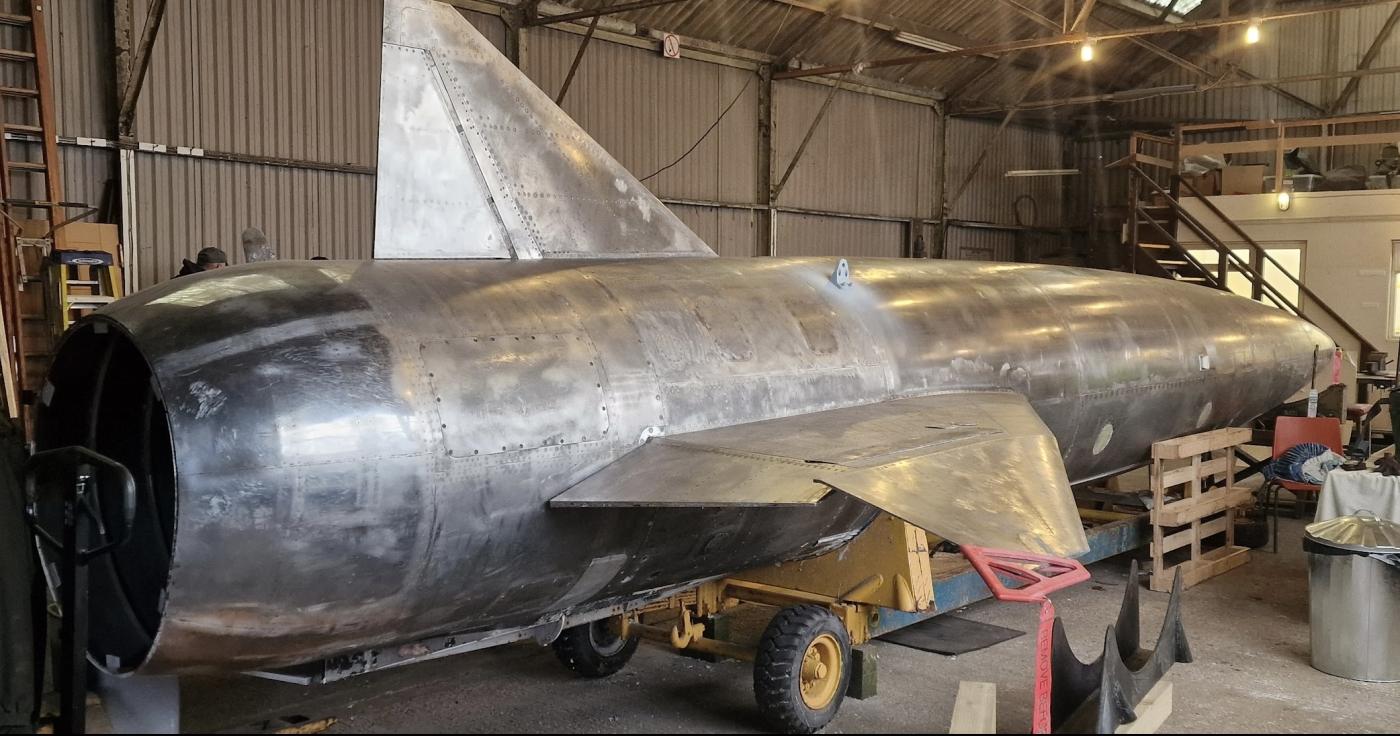
Physically, Blue Steel was a large and imposing weapon. It measured approximately 35 feet in length, with a diameter of about 45 inches and a wingspan of just over 13 feet when its delta-shaped wings were deployed. Its overall weight was around 15,000 pounds, making it too heavy to be carried internally by the Vulcan. Instead, the missile was semi-recessed beneath the bomber’s fuselage, giving Vulcans armed with Blue Steel a distinctive appearance. Carrying the missile imposed aerodynamic penalties and reduced range, which further complicated operational planning.
The missile was powered by a Stentor liquid-fuel rocket engine developed by Armstrong Siddeley. This engine burned high-test peroxide as an oxidiser and kerosene as fuel, producing around 20,000 pounds of thrust. While powerful, the engine was complex, hazardous, and time-consuming to fuel, which limited readiness. Once launched, Blue Steel accelerated to around Mach 2 and followed a high-altitude ballistic trajectory toward its target, with a maximum range of roughly 100 to 150 miles depending on launch profile. Even this range was considered marginal, as it still required the Vulcan to approach relatively close to Soviet airspace.
Guidance was provided by an inertial navigation system, which was advanced for its era but not especially accurate by modern standards. The missile was intended for attacks on large, fixed targets such as cities, airbases, and industrial centres, where extreme precision was not essential. Circular error probable figures were measured in miles rather than metres, reflecting the strategic nature of the weapon.
Blue Steel carried a thermonuclear warhead known as Red Snow, which was a British adaptation of the American W-28 design. The yield of the warhead was approximately 1.1 megatons of TNT equivalent, making it vastly more powerful than the atomic bombs dropped during the Second World War. A detonation of this magnitude would have caused near-total destruction over several miles, with severe blast damage, intense thermal radiation, and long-term radioactive fallout extending far beyond the immediate target area.
Operationally, Blue Steel entered service in 1963 and equipped both Vulcan and Handley Page Victor bombers, though the Vulcan was its most iconic carrier. Despite its technological sophistication, the missile was always regarded as an interim solution. Its limited range, vulnerability during launch, and reliance on dangerous liquid propellants meant that it was quickly overshadowed by more survivable deterrent systems. Even as it entered service, planning was already well advanced for the shift to submarine-launched ballistic missiles.
One interesting aspect of Blue Steel was how closely it tied together Britain’s bomber and missile programmes. The Vulcan’s high-altitude performance was essential to giving the missile its maximum range and speed, and crews trained extensively in complex launch procedures that involved precise timing, altitude, and speed. The missile’s size and weight also influenced Vulcan handling, particularly during take-off and landing.
Blue Steel had a relatively short operational life. By the late 1960s, advances in Soviet surface-to-air missiles and interceptors made high-altitude bombing increasingly dangerous, and the Royal Air Force shifted the V-bombers to low-level penetration tactics, which were incompatible with Blue Steel’s launch profile. The missile was withdrawn from service in 1970, replaced in Britain’s strategic deterrent role by the Polaris submarine force.
Although it never came close to being used in anger, Blue Steel remains a significant artefact of Cold War history. It symbolised Britain’s determination to maintain an independent nuclear capability at a time when technology, politics, and strategy were all evolving rapidly. Today, surviving examples in museums offer a striking reminder of the scale, complexity, and destructive power of the weapons carried by the Vulcan bomber at the height of the nuclear standoff.
Photo shown is @ Newark aircraft museum in there workshop been refurbished for display .