B.E.2 Aeroplane
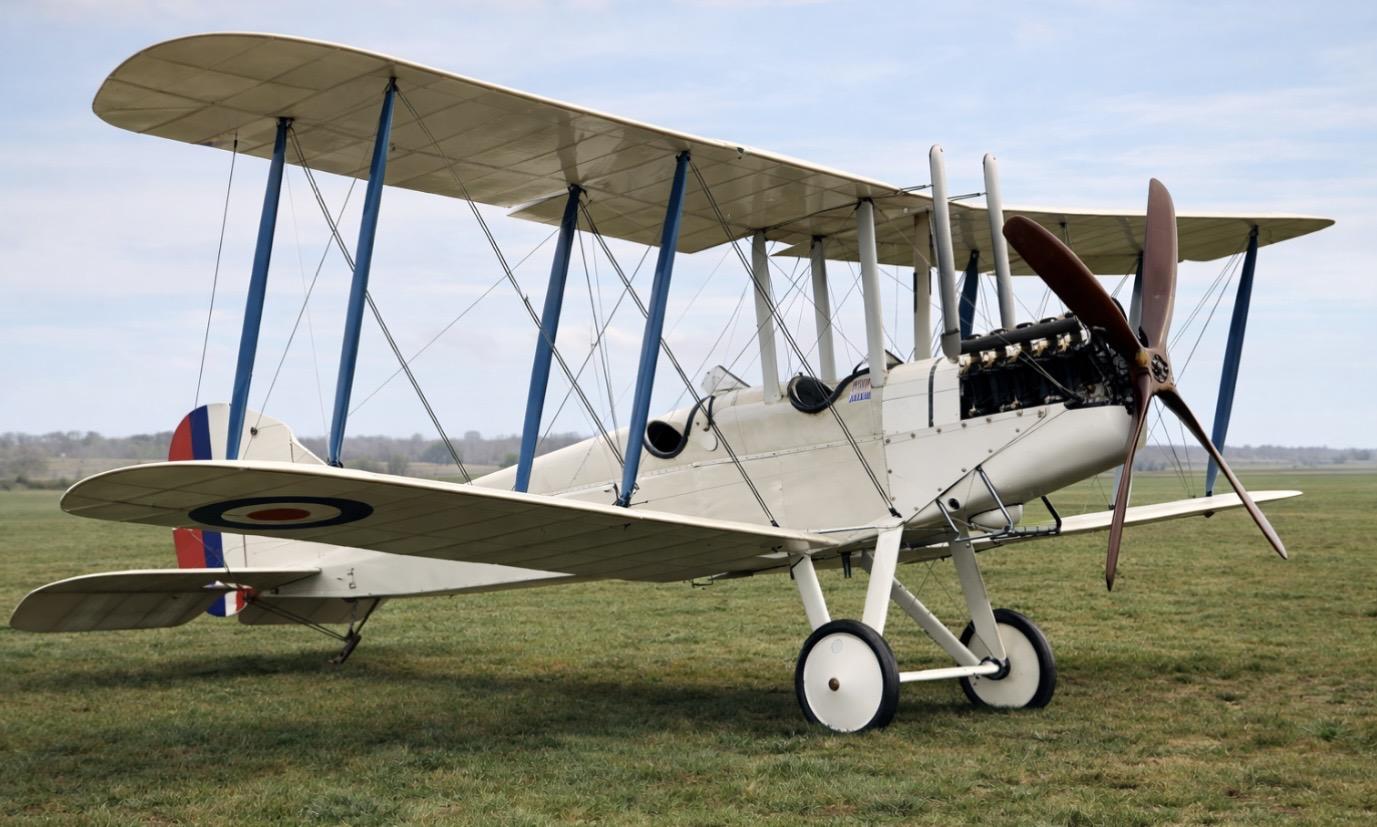
The Royal Aircraft Factory B.E.2 was one of the most important early British aeroplanes and played a major role in the opening years of the First World War. It was a two-seat, single-engine tractor biplane, with the propeller mounted at the front pulling the aircraft through the air, and it marked a shift from experimental flying machines to aircraft designed specifically for military use.
The aircraft was designed at the Royal Aircraft Factory by a team that included Geoffrey de Havilland and later refined by E. T. Busk. The designation “B.E.” stood for “Blériot Experimental,” reflecting its tractor layout inspired by the work of Louis Blériot.
The B.E.2 first flew in February 1912 and entered service with the Royal Flying Corps later that year, making it one of the earliest operational military aircraft. Although designed by the Royal Aircraft Factory, most were built by private companies such as Vickers and Bristol Aeroplane Company, along with several others brought into aircraft production during the war. In total, around 3,500 were built in a variety of versions.
Its main role was reconnaissance, which at the time was considered the most valuable use of aircraft. Crews observed enemy troop movements, mapped positions, and directed artillery fire from the air. As the war went on, it was also used for light bombing, communication duties, coastal patrol, and even night fighting. Some modified versions were used to intercept German airships, and several Zeppelins were destroyed by B.E.2 crews during 1916.
One of the most distinctive features of the B.E.2 was its stability. It was designed to fly steadily and predictably, which made it ideal for observation and aerial photography. However, this same stability made it slow to respond to controls and difficult to manoeuvre in combat. When more advanced German fighters began to appear, particularly during the period known as the Fokker Scourge, the B.E.2 became dangerously vulnerable and suffered heavy losses.
The aircraft carried a crew of two, with the observer seated in the front and the pilot behind. This arrangement was useful for observation work but made defensive armament awkward, as the observer had limited ability to fire a machine gun effectively.
In terms of performance, early versions were powered by a 70 horsepower Renault engine, while later models such as the B.E.2c and B.E.2e used improved engines like the RAF 1a, producing around 90 horsepower. A typical B.E.2 had a top speed of roughly 70 to 80 miles per hour, an operational ceiling of about 10,000 feet, and a range of around 180 miles, depending on the version and conditions.
The aircraft itself was constructed from a wooden frame covered in fabric, which was standard for the time. It had equal-span wings and evolved through several versions, from the early B.E.2a and B.E.2b to the more refined B.E.2c and later types, each incorporating small improvements in handling and performance.
Although it was eventually outclassed by faster and more heavily armed aircraft, the B.E.2 played a crucial role in the early development of military aviation. It helped establish aerial reconnaissance as an essential part of warfare and showed both the possibilities and limitations of early aircraft design.