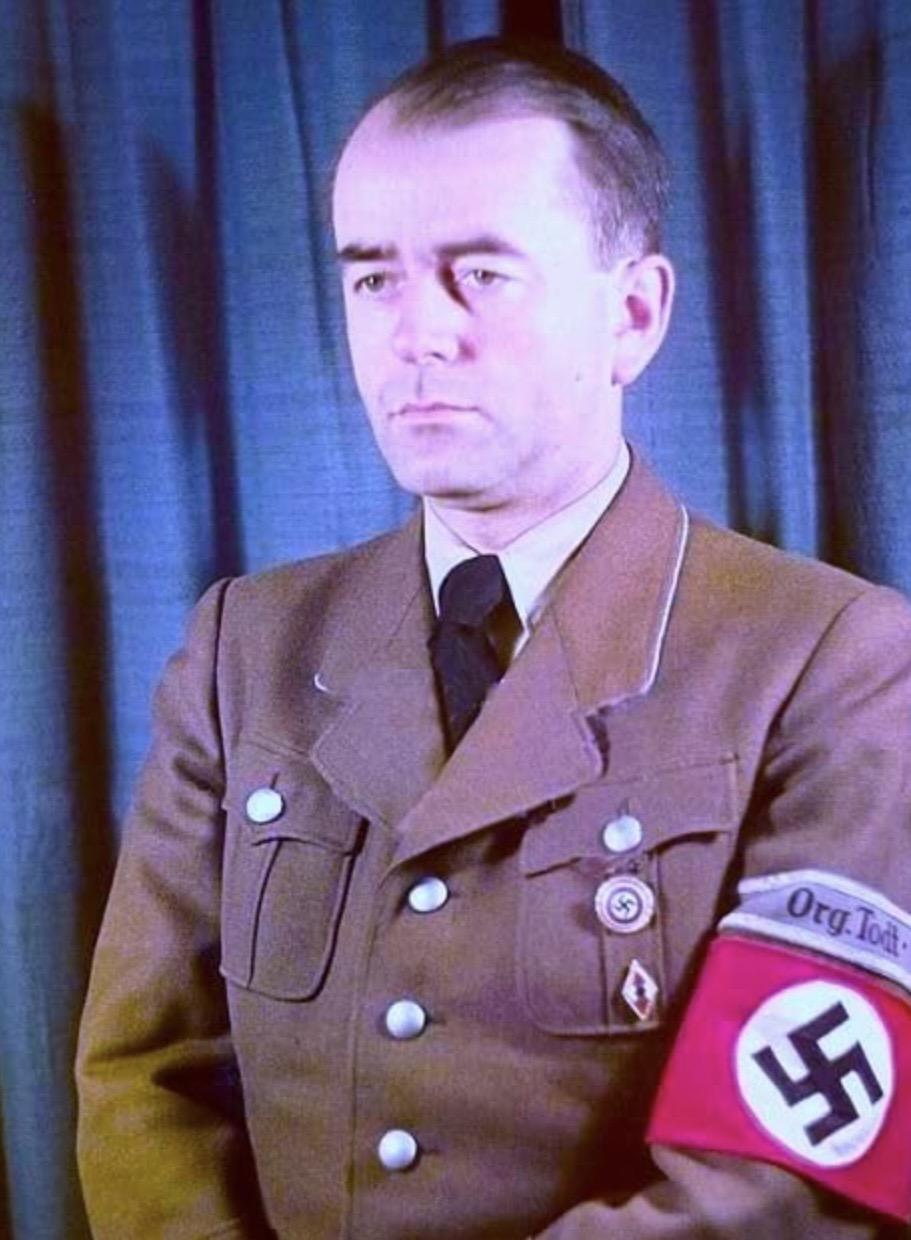
Albert Speer
Albert Speer was one of the most influential and controversial figures within Adolf Hitler’s inner circle during the Third Reich. Unlike many other leading Nazis who rose through political activism or military service, his rise was rooted in architecture and personal loyalty to Hitler. Over time he became not only the dictator’s favored architect but also one of the most powerful administrators in Nazi Germany, ultimately responsible for much of the country’s wartime armaments production. His life before, during, and after the Second World War reveals a complex mixture of ambition, opportunism, denial, and calculated self-presentation.
He was born on March 19, 1905, in Mannheim, Germany, into a wealthy upper-middle-class family. His father and grandfather were both successful architects, and the family lived comfortably in Heidelberg for much of his youth. The household was strict and achievement was expected. Despite the family tradition in architecture, he initially showed little enthusiasm for the profession. Eventually, under pressure from his father, he chose to follow the same path and study architecture.
He attended several respected institutions including the Technical University of Karlsruhe and later the Technical University of Munich. One of the most important influences on his early career was the architect Heinrich Tessenow, known for his simple and classical style. Tessenow’s emphasis on clarity, proportion, and monumental simplicity later shaped many of his architectural ideas. By the late 1920s he had become one of Tessenow’s assistants and was beginning to build a professional career.
Membership in the Nazi Party came in 1931, relatively late compared with early activists. He later claimed that the decision was motivated more by the hope of national recovery during the economic crisis of the Weimar Republic than by ideological commitment. At that time Germany was experiencing severe unemployment and political instability, and many middle-class professionals believed the Nazis might restore stability.
His connection to Adolf Hitler developed through architectural work. In 1933, soon after the Nazis came to power, he was asked to design decorative elements for a Nazi Party rally in Berlin. The work impressed Propaganda Minister Joseph Goebbels and eventually brought him to Hitler’s attention. Hitler had a lifelong fascination with architecture and urban planning, and he was deeply interested in grand building projects that could symbolize the power and permanence of the regime.
A close professional relationship quickly formed. Hitler admired the young architect’s ability to translate ideological ideas into physical structures. One of the most famous early designs was the “Cathedral of Light” created for the Nuremberg rallies, where powerful searchlights were arranged vertically around the rally grounds to form towering columns of light in the night sky. The effect created an almost mystical atmosphere that reinforced the dramatic spectacle of the rallies.
In 1934 he replaced Paul Ludwig Troost, Hitler’s original architect who had died unexpectedly. From that point forward he became the regime’s chief architect and was responsible for numerous important projects. Among these was the New Reich Chancellery in Berlin, completed in 1939. The building was intentionally enormous and intimidating, designed to impress visiting diplomats and symbolize the authority of the Nazi leadership.
He also played a major role in Hitler’s ambitious vision for transforming Berlin into “Germania,” a monumental capital that was supposed to reflect the supposed thousand-year future of the Third Reich. Plans included massive boulevards, gigantic government buildings, and an enormous domed assembly hall called the Volkshalle that was designed to hold over 150,000 people. Only small portions of these plans were begun before the war halted most construction.
His influence expanded dramatically during the war. In February 1942 Fritz Todt, the Minister of Armaments and War Production, died in a plane crash. Hitler unexpectedly appointed the thirty-six-year-old architect as his replacement. The appointment placed him in charge of organizing Germany’s entire armaments industry during the most critical phase of the war.
In this role he proved to be an efficient and energetic administrator. Industrial production was reorganized, bureaucracy reduced, and factory output coordinated more effectively. Despite increasing Allied bombing, the production of tanks, aircraft, and artillery rose sharply during the following years.
This expansion depended heavily on forced labor. Millions of prisoners of war, civilians from occupied territories, and inmates from concentration camps were forced to work in German factories under brutal conditions. After the war he claimed limited knowledge of these abuses, although later historical evidence suggests that he was far more aware of the system than he admitted.
By the later years of the conflict he had become one of the few people who could speak directly with Hitler. As Germany’s military situation worsened, Hitler trusted only a small circle of advisers, and the armaments minister remained among them. In early 1945 Hitler issued what became known as the “Nero Decree,” ordering the destruction of German infrastructure so that advancing Allied forces would inherit a devastated country. Bridges, factories, and railways were to be demolished.
He quietly resisted these instructions, arguing that destroying the nation’s infrastructure would bring catastrophic suffering to the civilian population. In practice many of the orders were ignored or deliberately delayed, allowing much of Germany’s industrial capacity to survive.
After Germany’s defeat in May 1945 he was arrested by Allied forces and placed on trial at the International Military Tribunal in Nuremberg. During the proceedings he adopted a strategy very different from most other defendants. Rather than denying responsibility completely, he acknowledged a level of moral guilt for the regime’s actions, although he insisted he had no knowledge of the Holocaust.
This partial acceptance of responsibility distinguished him from figures such as Hermann Göring or Joachim von Ribbentrop, who largely denied wrongdoing. His calm demeanor and apparent willingness to admit fault made an impression on the tribunal.
He was convicted of war crimes and crimes against humanity, mainly for the use of forced labor in armaments production. However, he avoided the death sentence given to several other leading Nazis. In October 1946 he was sentenced to twenty years in prison.
The sentence was served in Spandau Prison in West Berlin alongside several other high-ranking Nazi officials, including Rudolf Hess and Baldur von Schirach. Life in Spandau was strict but orderly. During imprisonment he secretly wrote notes and reflections that would later become the basis for his memoirs.
One unusual pastime during these years was an imaginary journey around the world. While exercising in the prison yard each day, he calculated distances and recorded them as though he were walking across continents, keeping detailed logs of the imaginary travels.
Release came on October 1, 1966, after the full twenty-year sentence had been completed. After leaving prison he quickly re-entered public life as an author. His memoir Inside the Third Reich and later Spandau: The Secret Diaries became international bestsellers.
In these books he portrayed himself as a technocratic administrator who had been close to Hitler but morally separate from the worst crimes of the regime. For many years this image strongly influenced public perception. Later historical research, however, uncovered documents suggesting he likely knew far more about Nazi atrocities, including aspects of the Holocaust, than he admitted in his writings.
During the final years of his life he lived relatively quietly in West Germany while continuing to write and give interviews about the Nazi leadership and Hitler’s personality. Because so many other senior figures had died, he became one of the most important surviving witnesses to the inner workings of the Third Reich.
He died on September 1, 1981, in London at the age of seventy-six after suffering a stroke while visiting the city. His legacy remains controversial. Some historians describe him as a skilled administrator who attempted late in the war to prevent further destruction, while others view him as a calculating figure who carefully shaped his image to avoid full responsibility for his role within one of the most destructive regimes in modern history.