Adolph Eichman
Adolf Eichmann was born on 19 March 1906 in Solingen, an industrial town in western Germany, to Karl Eichmann, a middle-class accountant, and Maria Schefferling. His mother died when he was young, and in 1914 his family moved to Linz in Austria, a city that would later be associated with Adolf Hitler’s youth as well. Eichmann was an unimpressive student who struggled academically and left secondary school without a diploma. He trained briefly as a mechanical fitter and later worked in sales for several companies, including an Austrian vacuum oil firm. In the unstable economic and political climate of post-First World War Austria, he drifted toward nationalist and antisemitic circles, influenced by friends and by the growing appeal of German nationalist movements.
In 1932 Eichmann joined the Austrian Nazi Party and the SS, at a time when both were still illegal in Austria. After Austrian authorities cracked down on Nazis, he fled to Germany in 1933, where he became a full-time SS member. Initially he held minor administrative jobs, but his career changed when he was assigned to the Sicherheitsdienst, the SS intelligence service. There he came under the influence of Reinhard Heydrich, one of the most powerful and ruthless figures in the Nazi hierarchy. Eichmann was tasked with researching Jewish organizations and Zionism, which he did with obsessive thoroughness, reading widely and even learning basic Hebrew and Yiddish. Although he was not a deep ideologue in the sense of writing theory, he absorbed the regime’s antisemitic worldview and became an expert bureaucrat on Jewish affairs.
After Germany annexed Austria in 1938, Eichmann was sent to Vienna to organize the forced emigration of Jews. He created a highly efficient system that used intimidation, extortion, and paperwork to strip Jews of their property and push them out of the country as quickly as possible. This operation was considered a success by Nazi leaders, and Eichmann was promoted and transferred to Berlin to apply similar methods on a larger scale. When the Second World War began and Nazi policy shifted from expulsion to mass murder, Eichmann’s role expanded dramatically. He became head of Section IV B4 of the Reich Main Security Office, the department responsible for Jewish affairs and deportations.
In this position Eichmann became one of the central organizers of what the Nazis called the Final Solution, the systematic murder of Europe’s Jews. He did not usually decide policy himself, but he was indispensable in turning genocidal plans into reality. He coordinated with railways, local Nazi authorities, and SS units to arrange the transport of millions of Jews from across occupied Europe to ghettos, concentration camps, and extermination camps such as Auschwitz, Treblinka, and Sobibor. He attended the Wannsee Conference in January 1942, where senior officials formalized the plan to annihilate the Jewish population of Europe, and he took detailed notes that showed how calmly and bureaucratically mass murder was discussed. Eichmann prided himself on efficiency and obedience, later claiming that he was simply following orders, though his energy and initiative in carrying out deportations showed a far deeper level of involvement.
As the war turned against Germany, Eichmann continued to push deportations even when they no longer made military sense, most notably in Hungary in 1944. There, in just a few months, more than 400,000 Hungarian Jews were sent to Auschwitz, the majority to their deaths. Even as Allied forces closed in, Eichmann resisted efforts to halt the killings, arguing that the mission had to be completed.
At the end of the war Eichmann was captured by American forces but managed to escape from a prisoner-of-war camp in 1946. For several years he lived in Germany under assumed names, working menial jobs and evading capture. In 1950 he fled to Italy and then to Argentina using a Red Cross passport under the alias Ricardo Klement. In Buenos Aires he lived a quiet, modest life, working in factories and later for a Mercedes-Benz subsidiary, while maintaining contact with a small network of former Nazis.
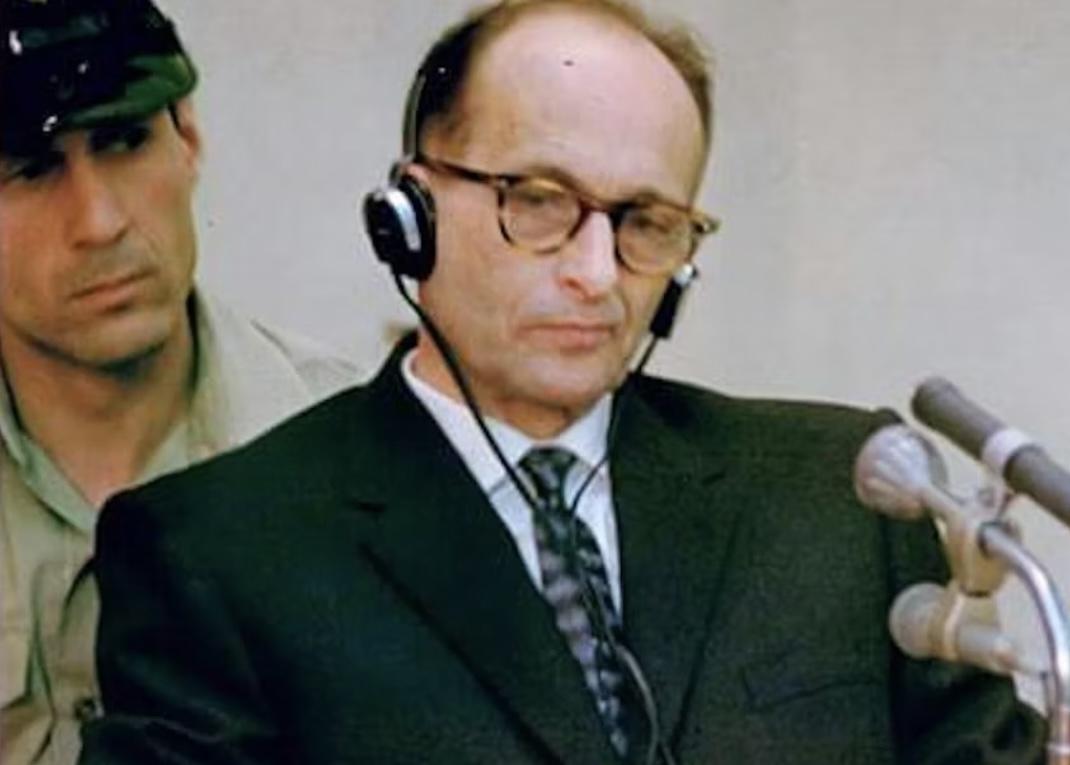
His whereabouts were eventually discovered by Israeli intelligence, partly through information from German prosecutors and Jewish refugees who had encountered him. In May 1960 agents of Israel’s Mossad kidnapped Eichmann on a street in a suburb of Buenos Aires and secretly flew him to Israel. His capture caused international controversy, but Israel proceeded to put him on trial in Jerusalem in 1961.
The trial was a landmark event, bringing the Holocaust into global public focus through the testimony of survivors and detailed evidence of Nazi crimes. Eichmann presented himself as a mere functionary who had followed orders and never personally killed anyone, but prosecutors demonstrated that his logistical and administrative work had been crucial to the machinery of genocide. He was found guilty of crimes against humanity, war crimes, and crimes against the Jewish people.
Adolf Eichmann was sentenced to death and hanged on 31 May 1962. His body was cremated and the ashes scattered at sea outside Israeli territorial waters, so that no grave could become a shrine. His life and trial left a lasting impact on how the world understands the Holocaust, the nature of bureaucratic evil, and the responsibility of individuals within murderous systems.