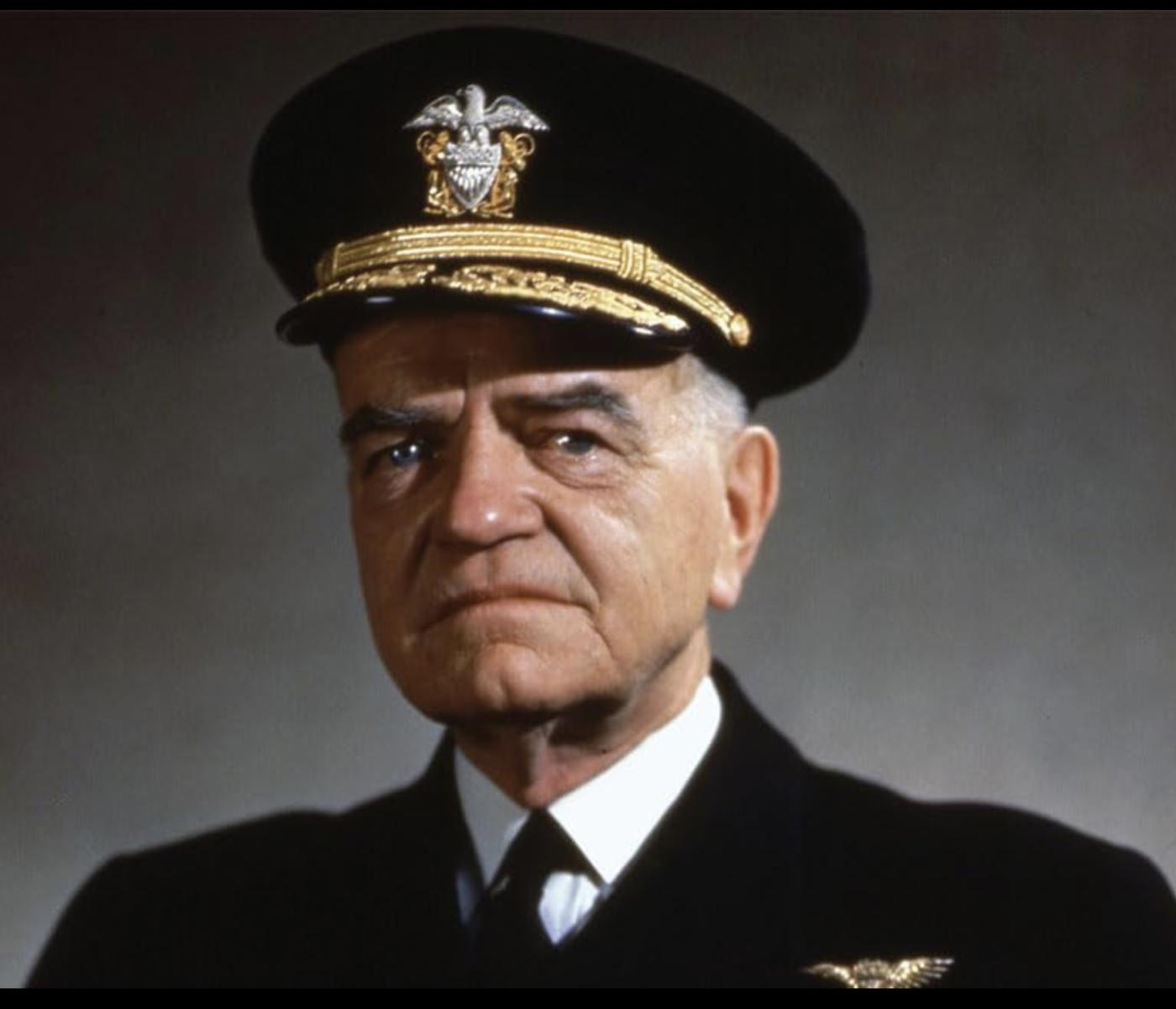
Admiral William F Halsey jr
Admiral William Frederick Halsey Jr. was one of the most forceful and recognizable American naval leaders of the Second World War, known to history by his nickname “Bull” for his aggressive spirit and uncompromising drive. He was born on October 30, 1882, in Elizabeth, New Jersey, into a family already deeply rooted in naval tradition. His father, William Frederick Halsey Sr., was a U.S. Navy officer who would eventually reach the rank of rear admiral, and from an early age the younger officer absorbed stories of the sea, discipline, and service. He attended public schools in New Jersey before entering the United States Naval Academy at Annapolis in 1900. There he was an average academic student but stood out for his determination, physical endurance, and leadership qualities, graduating in 1904 and beginning a naval career that would span more than four decades.
His early years in the Navy were shaped by the transition from sail and coal to oil and steel, and from small, scattered squadrons to a global fleet. He served on a variety of ships, including battleships, destroyers, and cruisers, and gained a reputation as an officer who demanded high standards from himself and those under his command. During World War I he served primarily in convoy and destroyer operations in the Atlantic, helping protect Allied shipping from German U-boats. Although the conflict did not give him a dramatic combat spotlight, it provided invaluable experience in leadership under pressure and in the management of fast-moving naval forces, skills that would later become central to his success.
One of the most remarkable decisions of his life came in the 1930s when, already in his fifties and a senior officer, he volunteered to become a naval aviator. At a time when many surface warfare officers viewed aviation with skepticism, he recognized that aircraft would dominate the future of naval warfare. He completed flight training in 1935 at the age of 52 and earned his wings, becoming one of the oldest men to qualify as a naval aviator. This bold choice reshaped his career and placed him at the center of the rapidly growing aircraft carrier forces that would soon dominate the Pacific War.
By the late 1930s the admiral was commanding aircraft carriers and carrier task forces, and when the United States entered World War II after the attack on Pearl Harbor in December 1941, he was already a key figure in the Pacific Fleet. In the bleak months that followed, when American naval forces were still recovering from devastating losses, his aggressive raids against Japanese-held islands helped restore confidence and showed that the enemy could be struck back. In early 1942 he commanded carrier groups that attacked the Marshall and Gilbert Islands, and later that spring he was involved in operations linked to the famous Doolittle Raid on Tokyo.
Illness prevented him from commanding at the Battle of Midway, but he returned later in 1942 to take charge of the South Pacific Area during the brutal struggle for Guadalcanal. There he oversaw a series of bitter naval battles against Japanese forces, gradually tipping the balance in favor of the Allies. His leadership during this campaign was crucial in keeping supply routes open and in supporting the Marines and soldiers fighting ashore. Under his direction, American sea and air power gained increasing control of the Solomon Islands region, marking one of the great turning points of the Pacific war.
In 1944 he was promoted to full admiral and given command of the U.S. Third Fleet, one of the most powerful naval forces ever assembled. He led it through the climactic battles of the war, including the Battle of the Philippine Sea and the Battle of Leyte Gulf. Leyte Gulf, fought in October 1944, was the largest naval battle in history and shattered Japan’s remaining naval strength. Some of his decisions during that engagement were controversial, especially his pursuit of a decoy enemy force, but the overall result was a decisive Allied victory. His fleet went on to strike relentlessly at Japanese airfields, shipping, and coastal targets, steadily closing in on the home islands.
Two powerful typhoons later struck the Third Fleet in late 1944 and mid-1945, causing heavy losses and damage. These disasters brought criticism and official inquiries, yet he remained in command and continued leading operations until Japan’s surrender in August 1945. He was present in Tokyo Bay aboard the battleship Missouri when the surrender documents were signed, witnessing the formal end of the war he had fought for nearly four years.
After leaving active service in 1947, the famous naval commander remained a major public figure. He wrote and lectured widely, sharing his views on naval warfare and leadership, and his autobiography became a bestseller that further shaped how the public remembered him. Although historians have debated some of his wartime judgments, he was widely admired for his boldness, his loyalty to his sailors, and his refusal to be timid in the face of danger.
In later life he settled in California, where he stayed closely connected to the Navy and its traditions. He attended reunions and commemorations and was frequently invited to speak about the war and its lessons. Even as age and illness reduced his activity, he retained the strong opinions and direct manner that had defined him throughout his career. William F. Halsey Jr. died on August 16, 1959, at the age of 76, leaving behind a legacy of dramatic leadership, decisive victories, and lasting influence on American naval history.