
German Radio Operators Badge
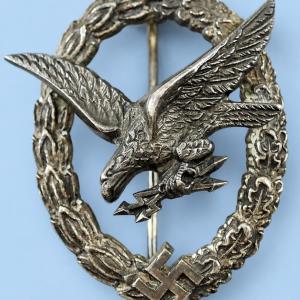
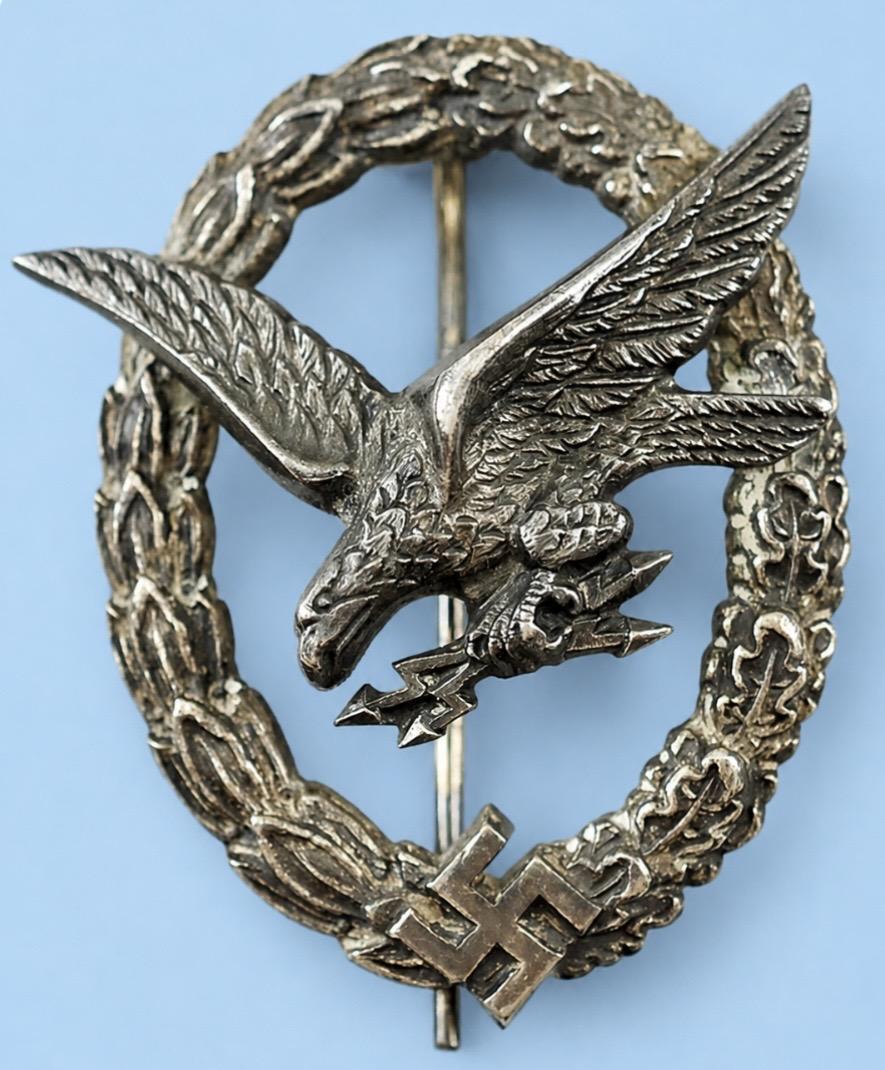
This Luftwaffe flying qualification award was oval in shape and followed the general style used for Luftwaffe aircrew badges. Around the outside was a wreath, usually with laurel leaves on one side and oak leaves on the other. At the bottom of the wreath was the swastika, as was normal for German military awards of the period. In the centre was a diving Luftwaffe eagle. The feature that makes the radio operator badge especially recognisable is that the eagle clutches crossed lightning bolts in its talons. These lightning bolts represented signals, wireless communication, and the radio trade.
Manufacture was normally in two pieces, with the wreath and the eagle made separately. The eagle was attached to the wreath by rivets, and the reverse usually had a vertical pin, hinge, and catch so that it could be worn on the uniform. It was worn on the lower part of the left breast pocket, below higher decorations if the man had them. Early examples were usually better made, often in tombak, nickel silver, or other good-quality non-ferrous metals. As the war went on and Germany’s supply situation became worse, many were made from zinc. Zinc examples often lose much of their original finish, which is why many surviving pieces today look dull, dark, or grey.
This award was not produced by one single factory. Like many German military awards of the period, it was made by a number of approved private firms. Known makers include C. E. Juncker of Berlin, F. W. Assmann & Söhne of Lüdenscheid, Wilhelm Deumer of Lüdenscheid, Berg & Nolte of Lüdenscheid, Gebrüder Schneider, and other firms known from surviving examples and collector research. Juncker badges are especially prized by collectors because of their early quality and sharp detail. Assmann and Deumer examples are also well known. Berg & Nolte examples are known too, including museum-held pieces. Although the basic design was standard, each maker had its own small differences in materials, hinge, catch, rivets, finish, and reverse markings.