Operation Battle Axe
Operation Battleaxe, fought from 15 to 17 June 1941, was one of the most important early British offensives of the North African campaign in the Second World War. It was launched on the Egyptian-Libyan frontier with the aim of breaking through the Axis defences, relieving the besieged port of Tobruk, and pushing Erwin Rommel’s German and Italian forces back from the frontier. Although smaller than later desert battles such as Operation Crusader or El Alamein, Battleaxe was historically significant because it was the first major occasion in the war when British forces attacked a prepared and defended German position. Until then, the German Army had mostly been associated with fast-moving attacks, armoured breakthroughs and the famous Blitzkrieg style of warfare. In the desert in June 1941, the British were about to discover that German troops could be just as dangerous when dug in, hidden and waiting.
The background to Operation Battleaxe lay in the dramatic changes that had taken place in North Africa during the first half of 1941. In late 1940 and early 1941, the British and Commonwealth forces had won a brilliant victory over the Italians in Operation Compass, driving deep into Libya and capturing large numbers of prisoners. But Britain then diverted troops, aircraft and equipment to Greece, weakening the desert army at a critical moment. Germany responded to Italy’s crisis by sending the Afrika Korps under General Erwin Rommel. Rommel arrived in North Africa in February 1941 and quickly transformed the campaign. Instead of waiting passively, he attacked. By April his forces had swept the British back across Cyrenaica, retaken much of the ground lost by the Italians, and reached the Egyptian frontier. The one great Allied stronghold still holding out behind Axis lines was Tobruk.
Tobruk mattered enormously. It was a deep-water port on the Libyan coast, and in desert warfare ports were as valuable as fortresses. Armies in North Africa could not simply live off the land. Everything had to be brought forward over huge distances: fuel, ammunition, water, food, spare parts and medical supplies. If Rommel captured Tobruk, his supply problem would become much easier. If the Allies held it, he would be forced to carry supplies past it or around it while also containing a stubborn garrison in his rear. By June 1941, Tobruk was surrounded by German and Italian forces but still resisting. Its defenders, including many Australian troops, became famous as the “Rats of Tobruk”. British Prime Minister Winston Churchill was impatient for action and pressed General Sir Archibald Wavell, Commander-in-Chief Middle East, to mount an offensive to relieve the port.
The first attempt to improve the frontier position had been Operation Brevity in May 1941. It achieved only temporary gains. The British briefly captured Halfaya Pass, Fort Capuzzo and other positions, but Rommel counterattacked and recovered much of the ground. Halfaya Pass in particular became a key point. It was a steep and important route through the escarpment near the frontier, controlling movement between the coastal plain and the higher desert. The Germans and Italians strengthened the area after Brevity, and Halfaya became the southern anchor of a defensive system stretching through the frontier zone. German anti-tank guns, including the famous 88 mm guns, were dug in and carefully concealed. Mines were laid. Gun positions were hidden. The defenders waited for the British tanks to come forward into prepared killing zones.
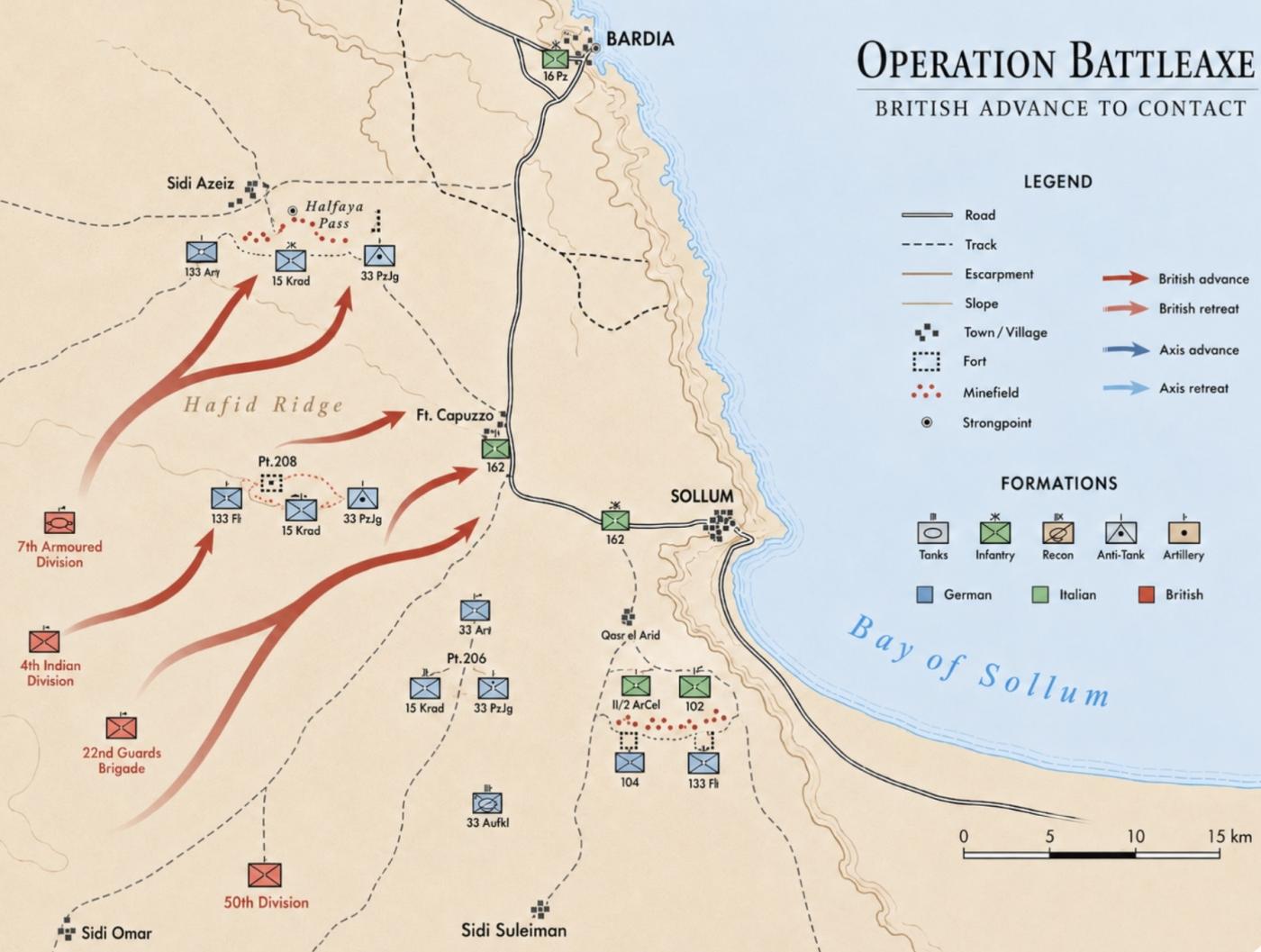
The British plan for Operation Battleaxe was ambitious. The attack would be made in three main thrusts. One force would attack along the coast and seize Halfaya Pass. Another would capture the frontier positions around Sollum, Musaid and Fort Capuzzo. Farther inland, British cruiser tanks would move toward Hafid Ridge, where German armour was expected to appear. Once the frontier defences were broken and Axis armour defeated, the British would push on toward Tobruk and link up with the garrison. In theory, the operation could restore the situation in Cyrenaica and force Rommel into retreat. In practice, the plan depended on speed, coordination, accurate intelligence and the ability of British armour and infantry to overcome German anti-tank defences.
The British had received new tanks in the so-called “Tiger” convoy, which had brought badly needed armoured reinforcements through the Mediterranean. Among them were Matilda infantry tanks and Cruiser tanks, including the newer Crusader. The Matilda had earned a formidable reputation against the Italians because of its thick armour, and British crews had come to trust it. But the desert war was changing. German anti-tank tactics were far more sophisticated than those the British had faced during Operation Compass. The 88 mm gun, originally designed as an anti-aircraft weapon, could be used with devastating effect against tanks. Properly sited, camouflaged and protected, it could destroy even heavily armoured Matildas at ranges where British tank guns struggled to reply effectively. The British also suffered from weaknesses in communication, training and coordination. Many tanks lacked reliable radios, and the crews had not had long to train with their new machines before being sent into battle.
On the morning of 15 June 1941, Operation Battleaxe began. The attack on Halfaya Pass quickly turned into a disaster. British artillery support was delayed and disrupted by the conditions, including soft sand that hampered movement. The Matildas and infantry moved forward against positions that were much stronger than expected. Some tanks struck mines or were channelled into vulnerable routes. As they approached the pass, hidden German guns opened fire. The 88 mm guns, in particular, cut through the Matildas’ armour. What had once seemed almost invulnerable now burned or stood disabled in the desert. Infantry attacks by Indian and British units also failed to break through. Halfaya Pass remained in Axis hands, and from then on it earned the grim nickname “Hellfire Pass”.
Elsewhere on the first day, the British had more success but paid heavily for it. Fort Capuzzo was captured around midday, and German counterattacks there were beaten off. This gave the impression that the attack might still succeed. But on the inland flank, at Hafid Ridge, British cruiser tanks ran into another carefully prepared defensive position. German anti-tank guns were placed to exploit the ground, and the British tanks had difficulty dealing with them. One of the most serious weaknesses of British cruiser tanks at this stage was their limited ability to fire effective high-explosive shells against anti-tank gun crews. This meant that British tankers often had to close dangerously near to German guns in order to knock them out. The result was a costly struggle in which the British gained some ground but lost many tanks.
Rommel, meanwhile, reacted with speed and confidence. He was not merely defending passively. He saw the British attack as an opportunity to damage their armoured forces and perhaps envelop them. German signals intelligence also helped him. British wireless discipline was poor, and German intercept units were often able to pick up useful information. Rommel had already expected another British attempt after Operation Brevity, and his frontier defences were prepared with that in mind. His method was to let the British strike the defended positions, absorb their attack, and then use mobile armoured forces to counterattack the flanks and rear.
On 16 June, the battle became confused. The British still held Fort Capuzzo, but Halfaya had not fallen, and the armoured formations were being worn down. Rommel ordered attacks around Capuzzo and manoeuvres by German mobile forces to threaten the British flank. The British repulsed some German attacks and inflicted tank losses, but the pressure disrupted their plans. Command and control problems became increasingly serious. Lieutenant-General Noel Beresford-Peirse, commanding the Western Desert Force, was too far back from the battle to keep a firm grip on events. Reports were delayed or unclear. Subordinate commanders were forced to make major decisions with incomplete information. The desert itself added to the problem: dust, distance, heat and scattered columns made it difficult to know exactly where friendly and enemy forces were.
One of the most interesting features of Battleaxe was the contrast between British and German methods. The British often thought in terms of tanks charging forward to seize objectives, supported by infantry and artillery where possible. The Germans were more inclined to combine tanks with anti-tank guns, artillery and mobile reserves. They would use tanks to lure or pressure the enemy, but they also relied heavily on hidden guns to destroy British armour. In the desert, where there were few buildings or forests, this might seem difficult, but the ground was not as flat and empty as it appeared. Ridges, folds in the sand, escarpments and patches of broken terrain could hide guns until the last moment. The British repeatedly discovered that what looked like open desert could suddenly become a deadly trap.
By 17 June, the British position was becoming dangerous. The 7th Armoured Brigade had been badly reduced, and other tank units were also short of runners. Rommel attempted to bring his armoured forces together and drive toward Halfaya Pass, threatening to cut off the British troops still forward around Capuzzo and the frontier. If the British failed to withdraw in time, a large part of the attacking force might be trapped. In one of the ironies of the battle, the Matilda tanks, which had been so badly punished at Halfaya, performed better when German tanks attacked without full anti-tank gun support. German Panzer IIIs had difficulty penetrating Matilda armour in direct tank fighting. Even so, the British could not reverse the battle. Their offensive had lost momentum, their armour had been badly weakened, and the risk of encirclement was growing.
The British withdrew before Rommel could complete the trap. This avoided an even greater disaster, but it meant that Operation Battleaxe had failed. Tobruk remained under siege. Halfaya Pass remained in Axis hands. The frontier defences had not been broken. The British had suffered serious tank losses, and many of the newly arrived tanks had been knocked out, broken down or abandoned. The operation had lasted only three days, but it revealed major weaknesses in British desert warfare: poor coordination between tanks, infantry, artillery and air support; inadequate communication; weak tactical handling of armour; and a dangerous underestimation of German defensive skill.
The failure had consequences at the highest level. Churchill was deeply disappointed. He had pushed for an offensive and expected more from the newly arrived tanks. Wavell, who had been cautious about launching the attack before his forces were fully ready, was removed from his Middle East command and sent to India. General Claude Auchinleck replaced him. This change of command reflected the political pressure surrounding the desert war. North Africa was not a sideshow for Britain; it was one of the few places where British forces were fighting the German Army on land in 1941. Success or failure there had enormous importance for morale, strategy and prestige.
For Rommel, Battleaxe was a significant defensive victory. It strengthened his reputation and confirmed that the Afrika Korps could beat British armour not only by manoeuvre but also by prepared defence. The battle also helped establish the deadly reputation of the 88 mm gun in the desert. British tank crews came to fear it, and with reason. At Halfaya and Hafid Ridge, the “eighty-eight” showed that thick armour alone was not enough. Tanks needed artillery support, infantry cooperation, reconnaissance and the ability to suppress enemy gun positions. Without those, even a heavily armoured vehicle could become a target moving toward an unseen gun.
Operation Battleaxe is sometimes overshadowed by later desert battles, but it deserves close attention because it was a hard lesson in modern armoured warfare. The British entered the battle with courage, determination and some excellent equipment, but they faced an enemy who had prepared the ground, concealed his weapons and understood how to combine defence with counterattack. The British soldiers and tank crews fought bravely, and in several places they achieved local successes, especially around Fort Capuzzo. But bravery could not compensate for flawed planning, poor communications and insufficient combined-arms coordination.
The battle also showed how quickly reputation could change in war. The Matilda tank had been called the “Queen of the Desert” after its success against the Italians, but at Halfaya it met weapons that could destroy it. German armoured warfare had been associated with rapid attack, but at Battleaxe the Germans showed the value of patient defence. The British expected the relief of Tobruk to follow from one strong blow, but instead learned that Rommel’s frontier line could not be broken by tanks alone. These lessons would influence later British preparations. When Operation Crusader was launched in November 1941, the British again tried to relieve Tobruk, this time with a larger force and after more preparation. Crusader would eventually succeed where Battleaxe had failed, but the cost of learning had been high.
In the end, Operation Battleaxe was a defeat, but it was not meaningless. It exposed the realities of fighting the German Army in North Africa. It showed that the desert battlefield rewarded flexibility, concealment, intelligence and coordination as much as speed and courage. It marked the moment when British forces first directly attacked a strong German defensive position and discovered how formidable such a position could be. The battle lasted only from 15 to 17 June 1941, yet its lessons echoed through the rest of the desert war. Halfaya Pass, Fort Capuzzo and Hafid Ridge became names associated not with sweeping victory, but with a painful education in the kind of warfare Britain would have to master before it could defeat Rommel in the desert.