Tellermine
The German Tellermine was one of the most recognisable anti-tank mines of the Second World War. Its name came from the German word Teller, meaning plate or dish, because it was broad, round and fairly flat, almost like a metal plate. Allied soldiers often called it the Teller mine or simply the T-mine. It was not just one weapon, but a family of anti-tank mines, the best-known versions being the 35, 42 and 43 models.
The idea behind it was simple but very effective. The mine was placed on or just beneath the surface of the ground where tanks, lorries, half-tracks or other vehicles were expected to pass. When enough weight pressed down on the top, it exploded beneath the vehicle. Its purpose was usually to disable rather than completely destroy a tank. An explosion under a track could break or throw the track, damage the wheels and suspension, rupture the lower hull, injure the crew and leave the vehicle helpless in the middle of a battlefield. Once stopped, it became an easy target for anti-tank guns, artillery, mortars or infantry.
This weapon was not the invention of one famous named designer in the way that some rifles, aircraft or tanks are linked to a particular man. It was a product of the German military ordnance system, developed by army engineers as part of Germany’s interwar and wartime programme of engineer weapons. An earlier model, the 29, had already appeared before the war, and the more famous 35 version was developed from the same general idea. The number in the designation usually referred to the year the model was introduced, so the 35 was associated with 1935, the 42 with 1942 and the 43 with 1943.
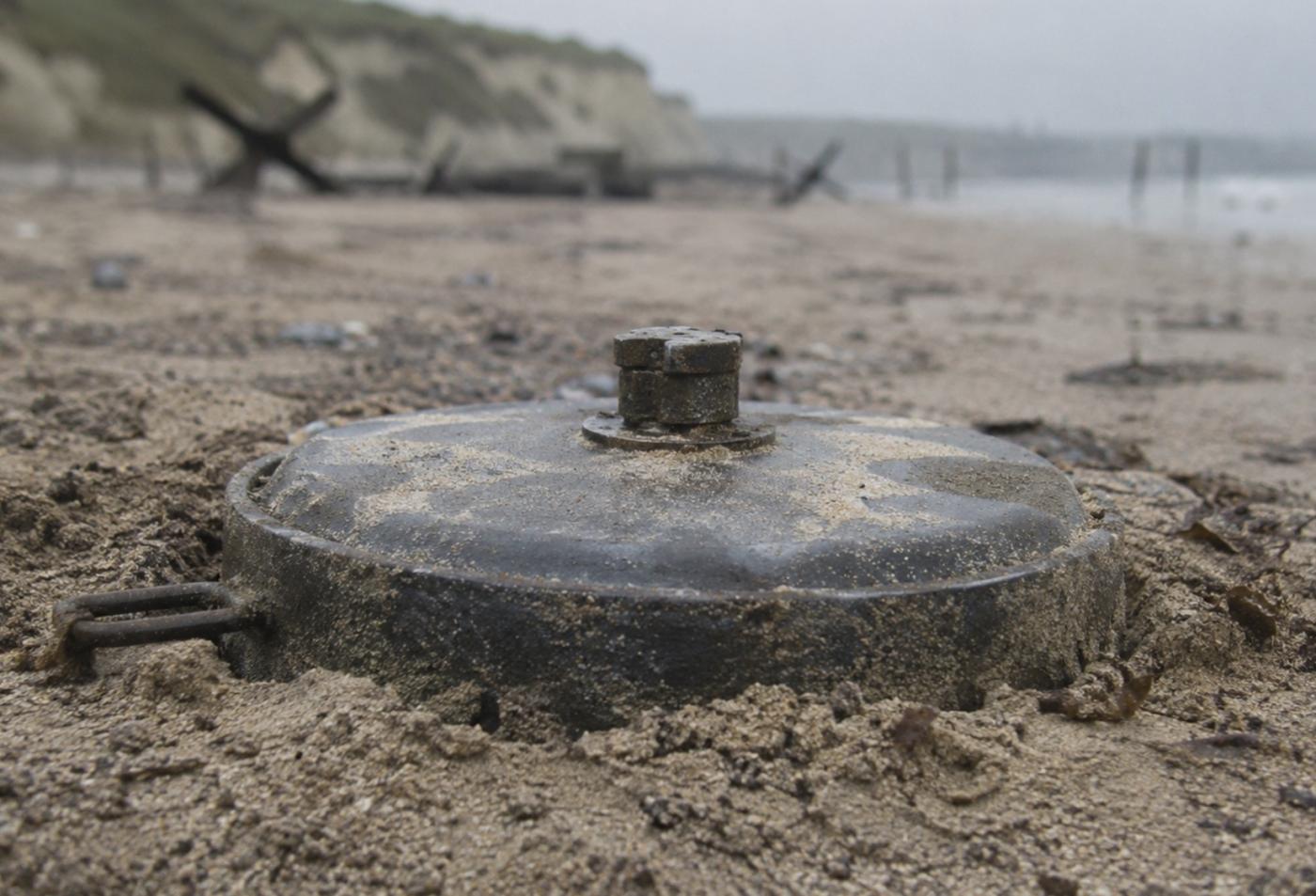
The 1935 model became the classic version. It was a round steel-cased mine, about twelve and a half inches across, a little over three inches high and weighing about twenty pounds. More than half of that weight was explosive, usually TNT. It had a central pressure plate on top and a carrying handle on the side. That handle may seem like a small detail, but it mattered. Mines were not usually laid one at a time in a casual way; they were moved in quantity, carried by engineers and placed in belts, roadblocks, defensive zones and beach obstacles. A simple handle made a heavy metal mine easier to move and position quickly.
The basic construction was rugged and practical. The body was metal and the shape allowed it to sit low in the ground. Once covered with earth, sand, grass, snow or debris, it could be very difficult to see. The pressure plate was intended to respond to the heavy load of a vehicle rather than an ordinary footstep, although any unexploded mine is dangerous and unpredictable. It was a battlefield weapon designed for weight, shock, concealment and reliability.
One of its most feared features was that anti-handling devices could be fitted. These were intended to make the mine dangerous to lift, move or disarm. German engineers could fit additional fuzes into side or bottom positions so that it might explode if disturbed. This turned mine clearance into a slow and nerve-racking job. For Allied sappers and engineers, the danger was not only the main charge but the possibility that it had been booby-trapped. Something that looked simple on the surface could be deadly if handled carelessly.
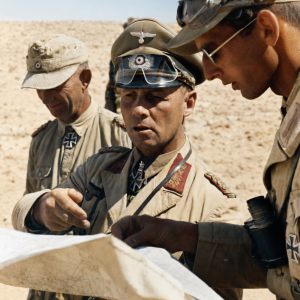
The mine was used in nearly every theatre where German forces fought. It appeared in Poland, France, North Africa, Russia, Italy, Normandy and in the final defence of Germany. In the desert it was particularly effective because the ground often channelled vehicles along tracks and open approaches. A special desert form, sometimes called the 35 S, was produced with a ribbed upper surface that helped it remain concealed in sand. In North Africa, both sides became extremely experienced in mine warfare, and German minefields were a major hazard for British and Commonwealth armour.
It was also heavily used on the Eastern Front, where vast defensive positions were built to slow Soviet tank attacks. German doctrine made wide use of minefields, not as isolated traps but as part of a complete defensive system. Mines were laid to block roads, protect flanks, channel tanks into killing zones or delay an advance long enough for artillery and anti-tank guns to be brought to bear. A minefield by itself was a danger, but a minefield covered by machine guns, mortars and anti-tank guns was far more serious.
In Normandy, these weapons were part of the German Atlantic Wall defences. They were buried behind beaches, laid in approaches and sometimes attached to obstacles intended to damage landing craft and vehicles. On some beaches they were fixed to stakes or placed among anti-landing obstacles so that the rising tide or an incoming craft could trigger them. The Germans also developed protective containers and waterproof arrangements for mines used in wet sand, tidal areas or underwater positions. This made them useful not only for roads and fields but also for coastal defence.
As the war continued, Germany introduced simplified versions. The 42 model followed the 35 but used a modified design. It still kept the round metal body and anti-tank purpose, but changes were made to the pressure plate and construction. One reason for the change was to reduce accidental detonation from nearby blast. A smaller pressure plate helped make the mine less likely to be set off by shock or explosion nearby and more likely to function when actually pressed by a vehicle.
The 43 model was an even more simplified wartime version. By 1943 Germany was under increasing pressure from Allied bombing, shortages of raw materials and the demands of fighting on several fronts. Weapons had to be cheaper, quicker and easier to produce. This later version reflected that need. It was still an effective anti-tank mine, but it was designed with simplified manufacturing in mind. Millions were produced, making it one of the most common German anti-tank mines of the later war.
Manufacture was not centred on one famous factory. German wartime production was spread across a network of state arsenals, private factories, subcontractors and coded manufacturers. The metal cases, explosive fillings, fuzes and other components could be made or assembled by different firms. Many German weapons and ammunition items carried codes rather than full company names, partly for security and partly because of the way the ordnance system was organised. For that reason, this mine family is best understood as a standard German military design produced by the wider armaments industry rather than as the work of one named company.
The fuzes changed over time. The 35 model commonly used the T.Mi.Z.35 fuze, while later versions could use later igniters such as the T.Mi.Z.42. The fuze was the mechanism that responded to pressure and initiated the explosive charge. In simple terms, when sufficient force came down on the pressure plate, the fuze functioned and set off the main filling. These details made the weapon effective, but they also made it extremely dangerous after battle. Many wartime mines remained live long after they were laid, and unexploded German examples continued to be found for decades.
The explosive charge was large enough to cause severe damage. Against a tank, the mine did not need to pierce the thick frontal armour like a gun. Instead, it struck from below, where armour was usually thinner and where tracks, wheels, suspension and belly plates were vulnerable. A tank that hit one might survive as a fighting compartment, but if its track was blown off it was immobilised. Recovery under fire was difficult and dangerous. Sometimes the crew had to abandon the vehicle. Against lighter vehicles, such as trucks, armoured cars or half-tracks, the damage could be devastating.
The psychological effect was also important. A minefield slows everything down. Drivers become cautious. Infantry have to wait while engineers clear lanes. Tanks are forced into predictable paths. Commanders lose time. A road that might have taken minutes to cross can become a serious obstacle. Even when no vehicle is destroyed, the mere suspicion of mines can delay an attack and create confusion. This was one of the main purposes of German mine warfare: not just to destroy, but to control movement.
German engineers were skilled in laying mines in patterns that made tactical sense. They could be arranged in belts, scattered around road junctions, placed in likely tank approaches, buried in verges or hidden among rubble. They were often mixed with anti-personnel mines so that infantry and engineers trying to clear the anti-tank weapons were themselves at risk. This round mine therefore formed part of a wider German system that included the S-mine, the Schu-mine, the Riegelmine and many other devices.
The S-mine, often called the “Bouncing Betty” by Allied troops, was intended against personnel. The Schu-mine was a small wooden anti-personnel mine that was difficult to detect with mine detectors. The Riegelmine was a long rectangular anti-tank mine. The Topfmine was a later German low-metal device made to be harder to find. Among all these weapons, the Teller type stood out because it was simple, strong, powerful and produced in very large numbers.
Its appearance could vary. Some were painted in field grey, dark yellow, green or other colours depending on period, factory and theatre. Mines might be repainted, camouflaged or covered with mud and sand. Some carried stencilled markings, inspection stamps or coded factory marks. Surviving examples in museums and collections often differ because they may have been repainted, restored or assembled from parts. This can make exact identification difficult unless the markings and construction details are carefully examined.
Captured examples were studied closely by the Allies. British, American and Commonwealth forces produced manuals and training aids showing how to identify and deal with German mines. Soldiers were taught to recognise the shape, size and danger signs, but they were also warned that a visible mine might be only part of the problem. The real danger could be beneath it, beside it or connected to it. Mine clearance became one of the most dangerous jobs carried out by combat engineers.
The Germans also used them creatively. They were not always buried in the normal way. They could be attached to obstacles, placed inside buildings, used in road demolitions, hidden in rubble or adapted for field traps. Their round shape, heavy explosive charge and strong case made them useful for more than simple anti-tank minefields. However, their main role remained the same: to stop vehicles and force the enemy to slow down.
This was not a glamorous weapon. It had no engine, no crew, no moving parts like a tank or aircraft, and no dramatic appearance when sitting in a storage crate. Yet it had enormous influence on the battlefield. A minefield could change the direction of an attack. It could protect a weak defensive position. It could turn a road into a trap and a field into a barrier. It could halt a tank column without a single German soldier being visible.
After the war, the design remained significant because so many had been produced and laid. Mine clearance continued in former battle areas, and unexploded German mines were still being discovered years later. The basic idea of the round anti-tank blast mine also influenced post-war designs in several countries. Some nations copied, adapted or studied German wartime examples, especially the simplified 43 model. The weapon had proved that a relatively cheap and simple object could have an effect out of all proportion to its cost.
It is therefore best understood as a practical German engineer weapon rather than as the invention of one celebrated designer. It was developed by military engineers, manufactured across the armaments system and refined through wartime experience. The 35 was the classic early model, the 42 an improved wartime version, and the 43 a simplified mass-production type. Together they became some of the most important anti-tank mines of the Second World War.
Its success came from a combination of simplicity, power and tactical usefulness. It was easy to understand, relatively easy to produce, dangerous to vehicles, and adaptable to many different environments. It could be buried in a Russian field, hidden in desert sand, placed beside an Italian road or fixed among beach obstacles in Normandy. It did not need to move or aim. It simply waited. That silent patience was what made the German Teller mine such a feared weapon.