Rommels Tactics
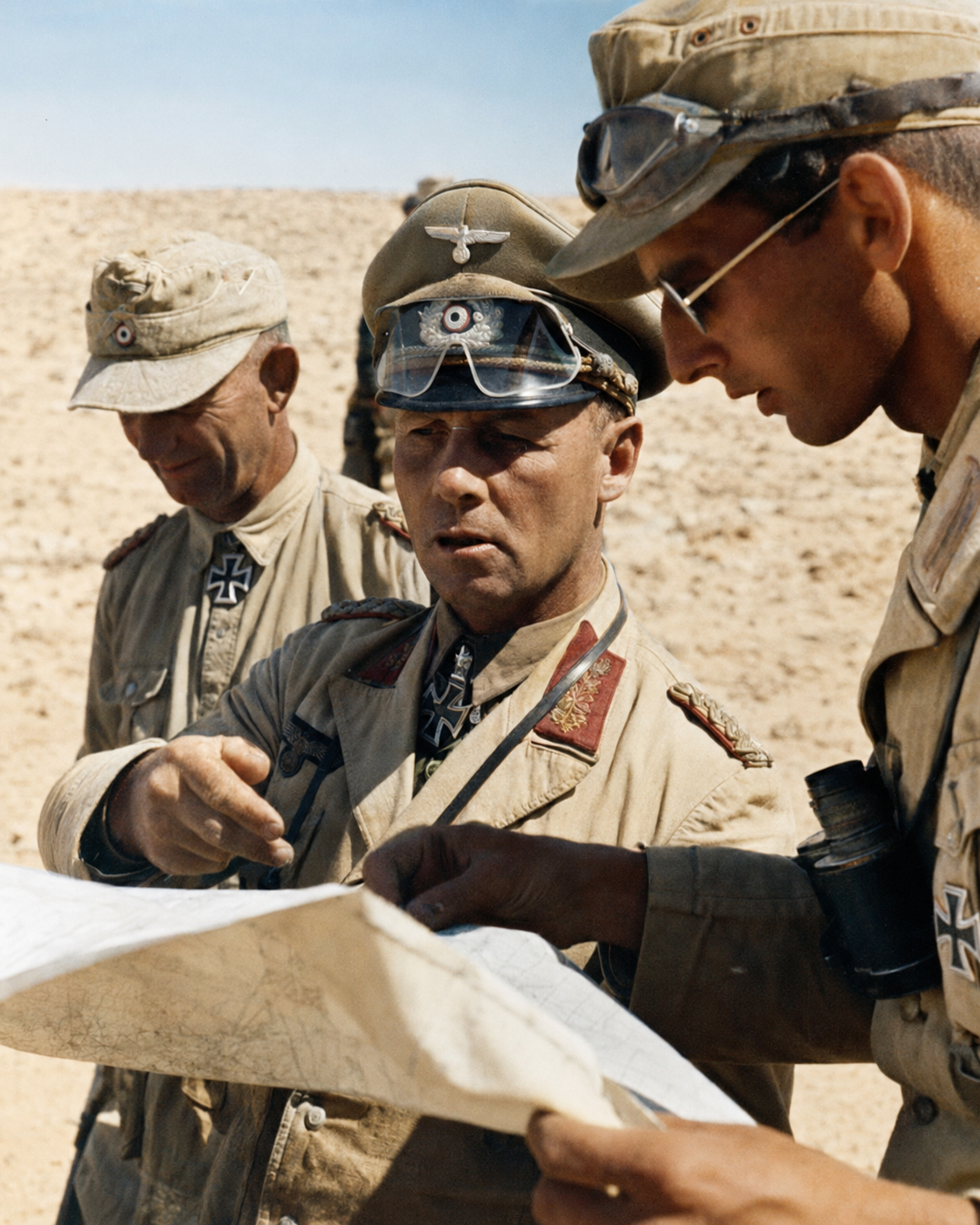
Erwin Rommel became one of the most famous battlefield commanders of the Second World War not simply because of the forces he commanded, but because of the way he tried to deceive, confuse and unsettle his opponents. His reputation as the “Desert Fox” was built largely in North Africa, where he repeatedly used speed, surprise, bluff and deception to make British and Commonwealth commanders believe his Afrika Korps was stronger, closer or moving in a different direction from where it actually was. Some stories about his tricks were later exaggerated by wartime propaganda and memoirs, but there is no doubt that Rommel placed enormous value on misleading the enemy and creating the impression that he held the initiative even when his resources were limited.
The North African desert was particularly suited to deception. Unlike the battlefields of northern Europe, there were few towns, forests or major landmarks to hide troops behind. Vehicles could often be seen or detected from great distances, while the enormous clouds of dust raised by moving columns could reveal the location of an advancing force. Rommel realised that this weakness could also be turned into a weapon. Dust did not necessarily have to reveal the truth. Properly manipulated, it could be used to create an entirely false picture of what his forces were doing.
One of the best-known methods associated with the Afrika Korps was deliberately raising huge clouds of dust to suggest that large armoured formations were moving through an area. Vehicles could drag branches, brushwood, pieces of timber or other material behind them so that the desert surface was disturbed far more heavily than normal. Trucks and cars could also be driven rapidly across dry ground simply to produce dust. Seen from a distance, particularly by enemy reconnaissance aircraft or observation posts, such clouds could give the impression that tanks and major columns were approaching.
There are also accounts of wooden boards or panels being fitted or dragged behind vehicles to throw additional sand and dust into the air. The principle was simple: a comparatively small number of vehicles could produce the visible signature of a much larger formation. In a battlefield where commanders were constantly trying to estimate enemy strength through distant observation, aerial reconnaissance and reports from forward units, even temporary uncertainty could be extremely valuable.
Another trick frequently associated with desert warfare was making vehicle columns appear larger than they actually were. Vehicles could be moved along routes where they were likely to be observed, disappear behind cover or terrain, then circle around and pass the same observation area again. To someone watching from a distance, particularly if individual vehicles could not be identified, the repeated movement could appear to be a continuous stream of reinforcements. The same relatively small group of trucks might therefore give the impression that a much larger force was arriving.
Rommel understood that perception could sometimes matter almost as much as actual numbers. If an opponent believed that another German armoured division was arriving, he might delay an attack, withdraw from a position or divert forces to meet a threat that did not really exist. Rommel repeatedly tried to create this hesitation because he preferred fighting an enemy who was reacting to him rather than one carrying out a carefully prepared plan.
Dummy vehicles were another important part of deception in North Africa. False tanks could be constructed from timber, canvas and other available materials and placed where enemy reconnaissance aircraft might see them. Trucks could sometimes be disguised to resemble tanks from the air. At other times genuine tanks could be concealed or made to appear like ordinary transport vehicles. This confused estimates of how many operational tanks were available and where the main striking force was concentrated.
The Germans were certainly not alone in using these techniques. British forces became extremely sophisticated at desert deception and later conducted major deception schemes of their own. However, Rommel had a particular talent for combining deception with sudden movement. His tricks were rarely intended simply to fool an observer. They were usually connected to a rapid change in direction, a flank attack or a concentrated armoured thrust.
One of his favourite methods was to threaten one part of the enemy position while preparing his real attack somewhere else. Reconnaissance vehicles, artillery activity and visible vehicle movements could suggest an attack against the front while tanks were quietly being assembled for a wide movement around a flank. Once the opponent began moving reserves towards the apparent danger, the real attack could suddenly appear elsewhere.
Rommel had developed his taste for surprise long before North Africa. During the First World War he served as an infantry officer and became known for aggressive infiltration tactics. Rather than attacking strong positions directly, he preferred finding weak points, slipping around defensive positions and striking headquarters, artillery batteries or supply areas from unexpected directions. His experiences were later described in his book Infantry Attacks and heavily influenced the way he commanded mechanised forces.
During the 1940 campaign in France, commanding the 7th Panzer Division, Rommel showed the same instinct. His division advanced so quickly and changed direction so frequently that both the enemy and sometimes German headquarters struggled to determine exactly where it was. The unit became known as the “Ghost Division” because of the speed of its movements and the difficulty of tracking it. Rommel often pushed reconnaissance units aggressively forward, accepting the risk of temporary confusion in return for keeping the enemy off balance.
In North Africa he took this idea even further. His forces were often numerically weaker and suffered serious shortages of fuel, replacement tanks, ammunition and transport. Rommel therefore tried to create temporary superiority at the decisive point rather than spreading his forces evenly. He might leave only a thin screen of troops in one area while secretly concentrating tanks elsewhere. Once the armour was assembled, he would strike hard before the enemy could react.
He was particularly skilled at using the desert’s open spaces to manoeuvre around defensive positions. Rather than wasting time attacking every fortified point head-on, German and Italian mobile forces could bypass them and strike their rear. This created panic because troops suddenly found enemy tanks behind their defensive line threatening supply routes and headquarters.
Rommel also understood the psychological effect of armour. Tanks did not always have to destroy an enemy formation to defeat it. Their unexpected appearance on a flank or in the rear could persuade troops that they were surrounded. In several desert battles, British units withdrew because they feared encirclement, sometimes abandoning equipment and positions before the Germans had physically cut every escape route.
One of his most effective ideas was keeping his armoured forces moving. Rommel believed that a stationary tank formation surrendered much of its advantage. He therefore tried to maintain momentum, even when his forces were tired or stretched. Rapid movement made it more difficult for enemy commanders to build an accurate picture of his intentions. Information received by headquarters could already be outdated by the time decisions were made.
He frequently used reconnaissance aggressively. Armoured cars, motorcycles and light vehicles were sent far ahead to locate enemy positions and discover gaps. Once a weakness was found, Rommel could quickly redirect his main force towards it. He personally visited forward positions far more often than many senior commanders, travelling around the battlefield to see conditions himself rather than relying entirely on written reports.
This habit sometimes placed him in considerable danger, but it gave him an unusually immediate understanding of the battlefield. He could see traffic movement, dust clouds, abandoned equipment and the direction in which enemy formations appeared to be moving. From these details he often made quick decisions before information reached higher headquarters.
Captured enemy vehicles could also be useful. German troops occasionally used captured British trucks, guns and tanks because replacement equipment was difficult to obtain. Such vehicles could also cause confusion from a distance, particularly in the chaotic conditions of a fast-moving desert battle. Identification was difficult through dust, heat haze and poor visibility, and commanders could not always be certain whether approaching vehicles were friendly or hostile until they were dangerously close.
Heat haze itself could work in Rommel’s favour. The shimmering desert air distorted shapes and distances. Tanks seen several miles away could be mistaken for trucks, while dust might hide the exact strength of a column. Experienced commanders learned to exploit these conditions, approaching from directions where the sun, haze and dust made observation difficult.
Rommel was also known for using captured intelligence quickly. Documents, maps, radio information and abandoned vehicles could reveal enemy formations and intentions. British radio communications in North Africa were sometimes insecure, and Axis intelligence benefited greatly from intercepted information. Rommel was eager to act on such intelligence before its value disappeared.
Another important element of his battlefield method was the use of anti-tank guns as an offensive weapon. British tank crews sometimes expected German armour to fight them directly. Rommel increasingly used his tanks to lure British armour towards concealed anti-tank positions, especially the formidable German 88 mm gun. German tanks might advance, make contact and then withdraw, encouraging British tanks to pursue. Once the pursuing armour entered the prepared killing ground, concealed guns opened fire at long range.
The 88 mm weapon had originally been designed primarily as an anti-aircraft gun, but its high velocity made it devastating against tanks. Rommel recognised its potential and integrated it into mobile defensive and offensive tactics. British tank units charging what appeared to be retreating German armour could suddenly find themselves under accurate fire from guns they had not previously seen.
This became one of the most feared tricks used by the Afrika Korps. It demonstrated an important part of Rommel’s thinking: what appeared to be a retreat might actually be bait. He understood that an aggressive opponent could sometimes be manipulated through his own desire to pursue.
False withdrawals were therefore another useful tactic. A unit might deliberately give ground, encouraging the enemy to leave prepared positions and follow. Once the enemy became stretched out or moved beyond supporting artillery, German tanks and anti-tank guns could counter-attack. The idea was not new, but Rommel used it effectively in a highly mobile environment.
He also tried to attack at times when the enemy was least prepared. Early morning, late afternoon and periods of reduced visibility could provide opportunities for movement. Night marches were sometimes used to reposition troops without revealing the scale of the movement through dust clouds. By dawn, formations could appear in places where the enemy had not expected them.
Rommel was particularly dangerous when he sensed hesitation. If reconnaissance suggested that an enemy commander was uncertain, he often increased the pressure rather than allowing him time to recover. Even limited attacks could be used to reinforce the impression that a much larger offensive was beginning. This sometimes caused opposing commanders to move reserves prematurely.
His command style relied heavily on initiative. Junior officers were expected to react quickly when opportunities appeared. The rapid pace of desert warfare meant that detailed orders could become useless within hours. Rommel preferred commanders who understood the overall objective and were prepared to act without waiting for constant instructions.
His reputation also became a weapon in itself. As British troops became increasingly familiar with the name Rommel, reports that he was personally commanding an attack could have a psychological effect. British commanders sometimes worried that every movement concealed another trick or unexpected flank attack. The legend of the Desert Fox therefore began to reinforce the very uncertainty that his tactics were designed to create.
Rommel also deliberately appeared stronger than he was. The Afrika Korps frequently operated with serious shortages, yet he tried to hide these weaknesses. Vehicles might be widely dispersed to suggest larger numbers. Radio traffic, dust and reconnaissance activity could all contribute to the illusion that substantial reserves were available.
Fuel shortages were among his greatest problems. His tanks and trucks consumed enormous quantities, and Axis supply routes across the Mediterranean were vulnerable. Rommel therefore understood that prolonged battles could be disastrous. His preferred solution was to achieve a rapid decision through manoeuvre before shortages became overwhelming.
At times this willingness to gamble produced spectacular successes. His advance across Cyrenaica in 1941 surprised British commanders who believed the Axis forces were not yet ready for a major offensive. Rommel attacked before many expected him to do so and drove the British back across hundreds of miles.
His capture of Tobruk in June 1942 was another high point. The fortress had resisted Axis forces the previous year, but Rommel concentrated his attack, combined artillery, engineers, aircraft and armour, and broke through the defences rapidly. Tens of thousands of Allied troops were captured, along with enormous quantities of supplies. Soon afterwards Hitler promoted him to field marshal.
Yet Rommel’s methods also had weaknesses. His determination to keep moving could stretch supply lines dangerously far. Fast advances sometimes left infantry, artillery and fuel columns struggling to catch up. He occasionally pushed operations beyond what Axis logistics could realistically support.
His reputation as an unbeatable tactical genius was also strengthened by wartime propaganda on both sides. German propaganda presented him as the ideal bold commander, while British newspapers often found it useful to portray him as an exceptional opponent. If British forces suffered setbacks, presenting the enemy commander as a military genius made those defeats easier to explain.
The reality was more complicated. Rommel made mistakes and could be overly impulsive, but his ability to read a battlefield rapidly was genuine. His greatest talent was probably not any single trick involving branches, wooden boards or repeated convoys. It was his ability to combine dozens of small deceptions with speed and aggressive manoeuvre until the enemy could no longer tell which threat was real.
A cloud of dust might suggest tanks. A group of trucks might repeatedly appear along the same route. Dummy vehicles might convince reconnaissance aircraft that armour was gathering for an attack. A German tank force might suddenly withdraw, tempting British tanks towards hidden 88 mm guns. Reconnaissance units could threaten one flank while the main force moved around the other. Each deception by itself was relatively simple. Together they could create a battlefield filled with uncertainty.
Rommel understood that commanders rarely possess perfect information. They make decisions from reports that may already be several hours old, observations made through dust or heat haze, intercepted radio signals and hurried estimates of enemy strength. If those pieces of information could be manipulated, the enemy commander could effectively be persuaded to make the wrong decision himself.
That was at the heart of the Desert Fox legend. Rommel constantly tried to make his opponents look in the wrong direction, overestimate his strength, expose their armour, move their reserves too early or believe that a retreat was genuine when it was actually a trap. His best victories came when speed and deception worked together.
Although many of the colourful stories surrounding him should be treated cautiously because desert warfare produced numerous legends on both sides, the broader picture is well established. Rommel valued surprise, movement, bluff, aggressive reconnaissance, concealed anti-tank guns, false threats and rapid concentration of force. He understood that sometimes the most effective weapon on the battlefield was not another tank or artillery piece, but uncertainty in the mind of the opposing commander.
It was this constant effort to remain one step ahead that helped make Erwin Rommel one of the most recognisable generals of the Second World War. His opponents could never be entirely certain whether the dust cloud on the horizon represented a major armoured force, a handful of vehicles creating a deliberate distraction, or the beginning of another sweeping movement around their flank. That uncertainty was exactly what Rommel wanted.