
Swedish S-Tank
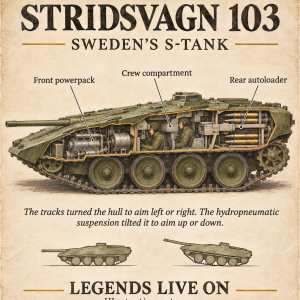
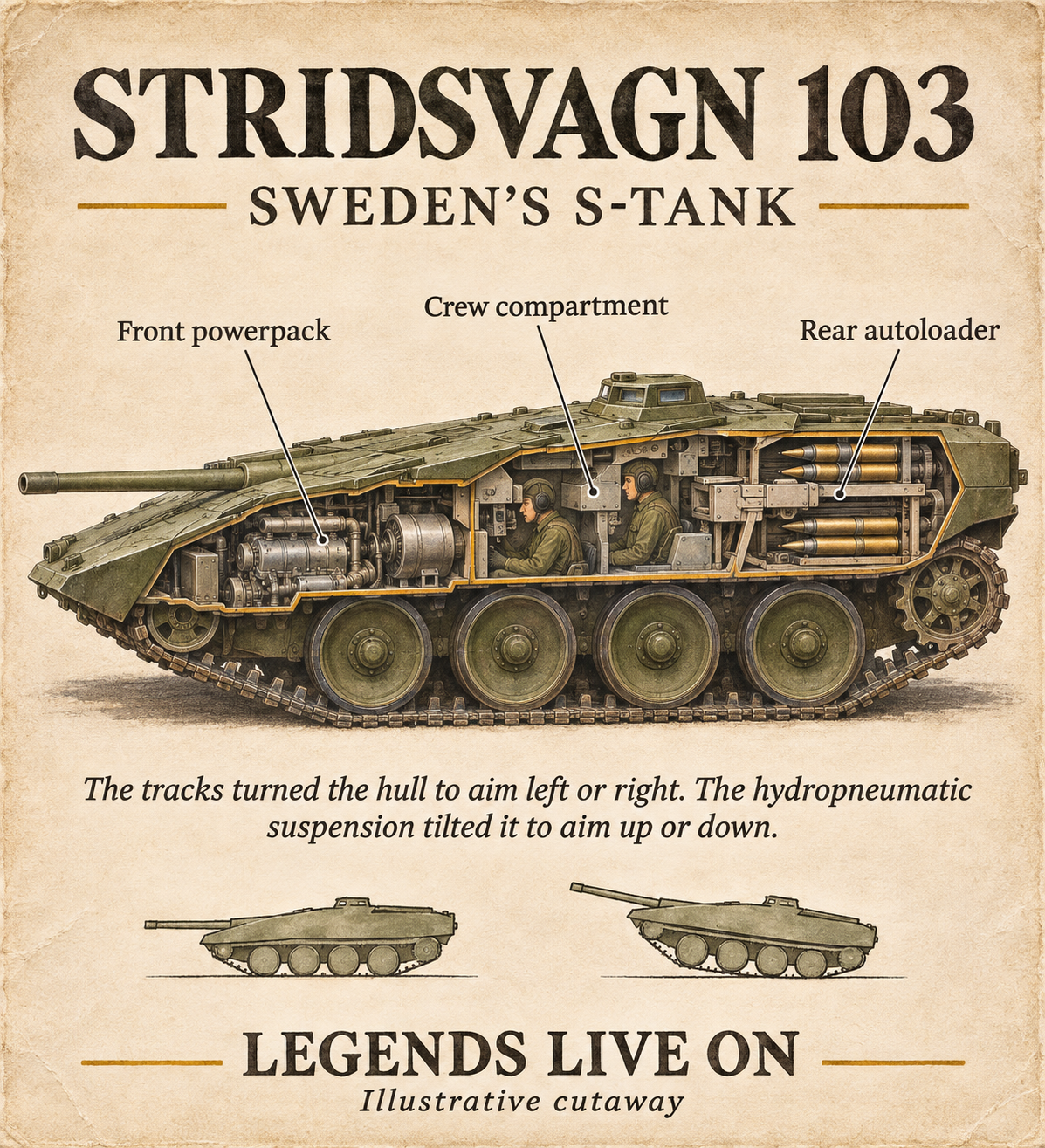
When a Swedish Stridsvagn 103 lined up a shot, the driver turned the entire tank towards the target, then raised or lowered the nose to aim. Its 105 mm gun was fixed directly into the hull. Doing away with the turret gave the S-Tank a low silhouette, so a shallow fold in the ground could hide most of the vehicle.
Swedish engineer Sven Berge proposed the design in 1956. Sweden considered an Anglo-American-style heavy tank and a lighter German-French-style vehicle before choosing to develop Berge’s domestic design in 1958. Bofors built the tank, the first production Strv 103As reached the Swedish Army in 1967, and Sweden took delivery of 290 S-Tanks.
The driver doubled as gunner. He steered the tracks to aim left or right and used the hydropneumatic suspension to tilt the hull up or down. The Bofors L74 was a lengthened, rifled version of Britain’s 105 mm L7. The rear autoloader fed it from a 50-round supply at up to 15 rounds a minute. Two fixed 7.62 mm machine guns and a third at the commander’s cupola provided secondary armament.
The crew consisted of a commander, a driver-gunner and a rear-facing radio operator with his own driving controls. If the tank needed to leave a firing position, the radio operator could drive straight back into cover while keeping the gun and sloped frontal armour facing the threat.
Two engines sat at the front. Early models paired a Rolls-Royce K60 diesel for ordinary driving with a gas turbine for extra power. The 103B gained a stronger turbine and a folding flotation screen. With the screen raised around the hull, the tracks propelled the tank through the water.
The 103C upgrade began in 1986 and brought a Detroit Diesel 6V-53T and revised turbine controls. The example at Sweden’s Arsenalen museum weighs 42.3 tonnes and had a top speed of 48 km/h, around 30 mph. Sweden also developed a removable grille across the front to protect against shaped-charge weapons and kept it secret until 1992.
The S-Tank attracted attention abroad. Norway compared it with the Leopard 1 in 1967. The Swedish tank did well in simulated engagements with the hatches closed, while the Leopard gained the advantage when the commanders opened their hatches. Norway went on to buy the Leopard 1.
Britain tested two S-Tanks at Bovington and other sites in 1968. In 1973, British crews trained in Sweden before taking ten Strv 103Bs to West Germany for exercises with the British Army of the Rhine. They operated alongside and against Chieftains around Soltau and north of Kassel, using Solartron equipment to register simulated hits. A Swedish account records that each S-Tank covered about 900 kilometres during the trials.
Two S-Tanks went to Fort Knox for American trials in 1975–76, firing 575 live rounds between training and testing. In one comparison, the S-Tank fired sooner than the American M60A1 AOS after a short halt against a stationary target, though it was somewhat less accurate in that particular test. A Swedish account of the wider trials reported good results at 2,000 metres, with slightly longer average times to fire across the exercises it described.
From a concealed position, the S-Tank could bring its gun onto a target and reverse back into cover. On the move, every bump carried the gun with it, and a damaged track could leave the crew unable to turn the gun onto a new target. As stabilised turret guns improved, accurate fire on the move became a stronger advantage. The S-Tank never saw combat, and Sweden eventually replaced it with Leopard 2 variants.