South Atlantic Medal
The South Atlantic Medal was instituted in 1982 following the Falklands War, a ten-week conflict fought between the United Kingdom and Argentina over the Falkland Islands, South Georgia and the South Sandwich Islands. The medal was created to recognise the service of British military personnel, merchant seafarers, and certain civilians who took part in Operation Corporate, the British campaign to retake the islands after the Argentine invasion in April 1982.
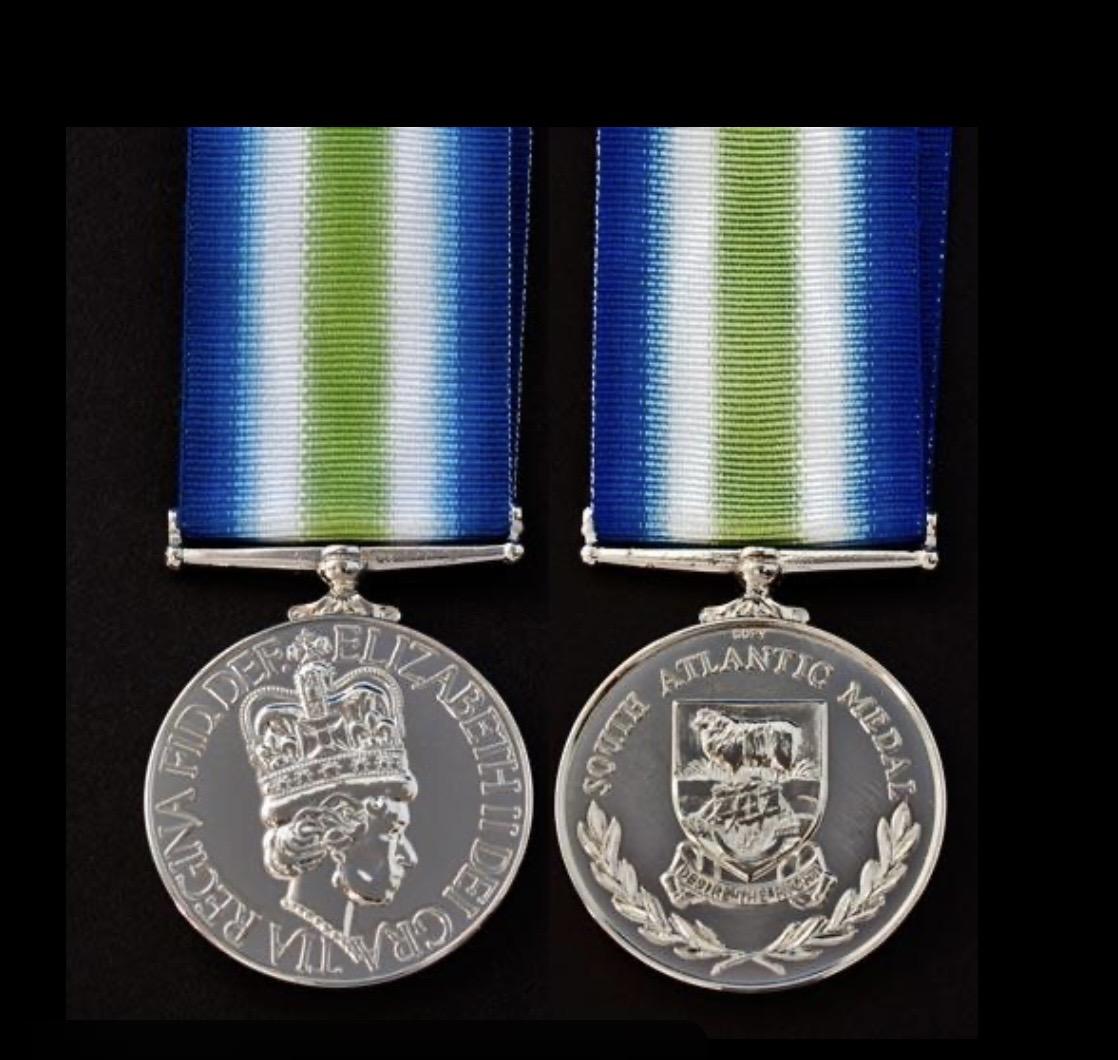
The medal was authorised by Queen Elizabeth II and designed in line with traditional British campaign medal conventions. The obverse bears the crowned effigy of the Queen, designed by Arnold Machin, whose portrait had already appeared on British coinage since the late 1960s. The reverse design features a symbolic representation of the South Atlantic theatre, including the Falkland Islands and surrounding waters, along with maritime imagery that reflects the naval and amphibious nature of the campaign. The design work was overseen by the Advisory Committee on the Grant of Honours, Decorations and Medals, which ensures consistency and historical continuity across British honours.
The medal was struck by the Royal Mint, the official producer of British coinage and many state honours. As with other campaign medals, it was manufactured primarily in cupro-nickel, a durable alloy suitable for long-term preservation. The ribbon is distinctive, featuring a central white stripe flanked by blue and green, representing the cold seas and remote islands of the South Atlantic region.
A key feature of the South Atlantic Medal is the presence or absence of the “Rosette” or clasp, which distinguishes levels of service. Those who served in the designated combat zone, defined as the area south of latitude 35° South, were awarded the medal with a rosette (often referred to as a clasp), indicating direct participation in operations. Personnel who supported the campaign outside this zone, such as those in logistical or support roles, received the medal without the rosette. This distinction has been historically significant and, at times, controversial among veterans, particularly regarding recognition of those whose service was considered peripheral but still essential.
In total, approximately 33,000 South Atlantic Medals were awarded. Of these, around 30,000 were issued without the rosette, while roughly 3,000 were awarded with the rosette denoting service in the operational area. Recipients included members of the British Armed Forces, the Merchant Navy, the Royal Fleet Auxiliary, and certain civilians such as journalists and government personnel who were present in the theatre of operations.
An interesting aspect of the medal’s history is the debate over eligibility, which has continued for decades. Some veterans who served just outside the qualifying zone or time frame have campaigned for recognition, arguing that the strict criteria excluded individuals who faced similar risks. The issue has been reviewed multiple times by the UK government, reflecting the enduring sensitivity surrounding military honours and the importance placed on equitable recognition.
The South Atlantic Medal also holds a strong place in British military heritage as one of the last campaign medals of the Cold War era. Unlike many earlier conflicts, the Falklands War was fought in a highly visible media environment, and the medal became a powerful symbol of national resolve and the sacrifices made during the campaign. It is often displayed alongside other service medals and is highly valued by collectors and historians, not only for its design but for its direct association with a brief yet intense modern conflict.