
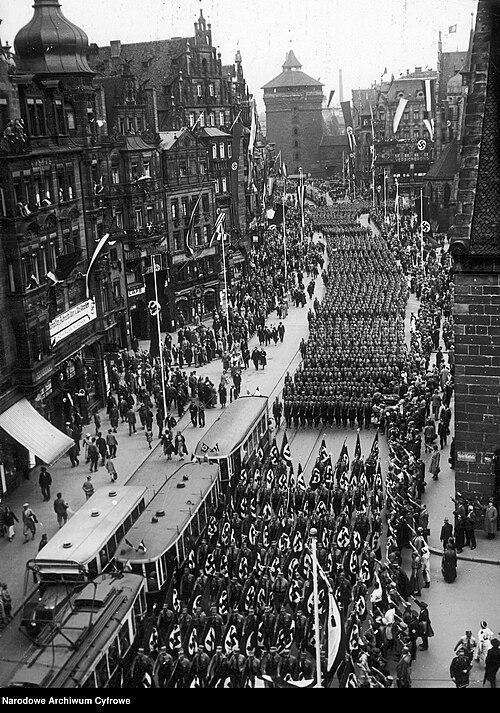
Nationalist and Fascist Paramilitary Movements in Europe, 1918–1945
Germany’s defeat in November 1918 brought an end to the German Empire and left the country in a period of political unrest. Kaiser Wilhelm II lost his throne, and the Social Democrat Friedrich Ebert took charge of a provisional government. In 1919, an elected assembly met in Weimar to write a new republican constitution. However, the new democracy faced opposition from the beginning. Germany’s military leaders had requested an armistice because they recognised that the army could no longer sustain the war, but some later spread the Dolchstoßlegende, or stab-in-the-back myth. This was the false claim that the German army had not really been defeated on the battlefield, but had instead been betrayed by civilians at home. Nationalists who opposed the republic used this story to blame socialists, Jews and democratic politicians for Germany’s defeat and to undermine the new republic.
At the same time, the government struggled to maintain order. As the imperial army was demobilised, Ebert had few reliable troops available to deal with armed uprisings. He therefore turned to the Freikorps, volunteer military units formed by officers and made up mainly of former soldiers. Many of these groups received support from the regular army. Some men joined because they needed work or missed the comradeship of military life, while others were strongly opposed to socialism and revolution. Many also followed commanders who had little trust in parliamentary democracy. Although the Freikorps helped the government fight revolutionary movements, their political loyalties were often very different from those of the republic they were defending.
The government’s dependence on these armed groups soon created further problems. Under the Treaty of Versailles, Germany had to reduce its military forces, which meant that many Freikorps units were ordered to disband. Not all of them accepted this decision. In March 1920, Hermann Ehrhardt’s naval brigade refused to disband and occupied Berlin’s government quarter in support of Wolfgang Kapp’s attempt to overthrow the republic. The regular army leadership refused to intervene against the rebels. Nevertheless, the attempted coup collapsed within days after a general strike brought much of the country to a standstill and civil servants refused to cooperate with Kapp’s government. The failure of the coup did not bring an end to the Freikorps movement. Some former members joined the regular army or veterans’ organisations, while others became involved in secret groups such as Organisation Consul, which murdered republican politicians. Some former Freikorps formations were mobilised again in 1921 to fight Polish insurgents in Upper Silesia.
Political violence also became an important part of post-war politics in Italy, although the situation there developed differently. Italy had fought on the winning side of the First World War, but many nationalists believed that the peace settlement had failed to give the country the territory it deserved. At the same time, strikes, protests and factory occupations caused growing fear of a socialist revolution, especially among employers and landowners. Benito Mussolini used these tensions to build support for the Fascist movement, which he founded in 1919. From late 1920 onwards, Fascist action squads spread rapidly through agricultural regions such as the Po Valley. Landowners often supported these groups because they attacked socialist organisations and farm workers’ movements. Their members, known as squadristi, frequently wore black shirts and organised violent expeditions against political opponents. They assaulted and sometimes killed political opponents, destroyed trade union buildings and attacked socialist newspaper offices.
Over time, these squads became one of Mussolini’s most important political tools. Their violence weakened opposing organisations, while their presence in the streets helped the Fascists put pressure on the government. The squads became especially important in October 1922, when the Fascists organised the March on Rome. During the mobilisation, squads occupied public buildings in several Italian cities. King Victor Emmanuel III refused to approve a state of siege against the Fascists and instead appointed Mussolini prime minister. Once in power, Mussolini began to bring the different squads under more direct state control. A royal decree of 14 January 1923 established the Milizia Volontaria per la Sicurezza Nazionale (MVSN), commonly known as the Blackshirts; the measure took effect on 1 February. The organisation brought many Fascist squads together under Mussolini’s authority, although some local leaders continued to control their own groups. Its territorial legions supported the police and regular army in maintaining public order and enforcing Fascist rule. Under a decree of 4 August 1924, the militia was formally incorporated into the state’s armed forces. In this way, the violence that had helped the Fascists gain power was given a formal place within the state.
Mussolini’s success attracted attention beyond Italy, particularly in Germany. Adolf Hitler saw the March on Rome as an example of how a radical political movement might seize power. His National Socialist German Workers’ Party, better known as the Nazi Party, already had its own paramilitary organisation. Originally formed to protect party meetings, it took the name Sturmabteilung (SA) in 1921. Some of its early members had previously served in Freikorps Oberland, while Ernst Röhm, who had served as a staff officer in the Freikorps, helped the organisation through his connections with the army and nationalist militias. Inspired partly by events in Italy, Hitler attempted to take power in Munich during the Beer Hall Putsch of November 1923. The SA participated in the failed coup, after which the authorities banned the organisation. When Hitler began rebuilding the Nazi Party in 1925, the SA was re-established.
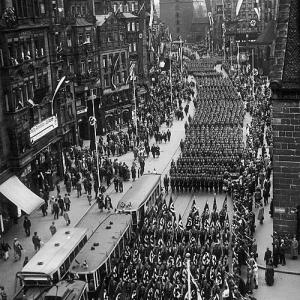
After the failure of the putsch, Hitler increasingly focused on gaining political power through elections. The SA played an important role in this new approach, although violence remained central to its activities. Its members, who became known as brownshirts, protected Nazi speakers, disrupted rival political meetings and fought communists and socialists in the streets. Large marches and public demonstrations also helped spread Nazi propaganda while intimidating opponents in their own neighbourhoods. The Great Depression created further opportunities for recruitment, as many unemployed men joined the organisation. SA membership eventually grew into the hundreds of thousands. In 1931, Röhm became chief of staff and reorganised the force under regional commanders. Despite these efforts, discipline remained a problem. In Berlin, for example, SA members rebelled against Nazi leaders whom they considered too cautious. The organisation had become a powerful part of the Nazi movement, but its growing size also made it increasingly difficult to control.
By this time, the use of political militias had also influenced movements elsewhere in Europe. In the Netherlands, Anton Mussert co-founded the Nationaal-Socialistische Beweging (NSB) in 1931. The party initially took much of its political programme from Italian Fascism, and its paramilitary organisation showed influences from both the Italian Blackshirts and the German SA. This organisation, the Weerbaarheidsafdeling (WA), was formed in November 1932. Its members were recruited from within the NSB and organised into local units wearing black uniforms. They were responsible for protecting party leaders, maintaining order during meetings and protecting distributors of the NSB newspaper. Officially, the WA was an unarmed organisation intended to provide security. In practice, its members sometimes acted more aggressively. In Amsterdam, WA men repeatedly ignored party instructions and instigated clashes with political opponents. This behaviour damaged the NSB’s attempts to present itself as a movement that would restore order to Dutch society.
While the Dutch WA was still developing, the SA in Germany was entering a new phase. Hitler became chancellor in January 1933, giving the Nazis access to state power. In Prussia, SA members were appointed as auxiliary police, allowing them to use violence with greater authority. They attacked Jews, raided trade union offices and tortured political prisoners in improvised detention camps. By the spring of 1934, the SA had grown to around four million members. Its size gave Röhm considerable influence, but it also created tensions within the Nazi leadership. Röhm wanted a 'second revolution' that would remove the traditional elites from positions of power. He also wanted the SA to absorb and replace the regular army as the core of a new national militia. Germany’s army leaders strongly opposed this idea. Hitler, meanwhile, needed the support of the regular army for his plans to rearm Germany and to take over the powers of the seriously ill President Paul von Hindenburg. The growing conflict between Röhm and the army therefore became a direct problem for Hitler.
Hitler resolved this conflict through violence. On 30 June 1934, he ordered the arrest of Röhm and other senior SA leaders at Bad Wiessee in Bavaria. Members of Heinrich Himmler’s Schutzstaffel (SS) carried out executions without trial, including at Munich’s Stadelheim prison. Röhm himself was murdered in his cell at Stadelheim on 1 July. The purge, later known as the Night of the Long Knives, also targeted other political enemies, including former chancellor Kurt von Schleicher. Hitler defended the killings by claiming that the SA had been preparing a coup against him. On 20 July, he made the SS independent of the SA. This strengthened Himmler’s position; the SS consolidated its control over concentration camps in 1934 and expanded its power over policing in subsequent years. The SA continued to exist under Viktor Lutze, but its political influence was greatly reduced. Its activities increasingly focused on pre-military training and propaganda. Unlike Mussolini, who had incorporated his Blackshirts into the armed forces, Hitler chose to weaken his party militia in order to protect his relationship with the regular army.
These developments also showed the limits of paramilitary power in countries where fascist movements had not taken control of the government. In the Netherlands, the authorities had already banned political uniforms in public in 1933. With further restrictions on private militias under consideration, Mussert dissolved the WA with effect from 31 December 1935. The NSB therefore lost an important means of showing its strength in public.
The position of the Dutch WA changed dramatically when Germany occupied the Netherlands in May 1940. The occupation gave the NSB opportunities that it had not enjoyed under the Dutch government, and Mussert revived the WA that autumn. Encouraged by some German officials, WA members once again marched openly through the streets in their black uniforms. They also became involved in attacks on people who opposed the occupation, as well as on Jewish shops and cafés.
This growing violence became especially visible in Amsterdam in early 1941. On 9 February, WA members attacked Café Alcazar, a café with many Jewish customers, smashing its windows and destroying parts of the interior. In response to repeated attacks, Jewish residents and some of their non-Jewish neighbours organised groups to defend themselves. On 11 February, WA member Hendrik Koot was fatally injured during clashes with Jewish residents and their non-Jewish neighbours; he died several days later. Tensions increased further after a confrontation with a German police patrol at the Koco ice-cream parlour on 19 February. On 22 and 23 February, German police arrested 427 Jewish men during raids in Amsterdam; most were subsequently deported to concentration camps. Outrage at these raids prompted Communist activists to organise the February Strike of 25–26 February, one of the most important acts of public protest against the German occupation in the Netherlands. The events illustrated how violence by local paramilitary groups could contribute to a wider cycle of confrontation and repression.
As the occupation continued, the WA remained under Mussert’s command and maintained its own identity within the NSB. It also published a weekly newspaper, De Zwarte Soldaat, to spread its views. In the summer of 1941, Mussert made WA service compulsory for male NSB members between the ages of 18 and 40. However, the WA was not the only Dutch organisation connected to German National Socialism. The Dutch SS, founded in September 1940, was formally part of the NSB but increasingly followed the German SS leadership under Heinrich Himmler. Some WA members later joined the Waffen-SS, the military branch of the German SS, or entered the Dutch Landwacht, an auxiliary police force controlled by the German authorities. These different organisations reflected the growing involvement of Dutch National Socialists in the structures of the occupation regime.
Meanwhile, the older Fascist paramilitary organisations continued to play roles in the wider conflicts of the 1930s and 1940s. Italian Blackshirt units had fought in the invasion of Ethiopia (1935–36) and in support of Franco during the Spanish Civil War before serving alongside regular Italian troops during the Second World War. Its position changed after Mussolini was removed from power in July 1943. The Italian royal government formally dissolved the MVSN by decree on 6 December 1943, although some former Blackshirts later joined the Republican National Guard of Mussolini’s German-backed Italian Social Republic. In Germany and the Netherlands, the remaining paramilitary organisations survived until the end of Nazi rule. The Dutch WA disappeared with the collapse of the NSB in 1945. The SA also survived until Germany’s defeat and was officially dissolved by the Allies in October 1945.
Taken together, these cases illustrate how important paramilitary violence became to radical nationalist movements in Europe between the two world wars. Although the Freikorps, Blackshirts, SA and WA developed in different political circumstances, they shared several important features. They used organised violence to intimidate opponents, disrupt political meetings and weaken organisations that resisted their movements. Their actions also made political conflict increasingly visible in everyday life, particularly through uniforms, marches and street fighting. Yet their relationships with the state developed in different ways. The Freikorps demonstrated how armed volunteers could turn against the government that had originally relied on them. Mussolini used the Blackshirts to gain power and then incorporated them into the Italian state. Hitler relied on the SA during the Nazis’ rise but later reduced its influence to secure the support of the regular army. In the Netherlands, the WA remained limited until German occupation allowed it to return. Together, these examples show that paramilitary groups were more than simply violent supporters of political parties. They helped shape the struggle for power and, where fascist or Nazi movements gained state power, could become integral to wider systems of political repression.
Author: Tom Dankers, Historian - Arnhems Oorlogsmuseum 40-45
Photo: Uncredited photographer. Press photo distributed through a news agency., Public domain, via Wikimedia Commons