Folgore Paratroopers
The Italian 185th Paratroopers Division “Folgore” was one of the most respected military formations fielded by Italy during the Second World War. Its soldiers became famous for their discipline, toughness, and fierce resistance during the North African campaign, especially at the Battle of El Alamein. Even British and German veterans later acknowledged the division as one of the finest infantry formations to fight in the desert war.
The name “Folgore,” meaning “Lightning,” reflected the purpose of the unit as a fast-moving airborne force designed to strike suddenly from the sky. Italy began developing parachute troops in the late 1930s after observing the success of airborne warfare in Europe. The Fascist government under Benito Mussolini wanted elite troops capable of carrying out surprise attacks behind enemy lines, capturing fortifications, and supporting large invasions.
The first Italian parachute school was established at Tarquinia, north of Rome, which became the center of airborne training in Italy. Volunteers underwent difficult physical and psychological testing before being accepted. The standards were extremely high, and only fit, highly motivated recruits completed the course. Training included parachute jumps, demolitions, weapons handling, endurance exercises, and aggressive infantry tactics. Recruits practiced from jump towers and aircraft such as Savoia-Marchetti transports while learning to operate independently after landing in enemy territory.
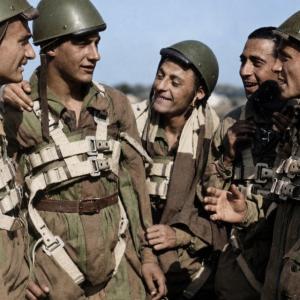
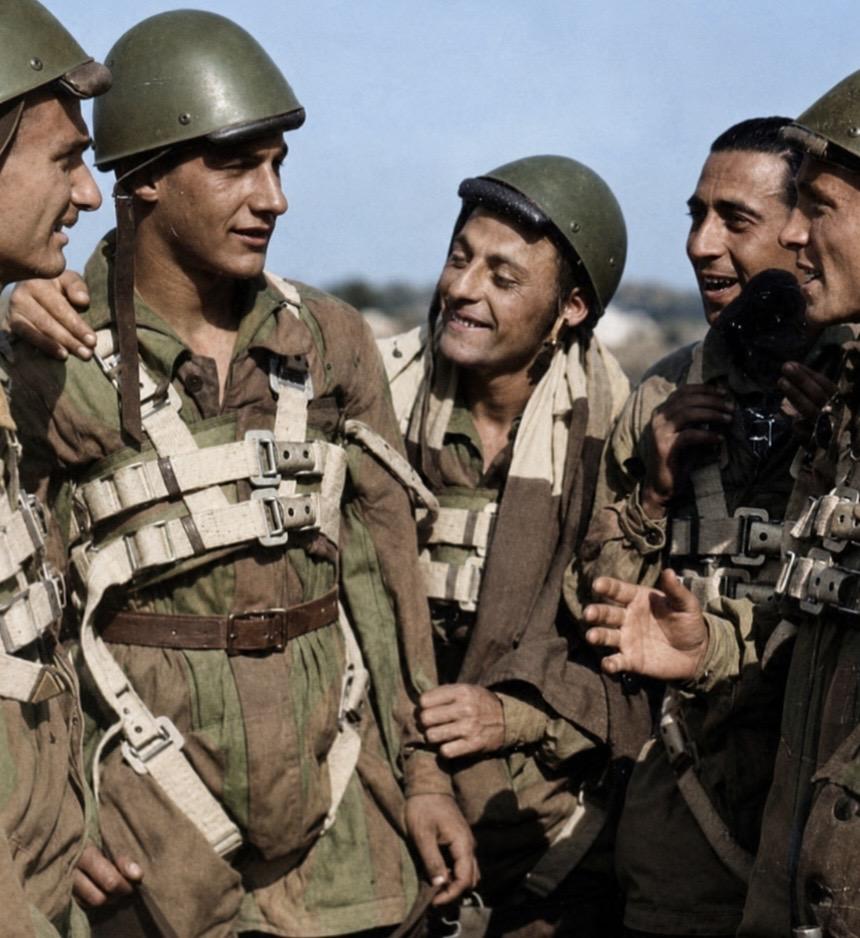
Many of the men who joined were volunteers attracted by the prestige of airborne service. They wore distinctive uniforms, parachutist badges, and modified helmets designed for jumps. The division eventually grew to around 15,000 men, organized into several paratrooper regiments with supporting artillery, engineers, and anti-tank units.
Originally, these troops were intended for the planned invasion of Malta, one of the most ambitious Axis operations proposed in the Mediterranean. Malta was a strategically important British-held island that threatened Axis supply routes to North Africa. The invasion plan called for large airborne assaults combined with amphibious landings. Italian paratroopers spent months rehearsing attacks on defensive positions, coastal targets, and urban strongholds. German Fallschirmjäger units were also expected to participate.
The operation, however, was repeatedly delayed and eventually cancelled as the situation in North Africa worsened. Instead of conducting combat jumps into Malta, the division was sent to Egypt in 1942 to reinforce Axis forces under Erwin Rommel.
Ironically, despite being created as airborne troops, they fought almost entirely as regular infantry during the war. Nevertheless, their elite training made them far more effective than many standard formations. In the desert they adapted quickly despite shortages of heavy weapons, transport, ammunition, and supplies that affected much of the Italian Army.
Their greatest test came during the Second Battle of El Alamein in October 1942. Positioned in the southern sector of the Axis defensive line, the paratroopers faced repeated assaults by the British Eighth Army under General Bernard Montgomery.
British commanders initially expected the Italians to collapse quickly under the weight of artillery and armored attacks. Instead, the defenders fought with remarkable determination. Using trenches, minefields, and improvised anti-tank tactics, they repeatedly repelled British advances. Lacking sufficient anti-tank guns, soldiers often waited until enemy tanks were dangerously close before attacking them with grenades, explosive charges, and Molotov cocktails.
The fighting became brutal. Desert positions were hammered by artillery while infantry and tanks attacked wave after wave. Despite being heavily outnumbered, the Italians held their ground for days. British reports later described them as disciplined and fearless under bombardment.
Several attacks by British armored units were stopped with heavy losses. Trenches and defensive positions became littered with destroyed vehicles. In some sectors the defenders continued fighting even after becoming isolated and surrounded.
Eventually the Axis line collapsed elsewhere, forcing a general retreat. By this stage the division had suffered devastating casualties and severe ammunition shortages. Many survivors continued fighting during the withdrawal across Libya before finally being captured or destroyed.
One famous phrase associated with the battle stated:
“The division is missing from the roll call because it is dead.”
The statement reflected the near destruction of the formation during the battle and became part of its legend.
Although Italy developed airborne forces with great ambition, large-scale combat parachute operations rarely occurred. The cancelled Malta invasion prevented what would likely have been the most important airborne assault involving Italian troops. As a result, the paratroopers seldom performed operational combat jumps during the war.
However, some smaller airborne and special operations missions were carried out by Italian parachutists in North Africa and the Mediterranean. Individual units and trained personnel occasionally undertook raids, reconnaissance work, sabotage missions, and behind-the-lines operations, though nothing on the scale originally planned.
Their equipment reflected their elite role. Soldiers used modified M33 helmets with stronger chinstraps for parachuting, reinforced jump smocks, and specialized harnesses. Weapons included Carcano rifles, Beretta submachine guns, Breda machine guns, mortars, grenades, and fighting knives suited to close combat.
Strong unit pride developed among the paratroopers. They viewed themselves as distinct from ordinary infantry and cultivated a reputation for aggressiveness, discipline, and endurance. Their black feather insignia and airborne badges became symbols of elite status within the Italian military.
Although the division was effectively destroyed in North Africa, its reputation survived the war. Today the modern Paratroopers Brigade Folgore preserves its traditions and honors the memory of the wartime paratroopers.
Military historians generally regard the division as one of Italy’s best combat formations of the Second World War.