
On this day in military history…
On 25 October 1983, American Rangers parachuted towards an airfield on the Caribbean island of Grenada while US Marines landed elsewhere along its coast. Overhead, gunships and carrier aircraft supported an invasion intended to protect American citizens, remove a military regime and prevent the island becoming a stronger Soviet and Cuban foothold. Codenamed Operation Urgent Fury, the campaign would achieve its principal objectives within days, but expose serious weaknesses in American military planning and provoke international controversy. The crisis had its roots in March 1979, when Maurice Bishop’s New Jewel Movement overthrew the government of Eric Gairy. Bishop established a socialist administration and developed close relations with Cuba and the Soviet Union. Washington became particularly concerned about the construction of an international airport at Point Salines. Grenada argued that it was essential for tourism and economic development; American officials feared its long runway could also support military aircraft and Soviet and Cuban supplies.
In October 1983, a bitter struggle within the revolutionary leadership brought the situation to breaking point. Bishop was placed under house arrest, briefly freed by supporters and then recaptured. On 19 October, soldiers executed him and several colleagues at Fort Rupert. A Revolutionary Military Council headed by General Hudson Austin assumed power and imposed a severe curfew, transforming a political confrontation into a regional emergency. Hundreds of American medical students were attending St George’s University on the island, and President Ronald Reagan’s administration presented their safety as a central reason for intervention, alongside requests for assistance from neighbouring Caribbean governments. The operation became both an evacuation mission and an armed intervention to overthrow the military leadership. Whether the students faced an immediate danger sufficient to justify invasion remained fiercely disputed.
The assault brought together Army Rangers, paratroopers of the 82nd Airborne Division, Marines, Navy SEALs, Delta Force and specialist aviation units, supported by warships and aircraft. Vice Admiral Joseph Metcalf III commanded the joint task force, with Caribbean troops joining the intervention while American forces undertook the main fighting. Planning proceeded at extraordinary speed, leaving commanders with incomplete intelligence about enemy positions, terrain and even the locations of all the students they were supposed to evacuate. The dangers became apparent before the main landings, when four Navy SEALs were lost at sea during an attempted reconnaissance insertion. Other special forces missions would encounter strong resistance and targets whose defences had been poorly understood.
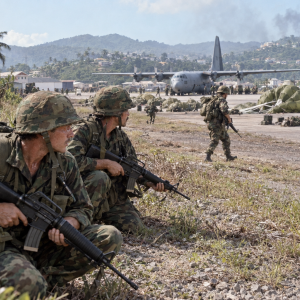
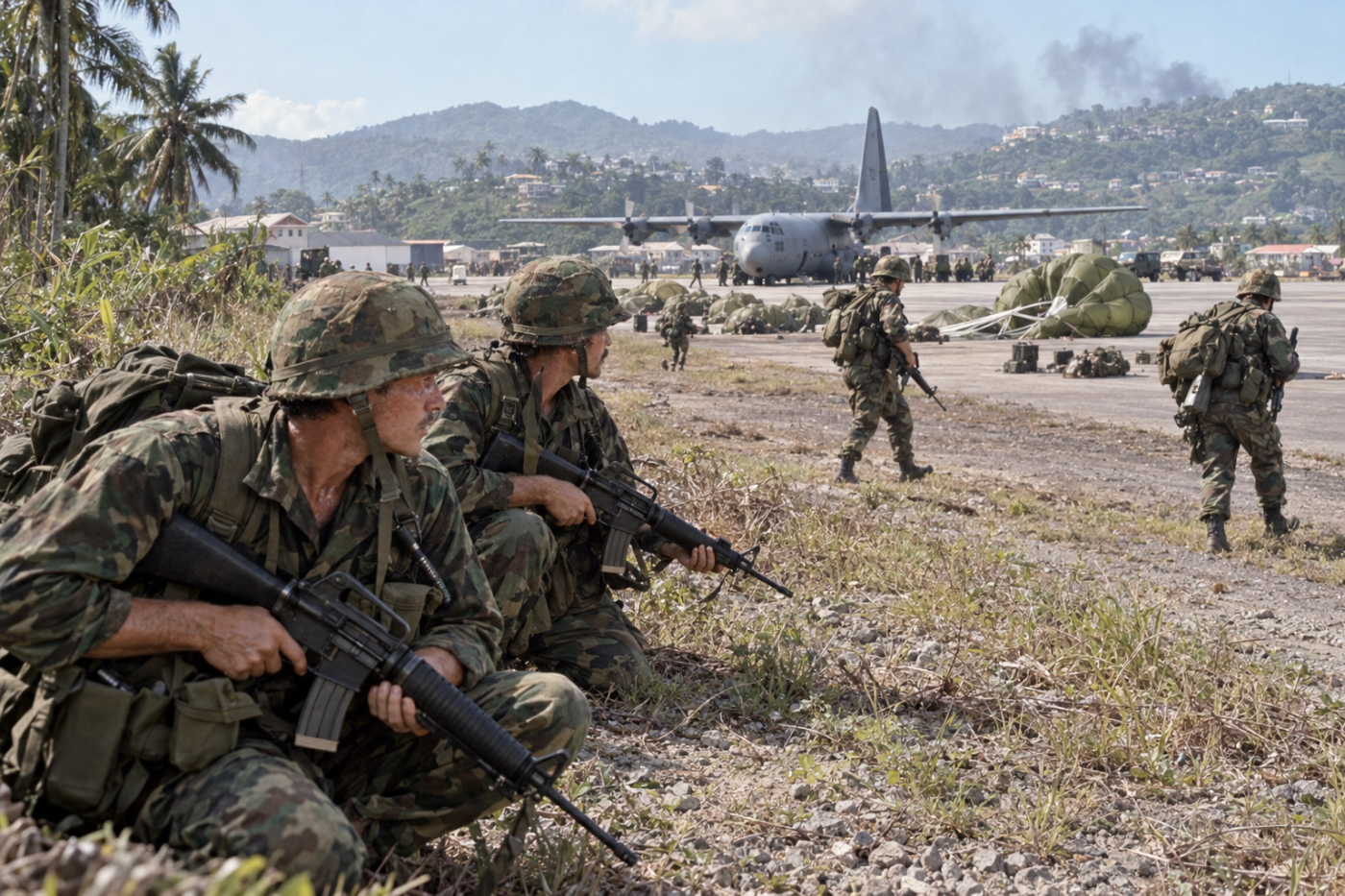
At Point Salines, Rangers from the 1st and 2nd Battalions of the 75th Infantry conducted the invasion’s most dramatic airborne assault. Transport aircraft dropped men from approximately 500 feet, reducing their exposure to anti-aircraft fire but leaving little time beneath their parachutes. On the ground, they fought to secure the unfinished airfield and clear obstacles from its runway. Capturing it was vital for bringing in reinforcements, vehicles and supplies. Resistance came from Grenadian troops and armed Cuban personnel around the airport. Many Cubans were construction workers, although they included men with military training and access to weapons. Their presence produced real fighting, but the invasion did not encounter the large Cuban expeditionary army that some Americans had feared. Once the runway was secured, transports began delivering troops of the 82nd Airborne Division.
Meanwhile, Marines landed near Pearls Airport in the north-east, their helicopters encountering small-arms and machine-gun fire while supporting aircraft attacked defensive positions. They secured the airport and advanced towards other objectives, eventually helping relieve special forces elsewhere. One difficult mission centred on Governor-General Sir Paul Scoon, Queen Elizabeth II’s representative in independent Grenada. Navy SEALs reached his residence but came under fire and could not withdraw as planned. They defended the building with Scoon and other civilians inside until relief arrived. Elsewhere, a helicopter assault on Richmond Hill Prison encountered heavy anti-aircraft fire. Steep surroundings and nearby gun positions made the approach exceptionally dangerous, forcing the attackers to abandon the immediate attempt.
Evacuating the medical students also proved more complicated than expected. Securing those near the airfield did not complete the task, as hundreds remained at the Grand Anse campus farther north. On 26 October, Rangers carried by Marine helicopters launched a rescue operation, gathering 233 students and evacuating them by air. It was one of the campaign’s clearest successes and demonstrated what the services could achieve when their troops, aircraft and support worked together effectively. American superiority gradually overwhelmed the defenders, but victory came at a cost: nineteen US servicemen died and approximately 116 were wounded. Cuban and Grenadian personnel were also killed, along with civilians. One particularly tragic incident involved the accidental bombing of a psychiatric hospital near a military target, illustrating the dangers faced by the island’s population as fighting spread around homes and public buildings.
Urgent Fury exposed problems that overwhelming firepower could conceal only temporarily. Intelligence was incomplete, maps inadequate, communications between services unreliable and command arrangements cumbersome. Friendly-fire incidents and difficulties coordinating aircraft with troops underlined the risks. Alongside the failed Iranian hostage rescue of 1980, Grenada strengthened the case for reforms to American joint operations and special operations command structures. Diplomatic consequences were also substantial. Margaret Thatcher, normally one of Reagan’s closest allies, opposed the intervention and was deeply disturbed by plans to invade a Commonwealth country. On 2 November, the United Nations General Assembly condemned the intervention by 108 votes to nine, with 27 abstentions, describing it as a violation of international law. Washington defended its actions through the protection of its citizens and requests for assistance from Caribbean governments.
Organised resistance collapsed within days, and Operation Urgent Fury formally ended on 2 November 1983. American combat troops withdrew by mid-December, although a smaller security and advisory presence remained. Grenada held general elections on 3 December 1984. The invasion had removed the military council and evacuated the students, but its legacy extended beyond the island: a short, successful campaign had exposed weaknesses that the United States could not afford to ignore in a larger war.