
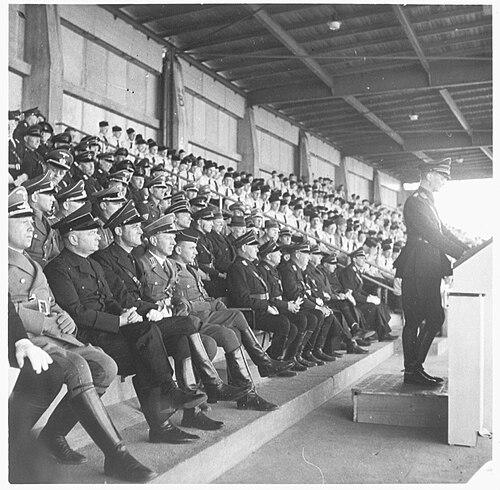
Arie Johannes Zondervan
Arie Johannes Zondervan was born in Berlin on 21 October 1910. Raised in a Protestant household, he moved to the Netherlands with his parents in 1918 and attended the Kennemer Lyceum at Bloemendaal. Poor eyesight frustrated his ambition to become a naval officer and later prevented him from qualifying as an army reserve officer, although he completed conscript service in 1931–1932 as a sergeant. He instead studied Dutch East Indies law at Leiden, graduating in May 1938, when Depression-era restrictions obstructed his intended colonial career.
Zondervan had already entered fascist politics, briefly joining Jan Baars’s movement before becoming a member of Anton Mussert’s Nationaal-Socialistische Beweging (NSB) in March 1933. In Haarlem he organised political instruction and physical training within its Weer-Afdeeling (WA). Further responsibilities followed: in 1938 he became secretary to the local NSB district leader, and in February 1939 Mussert appointed him his personal adjutant. Accompanying the party leader on speaking tours and foreign visits placed Zondervan close to the movement’s leadership. Personal loyalty to Mussert became the foundation of his subsequent authority.
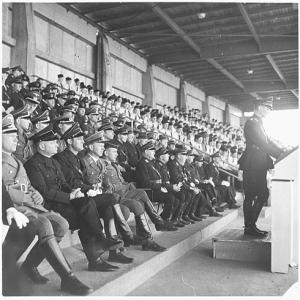
The German invasion of 10 May 1940 transformed those prospects. Mobilised in the Dutch Army, Zondervan briefly became a prisoner of war before returning to political activity. Mussert entrusted him with command of the revived WA. Founded in 1932 and dissolved in 1935, this black-uniformed organisation drew inspiration from the German Sturmabteilung (SA). Its regional formations guarded party meetings, trained members and demonstrated NSB strength through public marches. It was a party paramilitary organisation, rather than part of the Dutch Army, and its revival gave Mussert an instrument of political intimidation under occupation.
WA members attacked opponents, Jewish citizens and Jewish businesses. Zondervan’s order of 26 July 1940 prohibiting weapons went widely unheeded; later expulsions and instructions urging restraint also failed to establish effective discipline. He presided over an organisation whose violence he could not control. In Amsterdam, repeated incursions into the Jewish quarter met resistance from Jewish and non-Jewish self-defence groups. During fighting on 11 February 1941, WA member Hendrik Koot was mortally injured; he died three days later. German reprisals followed amid further confrontations, including a clash with German police at the Koco ice-cream parlour on 19 February. The German round-ups of Jewish men on 22–23 February immediately prompted the February Strike of 25–26 February, a mass protest against anti-Jewish persecution.
In December 1941 Zondervan volunteered for the Dutch Volunteer Legion to encourage WA recruitment, serving under Waffen-SS control in Germany’s war of conquest against the Soviet Union. Holding the junior officer rank of Untersturmführer, he worked on the regimental staff, addressing friction between Dutch volunteers and German officers. His service took him to the Volkhov front in northern Russia. He returned on leave in March 1942 to report complaints to Mussert, then served again from late April until August. Throughout, his political allegiance remained with Mussert. On 3 October 1942 Mussert formally reinstated him as WA commander in Utrecht.
Military service had not resolved the competing loyalties within Dutch National Socialism. Zondervan defended Mussert’s position through the WA newspaper, De Zwarte Soldaat. Mussert envisaged a Dutch national state within a German-dominated Europe, whereas Henk Feldmeijer’s Nederlandsche SS, the Dutch political SS, favoured incorporation into a Greater Germanic Reich. Feldmeijer enjoyed the support of Hanns Albin Rauter, the senior German SS and police official in the Netherlands. Zondervan’s loyalty helped preserve the WA as Mussert’s organisation, but provided little protection against rivals whose influence depended directly upon German patronage.
The Nederlandsche Landwacht, announced on 12 November 1943, further exposed these limitations. Intended to protect NSB members and property, it developed into an armed auxiliary police force under Rauter’s authority, separate from the WA. Kees van Geelkerken became inspector-general, with Zondervan and Feldmeijer as inspectors. Feldmeijer’s German connections left Zondervan increasingly marginalised. The Landwacht checked identity papers, pursued resistance members and hunted Jews and others in hiding. Its police powers and German supervision gave it a different function from the WA’s party duties, while Zondervan’s senior title concealed his diminishing practical influence.
During Dolle Dinsdag, or ‘Mad Tuesday’, on 5 September 1944, rumours of imminent liberation sent collaborators fleeing before the Allied advance. Zondervan took his family to Assen and subsequently Groningen. The abolition of the Landwacht inspectorships in March 1945 left him with only liaison duties with Mussert. Moving to Hoorn in April, he hid in Amsterdam after liberation in May, then surrendered to Canadian troops at Den Dolder as a German soldier called ‘Albert Lütter’. Transported to Germany, he was recognised at Leer by a Dutch SS prisoner and handed over to the Dutch authorities.
Imprisoned at Scheveningen on 25 June 1945, Zondervan suffered weeks of severe, subsequently substantiated abuse by Dutch guards. His treatment became an issue in proceedings concerning his collaboration. The prosecution demanded death in January 1949, but the Utrecht chamber of the Amsterdam Special Court sentenced him to twenty years on 10 February. At the December cassation hearing, the prosecutor requested a reduction to fifteen years. Further proceedings investigated the mistreatment, but the twenty-year sentence was ultimately upheld in 1951. Released early in 1959, Zondervan settled in Germany. His subsequent life remains obscure, and his death date has not been reliably established.
Zondervan’s importance rested chiefly on his leadership of the NSB’s paramilitary movement. His career connected Mussert’s political ambitions with WA intimidation, service on the Eastern Front and the Landwacht’s repression. Yet his inability to discipline followers or resist rivals supported by Germany exposed the limits of that authority. He embodied both the contribution of Dutch collaborators to occupation rule and their dependence upon the German occupiers.
Author: Tom Dankers, Historian - Arnhems Oorlogsmuseum 40-45
Photo: NIOD Institute for War, Holocaust and Genocide Studies, Public domain, via Wikimedia Commons