On this day in military history…
On 24 April 1918, during the later stages of the World War I, a small village in northern France became the setting for a completely new kind of combat. Near Villers-Bretonneux, east of Amiens, history recorded the first ever tank-versus-tank battle. Until that moment, tanks had been used almost exclusively to support infantry, crush barbed wire, and cross trenches. The idea of tanks fighting one another had barely been considered, yet on this day it became a reality.
The battle took place during the German Spring Offensive, a massive push launched by Germany to break the deadlock on the Western Front before American forces could arrive in overwhelming numbers. As part of this offensive, German troops advanced toward Villers-Bretonneux, supported by a small number of their own tanks. These were A7V tanks, Germany’s only operational tank design during the war. In total, about 15 A7Vs were available at the front, but only a handful were involved in this particular clash.
The A7V was a large, boxy machine with thick armour and a crew of around 18 men. It carried a main 57 mm gun at the front and several machine guns around its sides. Despite its firepower, it had serious drawbacks. It was slow, top-heavy, and struggled on rough terrain. Still, it represented Germany’s attempt to match the Allied tank threat.
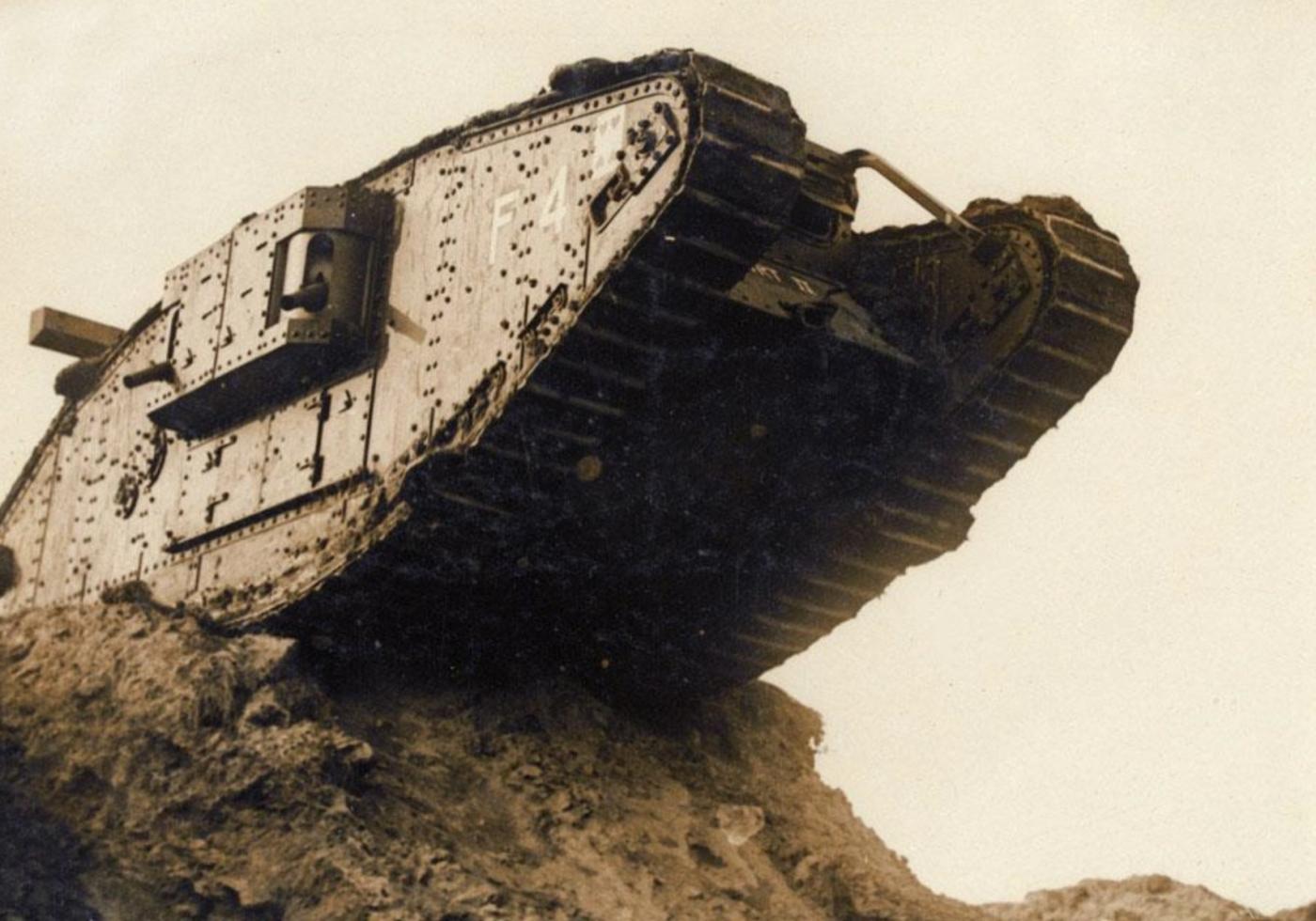
Opposing them were British tanks from the Mark IV tank series, operated by the British Tank Corps. These vehicles came in two main variants: “male” tanks, armed with cannons and machine guns, and “female” tanks, equipped only with machine guns for anti-infantry work.
On the morning of 24 April, three British Mark IV tanks advanced into action near Villers-Bretonneux. They were led by Lieutenant Frank Mitchell, commanding a “male” Mark IV, accompanied by two “female” tanks. At roughly the same time, three German A7V tanks approached the same area. One of these German tanks was named Nixe, a common practice among A7V crews.
As the tanks came within sight of one another, an entirely new kind of engagement began. The two sides opened fire, marking the first time armoured vehicles had directly fought each other.
The British female tanks quickly found themselves at a disadvantage. Armed only with machine guns, they could not effectively penetrate the armour of the German A7Vs. Under heavy fire, both female tanks were forced to withdraw after sustaining damage and casualties among their crews.
This left Lieutenant Mitchell’s male Mark IV to face the German tanks alone. The situation was tense and highly experimental, as neither side had any established tactics for tank-versus-tank combat. Mitchell manoeuvred his tank carefully, attempting to steady it for accurate firing while under enemy fire. The rough ground made aiming extremely difficult, as the tank rocked and jolted with every movement.
Mitchell ordered his gunner to fire at the nearest A7V, Nixe. After several shots, one of the British shells struck effectively, damaging the German tank and forcing its crew to abandon it. This became the first confirmed instance of one tank disabling another in combat.
The remaining German tanks withdrew shortly afterward, possibly due to mechanical issues or the shock of the encounter. The battlefield was chaotic, with infantry, artillery, and aircraft all playing roles around the armoured clash. At one point, German infantry attempted to advance, and Mitchell used his tank’s machine guns to drive them back.
An additional twist came when several lighter British Whippet tank tanks later joined the fighting in the area. These faster, more mobile tanks were designed for rapid attacks against infantry and were not heavily armoured. During the ongoing action, some Whippets engaged German forces but suffered losses, including one tank whose crew was killed after being set on fire.
In total, the core tank-versus-tank engagement involved three British Mark IV tanks against three German A7Vs, though only one British tank ultimately carried on the direct fight. While small in scale, the encounter was hugely significant. It demonstrated both the potential and the limitations of early tank warfare. Armour, firepower, and mobility were all still in their infancy, and crews had to improvise under extreme conditions.
The battle also revealed the importance of proper armament. The British “female” tanks were effectively useless against enemy armour, leading to a greater emphasis on mixed or better-armed designs in the future. Meanwhile, the A7V’s limited numbers and mechanical unreliability highlighted Germany’s late and constrained tank development compared to Britain and France.
The clash at Villers-Bretonneux did not decide the outcome of the wider battle, but it became a landmark moment in military history. It marked the beginning of armoured warfare evolving beyond infantry support into a distinct and decisive form of combat. Future conflicts would see tanks fighting tanks on a massive scale, something that began with this brief but historic engagement on 24 April 1918.