On this day in military history…
On 16 April 1945, the final major offensive of the Second World War in Europe began when the Soviet Union launched its assault on Berlin. This operation marked the culmination of years of brutal fighting on the Eastern Front and was intended to destroy what remained of Nazi Germany’s military capability and capture its राजधानी. The battle opened before dawn with one of the most intense bombardments in history.
The Soviet attack was led primarily by the 1st Belorussian Front under Georgy Zhukov and the 1st Ukrainian Front under Ivan Konev, with additional support from the 2nd Belorussian Front commanded by Konstantin Rokossovsky further to the north. Overall strategic direction came from Joseph Stalin, who was determined to take Berlin before the Western Allies could advance any further into Germany.
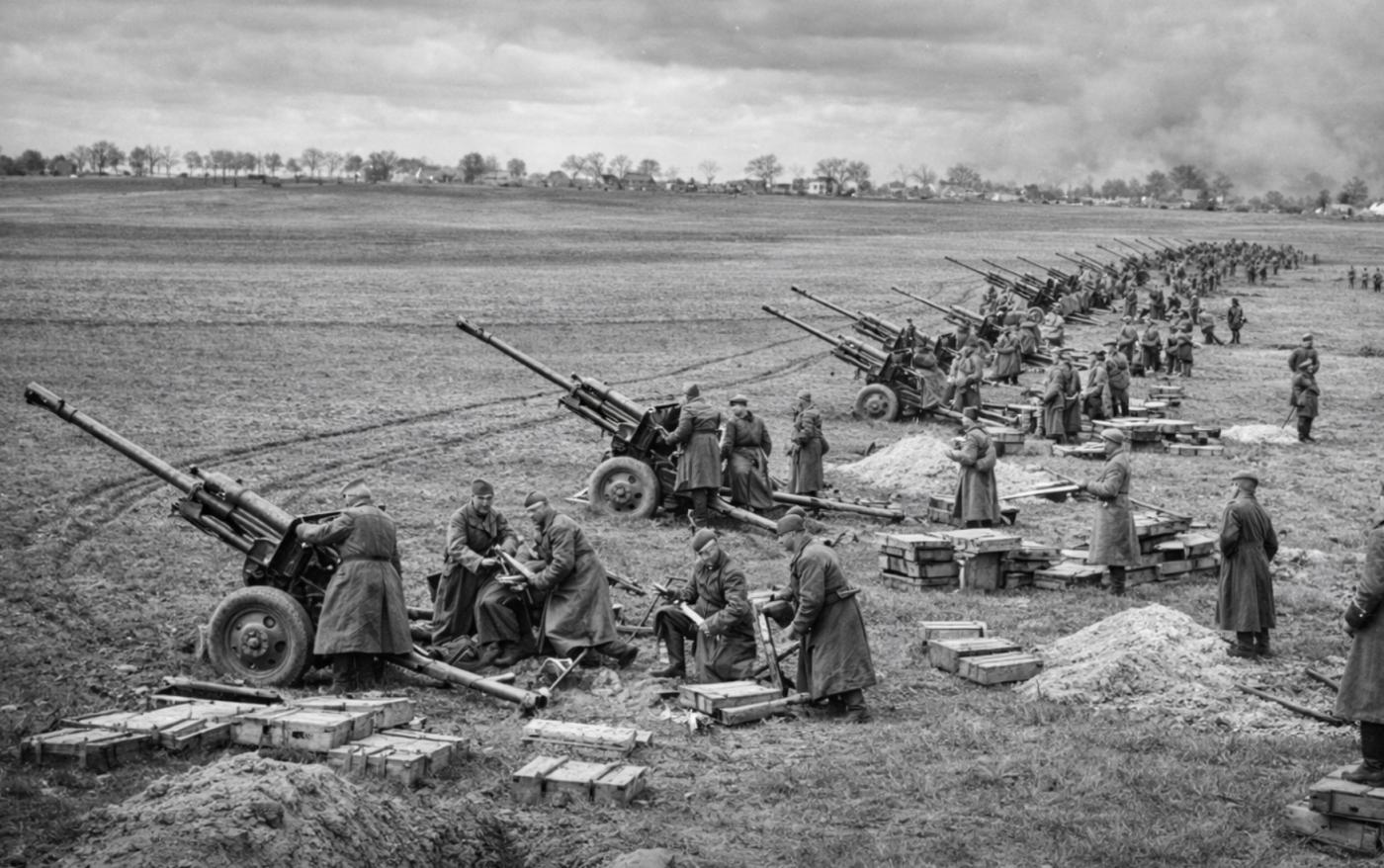
Zhukov’s forces were positioned along the Oder River, directly east of Berlin, facing the formidable German defensive line at the Seelow Heights. Konev’s armies were deployed further south along the Neisse River, tasked with breaking through and then turning north toward Berlin. Together, these fronts fielded an enormous concentration of manpower and equipment. The Soviets assembled roughly 2.5 million soldiers, over 6,000 tanks and self-propelled guns, more than 7,500 aircraft, and around 40,000 artillery pieces and mortars. The opening barrage alone involved thousands of guns firing simultaneously, lighting up the night sky and shaking the ground for miles.
At approximately 3:00 a.m. on 16 April, Zhukov initiated the assault with a massive artillery bombardment, followed by the use of powerful searchlights intended to silhouette German defenders and assist advancing troops. However, the tactic backfired somewhat, as dust and smoke reflected the light back toward the attackers, making visibility difficult. Soviet infantry and armored units then surged forward across the Oder, aiming to break through the German lines at the Seelow Heights, which represented the last major natural defensive barrier before Berlin.
The German defense of Berlin and its eastern approaches was organized under Army Group Vistula, commanded by Gotthard Heinrici, one of Germany’s most capable defensive strategists. Heinrici had anticipated the Soviet assault and withdrew his frontline troops just before the bombardment began, reducing casualties. He positioned his forces in depth, particularly along the Seelow Heights, which overlooked the Oder floodplain and gave German artillery excellent fields of fire.
The troops defending this sector included elements of the German 9th Army under Theodor Busse, supported by remnants of various Wehrmacht units, SS formations, and hastily assembled Volkssturm militia. These defenders were vastly outnumbered and often poorly equipped, but they made effective use of terrain, minefields, anti-tank guns, and entrenched positions. Despite their deteriorating situation, they were ordered to hold at all costs.
Within Berlin itself, the responsibility for the city’s defense was ultimately given to Helmuth Weidling, who commanded the Berlin Defense Area. The city was transformed into a fortress, with barricades, anti-tank obstacles, and strongpoints established in streets, parks, and buildings. The defenders inside Berlin included a mixture of regular army units, Waffen-SS troops, Hitler Youth members, and Volkssturm units composed of older men and boys. Many of these fighters had little training, but they were driven by a combination of ideology, desperation, and fear of Soviet retribution.
The German high command, including Adolf Hitler, believed that Berlin could be held long enough to force a political split between the Soviet Union and the Western Allies. Hitler remained in the Führerbunker beneath the Reich Chancellery, issuing orders that often bore little relation to the reality on the ground. He insisted that counterattacks would relieve the city, even as German forces were being steadily pushed back.
The first day of the battle demonstrated both the overwhelming strength of the Soviet assault and the resilience of the German defense. Zhukov’s troops suffered heavy casualties as they attempted to storm the Seelow Heights, encountering fierce resistance and well-prepared defensive positions. Progress was slower than expected, leading to intense pressure from Stalin, who was eager for rapid success and began encouraging Konev to advance more aggressively from the south.
Despite the initial difficulties, the sheer weight of Soviet numbers and firepower began to tell. Continuous artillery bombardments, waves of infantry assaults, and relentless armored attacks gradually wore down German defenses. Over the following days, the Soviets would break through the Seelow Heights, encircle Berlin, and begin the brutal urban fighting that would bring the war in Europe to its end.