Art Theft WW11
The systematic theft of art during the Second World War was not incidental to Nazi expansion—it was a central, organised policy that combined ideology, greed, and propaganda. Historians widely regard it as the largest art heist in human history, involving hundreds of thousands of objects and affecting nearly every occupied country in Europe.
The looting began even before the war officially started. From 1933 onward, the Nazi regime targeted Jewish collectors, dealers, and galleries, forcing sales at artificially low prices or seizing entire collections outright. After the invasion of countries such as France, the Netherlands, and Poland, specialised Nazi units were tasked with stripping museums, private homes, libraries, and churches. One of the most notorious organisations was the Einsatzstab Reichsleiter Rosenberg (ERR), which focused heavily on confiscating Jewish-owned cultural property. France in particular became a major centre of looting due to the immense value of its private collections.
The Nazis were not indiscriminate in what they took. Adolf Hitler planned a vast museum in Linz, Austria, to house what he believed would be the greatest art collection in the world, filled with Old Masters and classical works. At the same time, modern art that the regime labelled “degenerate” was either destroyed, sold abroad for foreign currency, or traded for pieces that fit Nazi taste.
The scale of the theft was enormous. Estimates suggest that between 1933 and 1945, more than 650,000 artworks were seized or coerced from their owners, while millions of additional cultural objects—books, religious items, and decorative arts—were taken. At the height of the looting, roughly one-fifth of all Western art in existence had been displaced by Nazi activity.
As Allied forces began to push into occupied Europe, a unique group was assembled to address the cultural devastation. Officially known as the Monuments, Fine Arts, and Archives program, but more commonly called the “Monuments Men,” these individuals were museum curators, art historians, architects, and scholars drawn from several Allied nations. Their original mission was to protect historic buildings and monuments from wartime destruction, but as the scale of Nazi theft became clear, their focus shifted to tracking down looted art.
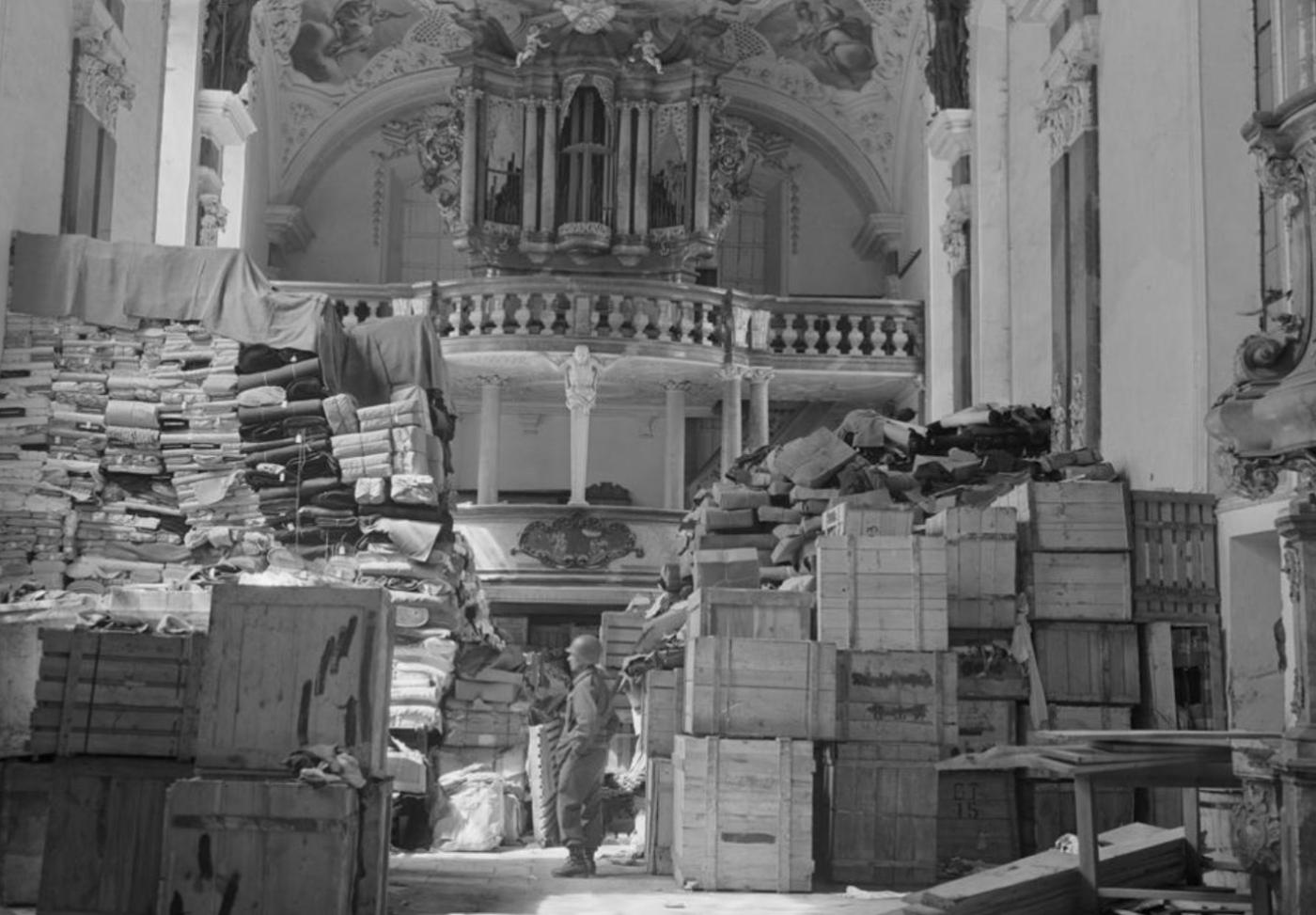
They operated under extremely difficult conditions, often working close to the front lines. As Germany collapsed, they began uncovering vast hidden caches of stolen works. These were frequently stored in unexpected locations such as castles, remote depots, and especially salt mines—chosen because they were dry, stable, and secure from bombing. Among the most famous discoveries were the repositories at Altaussee in Austria and Merkers in Germany, which contained thousands of paintings, sculptures, and gold reserves.
The success of the Monuments Men was remarkable. By the time their work formally ended in 1951, they had recovered and returned more than four million cultural objects, including paintings, tapestries, manuscripts, and religious artefacts. However, this was only part of the story, because the sheer scale of the theft meant that much remained unaccounted for.
After recovery, the process of returning art—known as restitution—was complex and often slow. The Allies established central collecting points in cities such as Munich, Wiesbaden, and Offenbach. Here, recovered objects were catalogued, photographed, and researched to determine their origins. The Munich Central Collecting Point alone processed and returned hundreds of thousands of artworks to their countries of origin.
Repatriation generally followed a national approach rather than returning works directly to individuals. Artworks were sent back to the countries from which they had been taken, and those governments were then responsible for locating the original owners or their heirs. This system worked reasonably well for major museum pieces but proved far more difficult for privately owned works, especially when entire families had been killed in the Holocaust or records had been destroyed.
As a result, a large proportion of looted art entered a grey zone after the war. Some items were absorbed into museum collections, others were sold on the art market, and many simply disappeared into private hands. In some cases, soldiers took objects home as souvenirs, further complicating the trail of ownership.
Even today, the legacy of Nazi looting remains unresolved. Estimates vary, but historians generally agree that at least 100,000 artworks are still missing, with some estimates suggesting well over that number. Many of these are not famous masterpieces but everyday cultural items—silverware, books, and household objects—that are much harder to trace.
Occasionally, dramatic discoveries still occur. In 2012, authorities uncovered around 1,500 artworks in a Munich apartment belonging to Cornelius Gurlitt, the son of a Nazi-era art dealer. The collection included works by artists such as Matisse and Chagall, and many were suspected to be looted. More recently, looted paintings have surfaced in places as far afield as South America, demonstrating how widely these objects were dispersed after the war.
The process of restitution has evolved significantly since the 1990s, when renewed public attention led to international agreements and greater scrutiny of museum collections. Provenance research—the investigation of an artwork’s ownership history—has become a major field, and institutions are now far more cautious about acquiring works without clear histories.
Despite these efforts, the search continues. Organisations and researchers are still actively trying to locate missing works, often relying on archival research, public tips, and advances in digital cataloguing.