On this day in military history…
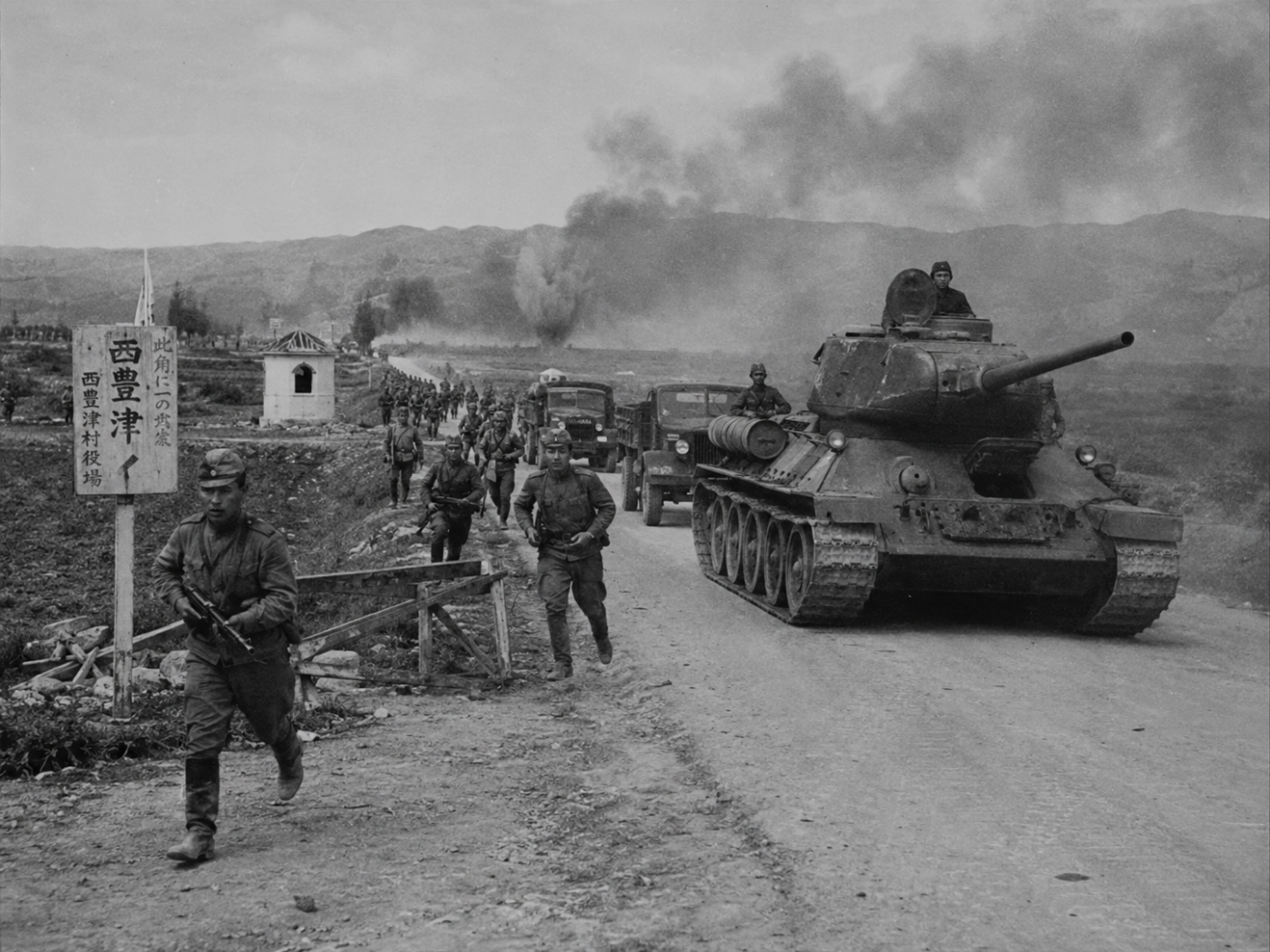
On 9 August 1945, while the world was still attempting to comprehend the destruction of Hiroshima and only hours before a second atomic bomb fell on Nagasaki, the Soviet Union launched one of the largest and most brilliantly executed land offensives of the Second World War. More than a million Soviet and Mongolian troops crossed into Japanese-occupied Manchuria from the west, north and east, attacking across deserts, mountains, forests and major rivers that Japanese commanders had believed would prevent any rapid advance.
The campaign destroyed Japan’s once-feared Kwantung Army in a matter of days, ended Japanese control of Manchuria and removed Tokyo’s last realistic hope of using the Soviet Union to negotiate a settlement with the Allies. Although the atomic bombs played a central part in Japan’s decision to surrender, the Soviet invasion created an entirely new military and political crisis. Japan now faced not only continued American bombing and invasion from the Pacific, but the possible loss of Manchuria, Korea, Sakhalin and perhaps even part of the Japanese home islands to the Soviet Union.
Japan had occupied Manchuria since 1931, establishing the puppet state of Manchukuo under the nominal rule of Pu Yi, the last emperor of China. The region was enormously important to the Japanese Empire. It contained coal, iron, industry, railways, agricultural land and military bases. It also provided Japan with a strategic foothold on the Asian mainland and a buffer against the Soviet Union.
The Kwantung Army had once been regarded as one of the most prestigious and powerful formations in the Imperial Japanese Army. Its officers had exercised enormous political influence and had played a leading role in Japan’s expansion into China. By 1945, however, much of its best manpower, artillery, armour and equipment had been transferred to the Pacific islands, China and the defence of the Japanese homeland. Many of its remaining formations were newly raised, poorly trained or inadequately equipped.
The Soviet Union and Japan had signed a neutrality pact in April 1941. This allowed Joseph Stalin to concentrate against Germany while Japan turned south towards the European colonies and the United States. Despite the agreement, both countries maintained considerable forces along their shared frontier, and Soviet and Japanese troops had already fought major border battles at Lake Khasan in 1938 and Khalkhin Gol in 1939.
At Khalkhin Gol, Soviet and Mongolian forces commanded by Georgy Zhukov had surrounded and destroyed a large Japanese force. That defeat helped persuade Japan’s leaders to abandon plans for a major northern war against the Soviet Union and instead expand towards Southeast Asia and the Pacific.
By 1945 the strategic situation had completely changed. Germany had been defeated, leaving Stalin free to transfer veteran troops from Europe to the Far East. At the Yalta Conference in February 1945, Stalin agreed that the Soviet Union would enter the war against Japan within approximately three months of Germany’s defeat. In return, the Western Allies accepted Soviet territorial and political interests in the Far East, including southern Sakhalin, the Kurile Islands and strategic positions in Manchuria.
Germany’s surrender became effective in May 1945. Almost exactly three months later, on 8 August, Soviet Foreign Minister Vyacheslav Molotov informed the Japanese ambassador that the Soviet Union was declaring war. Shortly after midnight on 9 August, Soviet forces began crossing the frontier.
The overall operation was directed by Marshal Aleksandr Vasilevsky, one of the Soviet Union’s most experienced senior commanders. He had served as Chief of the General Staff and had played an important part in planning many of the Red Army’s great offensives against Germany. Vasilevsky was given control of the Soviet Far East Command and coordinated three enormous army groups, known in Soviet terminology as fronts.
The Soviet plan was based on speed, surprise and deep penetration. Rather than slowly breaking through the strongest Japanese defensive zones, Soviet armoured and mechanised columns would advance through terrain believed to be unsuitable for large modern forces. The main attacking groups would drive into central Manchuria from opposite directions, cutting communications, surrounding Japanese armies and capturing the major cities before the defenders could reorganise.
The Trans-Baikal Front, commanded by Marshal Rodion Malinovsky, attacked from Mongolia and the Soviet Trans-Baikal region in the west. It included the 17th Army, 36th Army, 39th Army, 53rd Army and the powerful 6th Guards Tank Army. Malinovsky also controlled a Soviet-Mongolian Cavalry-Mechanised Group commanded by Colonel-General Issa Pliyev.
Malinovsky’s mission was among the most ambitious of the campaign. His formations had to cross the open expanses of the Gobi Desert and then force their way over the Grand Khingan mountain range. Japanese planners had considered this approach so difficult that they had not prepared the same depth of fortifications found elsewhere.
The spearhead was Colonel-General Andrei Kravchenko’s 6th Guards Tank Army. Kravchenko’s formation contained two tank corps and two mechanised corps, supported by engineers, artillery, infantry and thousands of vehicles. Many of its soldiers and commanders were veterans of the war in Europe. They had learned how to bypass resistance, maintain the momentum of an advance and use forward detachments to seize bridges, road junctions and mountain passes.
Instead of waiting for engineers to construct proper roads, Soviet vehicles moved across tracks, dry ground and mountain approaches that Japanese commanders had believed were impassable. Fuel shortages presented a greater danger than enemy opposition. Transport aircraft were used to deliver petrol to forward units, while tank crews carried additional fuel wherever possible.
The crossing of the Grand Khingan Mountains became one of the most remarkable achievements of the campaign. Heavy rain turned tracks into mud, engines overheated and some vehicles broke down, but the armoured columns continued moving. Once over the mountains they descended towards the central Manchurian plain, threatening the major cities of Changchun, Mukden and Harbin from the west.
On the eastern side of Manchuria, Marshal Kirill Meretskov commanded the 1st Far Eastern Front. His forces included the 1st Red Banner Army, the 5th Army, the 25th Army and the 35th Army, supported by mechanised formations, artillery and aircraft. Meretskov had also fought extensively against Germany and had commanded Soviet forces in the difficult northern campaigns against Finland.
The eastern attack faced some of the strongest Japanese fortifications in Manchuria. Along sections of the frontier, the Japanese had constructed fortified regions containing concrete bunkers, artillery positions, anti-tank obstacles, tunnels and underground accommodation. The terrain was heavily wooded, broken by hills and crossed by rivers.
Meretskov avoided a long preliminary bombardment that might have warned the Japanese. Soviet assault troops crossed the frontier in darkness and bad weather, infiltrating between strongpoints and attacking defensive positions from the rear. Engineers cleared mines and opened routes through obstacles, while artillery and aircraft struck Japanese command posts and communications.
The 5th Army, commanded by Colonel-General Nikolai Krylov, attacked through the heavily defended eastern frontier towards Mutanchiang. Krylov’s troops faced some of the most determined Japanese resistance of the entire campaign. Japanese soldiers fought from bunkers, caves and prepared positions, and several Soviet units suffered significant casualties while clearing the fortified zones.
To the north of Krylov, the 1st Red Banner Army under Colonel-General Afanasy Beloborodov advanced through forested and mountainous country towards the central Manchurian railway network. To the south, Colonel-General Ivan Chistyakov’s 25th Army advanced towards eastern Manchuria and northern Korea. This thrust eventually carried Soviet troops towards the important Korean ports and helped establish Soviet control over the northern part of the Korean peninsula.
The third great Soviet formation was the 2nd Far Eastern Front commanded by General Maksim Purkayev. It attacked from the north and north-east with the 2nd Red Banner Army, 15th Army, 16th Army and supporting formations. Its troops crossed the Amur and Ussuri river systems, working closely with Soviet naval vessels, river flotillas and engineers.
Crossing these rivers was an immense undertaking. Assault troops moved in boats under cover of artillery fire, while engineers constructed pontoon bridges and ferries for tanks, guns and lorries. The Soviet Amur Flotilla supported the advance with gunboats, armoured vessels and landing parties. Once bridgeheads had been established, larger formations moved south towards Harbin, Tsitsihar and other strategic centres.
The Soviet Pacific Fleet, commanded by Admiral Ivan Yumashev, supported operations along the coast and against Japanese positions in Korea, southern Sakhalin and the Kurile Islands. Soviet naval infantry carried out landings, while submarines and aircraft attempted to disrupt Japanese evacuation and reinforcement movements.
Altogether, the Soviet command committed roughly one and a half million personnel to the Far Eastern campaign, supported by thousands of tanks and self-propelled guns, tens of thousands of artillery pieces and mortars, and several thousand aircraft. Not all of these forces entered Manchuria itself, as operations also took place in Korea, Sakhalin and the Kuriles, but the scale of the concentration was overwhelming.
Facing them was the Kwantung Army under General Otozo Yamada, with headquarters at Hsinking, now Changchun. On paper the Japanese and Manchukuoan forces appeared formidable, but their actual fighting strength was far lower than their numbers suggested.
Yamada’s principal formations included General Seiichi Kita’s First Area Army in eastern Manchuria and General Jun Ushiroku’s Third Area Army in the central and western regions. The Japanese Fourth Army guarded northern Manchuria, while other formations were deployed in Korea, southern Sakhalin and the Kurile Islands.
The Japanese possessed hundreds of thousands of troops, but many divisions had been formed shortly before the invasion from reservists, local garrison personnel and men with limited training. Weapons were in short supply, transport was inadequate and several formations lacked effective anti-tank guns. Japanese tanks were generally light and badly outclassed by Soviet T-34s, heavy tanks and self-propelled artillery.
The Kwantung Army’s defensive plan also worked against it. Japanese commanders had recognised that they could not hold the entire frontier, but the transition to a defence in depth had not been completed. Some troops remained tied to forward fortifications, while the main defensive concentrations were positioned farther inside Manchuria. The Soviet advance was so rapid that several Japanese formations were caught while moving, assembling or awaiting orders.
Communications quickly collapsed. Soviet aircraft attacked railways, stations and headquarters, while fast-moving armoured columns cut roads and telephone lines. Headquarters often had little understanding of where Soviet spearheads had reached. Orders arrived too late or not at all, and units preparing to defend one direction suddenly found Soviet armour behind them.
Japanese resistance varied considerably. Some formations disintegrated or surrendered after being bypassed, while others fought with great determination. At Mutanchiang and several fortified regions, Japanese troops launched counter-attacks and continued fighting from isolated positions. Suicide attacks were made against Soviet tanks, with soldiers using mines, explosives and close-assault weapons.
These local actions could not alter the outcome. The Soviet offensive was not simply a frontal assault. It was a vast encirclement operation fought across an enormous area. While Japanese units defended individual bunkers, towns or roadblocks, Soviet columns were moving deep into their rear, capturing airfields, railway junctions and supply centres.
Within days, the 6th Guards Tank Army had crossed the Grand Khingan range and was advancing across the central plain. Soviet troops approached Mukden and Changchun, while forces from the east drove beyond the frontier fortifications. In the north, river crossings opened additional routes into the heart of Manchuria.
As the advance continued, the Soviet command used airborne and air-landed detachments to seize important cities and airfields ahead of the main ground forces. Small groups were flown into locations including Harbin, Changchun and Mukden to accept surrender, secure communications and prevent Japanese commanders or political figures from escaping.
At Mukden, Soviet forces captured Pu Yi, the former Chinese emperor whom Japan had installed as ruler of Manchukuo. He was attempting to leave the region and was later taken into Soviet custody. His capture symbolised the complete collapse of the Japanese puppet state.
The wider effect upon Japan was devastating. Before the invasion, some Japanese leaders still hoped that Moscow might act as an intermediary in negotiations with Britain and the United States. Japan had not fully understood that Stalin had already promised to enter the war. The Soviet declaration destroyed this diplomatic strategy immediately.
It also shattered the belief that Japan might preserve its position on the Asian mainland. Manchuria contained industry, resources and large military forces. It could no longer serve as a base for continued resistance or as a bargaining asset in negotiations. The rapid collapse of the Kwantung Army demonstrated that Japan had no effective means of stopping a Soviet advance through Northeast Asia.
The invasion also raised the possibility that Soviet forces might enter Hokkaido or occupy a portion of Japan itself. For Japanese leaders, the prospect of Soviet occupation carried particular dangers. They feared the destruction of the imperial system, Communist revolution and the division of Japan into occupation zones, as had already happened in Germany.
On 9 and 10 August, Japan’s Supreme Council for the Direction of the War met to consider surrender. The leadership remained divided, but the combination of Hiroshima, Soviet entry into the war and the bombing of Nagasaki made Japan’s position impossible. Emperor Hirohito intervened in favour of accepting the Allied surrender terms, provided the imperial institution could be preserved.
Historians continue to debate the relative importance of the atomic bombs and the Soviet invasion in bringing about the surrender. The bombs demonstrated that individual Japanese cities could be destroyed by a single aircraft, but the Soviet attack transformed the strategic situation across an entire continent. It eliminated Japan’s hope of Soviet mediation, destroyed its strongest remaining overseas army and created the possibility of Soviet occupation of Japanese territory. It is therefore more accurate to see Japan’s surrender as the result of several overwhelming blows arriving within a few days rather than one event acting alone.
Emperor Hirohito’s surrender broadcast was transmitted on 15 August, but fighting did not immediately end everywhere. Orders were confused, communications had failed and some Japanese commanders were reluctant to surrender. The Kwantung Army headquarters eventually instructed its formations to cease resistance, while Soviet troops continued moving to occupy key objectives.
By the end of the campaign, Soviet forces had overrun Manchuria, entered northern Korea, recovered southern Sakhalin and occupied the Kurile Islands. Hundreds of thousands of Japanese servicemen fell into Soviet captivity. Many were transported to labour camps across Siberia and other parts of the Soviet Union, where large numbers remained for years.
The human consequences for civilians were also severe. Japanese settlers fled south in panic, often abandoning homes and possessions. Families became separated, transport systems collapsed and many civilians were left without protection or supplies. Chinese and Korean populations were emerging from years of Japanese occupation, but the sudden collapse of authority produced looting, reprisals, displacement and political uncertainty.
The campaign had consequences far beyond the immediate defeat of Japan. Soviet occupation of northern Korea helped produce the division of the peninsula along the 38th parallel. Soviet forces also occupied Manchuria long enough for captured Japanese weapons and territory to become important factors in the renewed Chinese Civil War. The Chinese Communist forces ultimately benefited from access to areas and military equipment previously controlled by Japan, although the process was complicated and Soviet policy was guided by its own strategic interests.
Militarily, the invasion of Manchuria was one of the finest examples of Soviet operational warfare. It combined surprise, deception, overwhelming concentration of force, deep armoured penetration, airborne movement, river crossings and coordinated operations by land, air and naval forces. The Red Army had taken the lessons learned during four years of brutal fighting against Germany and applied them against an opponent still organised around relatively rigid defensive methods.
The Japanese had expected terrain, distance and prepared fortifications to slow the enemy. Vasilevsky, Malinovsky, Meretskov and Purkayev instead used those same conditions to achieve surprise. Soviet tanks crossed the desert, climbed mountain tracks and appeared in regions that Japanese planners had considered safe. Strongpoints were bypassed, command structures were disrupted and entire armies were placed in danger of encirclement before they fully understood the scale of the attack.
The Soviet invasion of Manchuria lasted only a few weeks, but its decisive phase was largely completed within days. The Kwantung Army, once a symbol of Japanese military power and imperial ambition, was broken apart with astonishing speed. Its destruction marked the end of Japan’s continental empire and ensured that there would be no prolonged final stand in Manchuria.
Coming between the atomic attacks on Hiroshima and Nagasaki, the offensive has sometimes been overshadowed in popular accounts of the war’s final days. Yet for Japan’s leaders, the arrival of the Soviet Union as an active enemy was a catastrophe of the highest order. It closed the last diplomatic escape route, destroyed the defence of Manchuria and threatened to bring Soviet armies to Japan’s own shores. Operation August Storm did not alone end the Second World War, but it was one of the decisive blows that made further Japanese resistance both militarily hopeless and politically dangerous.