On this day in military history…
On 16 July 1945, the world entered the nuclear age when the first atomic bomb was detonated in the remote desert of New Mexico. The explosion, known as the Trinity test, was the culmination of years of secret scientific research, industrial development and military planning conducted under the American-led Manhattan Project. At precisely 5.29 a.m. Mountain War Time, a plutonium implosion device exploded above the Jornada del Muerto desert, producing a flash of light visible for hundreds of miles and releasing an explosive force equivalent to approximately 21,000 tons of TNT.
The Trinity test was carried out on the Alamogordo Bombing and Gunnery Range, an isolated military area about 210 miles south of the secret weapons laboratory at Los Alamos. The chosen location lay within a vast, sparsely populated region whose Spanish name, Jornada del Muerto, has often been translated as “Journey of the Dead Man.” Its remoteness made it appear suitable for an experiment whose results could not be predicted with certainty, although thousands of civilians lived in towns, villages, ranches and Indigenous communities elsewhere in the surrounding region.
The bomb was developed as part of the Manhattan Project, the enormous wartime programme established to produce an atomic weapon before Nazi Germany could achieve the same objective. The project was commanded by Major General Leslie Groves of the United States Army Corps of Engineers, while the scientific work at Los Alamos was directed by the theoretical physicist J. Robert Oppenheimer. At its height, the Manhattan Project employed more than 100,000 people at laboratories, factories, military installations and industrial sites across the United States, although only a small number understood the project’s true purpose.
Scientists knew that splitting the nuclei of certain heavy elements could release an extraordinary amount of energy. Uranium-235 and plutonium-239 could both be used to create a rapidly growing nuclear chain reaction, but the two materials required different bomb designs. The uranium weapon, later known as Little Boy, used a comparatively straightforward gun-type arrangement in which one subcritical mass of uranium was fired into another. The scientists were sufficiently confident in this design that the uranium bomb was not tested before it was dropped on Hiroshima.
Plutonium presented a much greater technical problem. Plutonium produced in nuclear reactors contained isotopes that made a gun-type design unsuitable because the material might begin reacting too early. Such a premature reaction would scatter the bomb before a full nuclear explosion could develop, creating what scientists called a “fizzle.” The Los Alamos team therefore designed an implosion weapon in which carefully shaped conventional explosive charges would compress a plutonium core from every direction at almost exactly the same instant.
This required extraordinary precision. The high-explosive lenses surrounding the core had to produce a perfectly symmetrical inward-moving shock wave. Even a slight imperfection in their shape, manufacture or timing could distort the implosion and prevent the plutonium from reaching the density required for an effective nuclear chain reaction. The Trinity test was therefore considered essential because no one could be completely certain that the complicated implosion system would work until a full device had been detonated.
The test device was officially known simply as the Gadget. It was not shaped like a conventional aircraft bomb but appeared as a large, roughly spherical assembly of explosives, wiring and metal components. At its centre was a plutonium core surrounded by a uranium tamper, layers of high explosives and dozens of detonators that had to fire within an extremely small fraction of a second. The basic design would later be adapted into the Fat Man bomb dropped on Nagasaki.
The name Trinity was chosen by Oppenheimer. Its exact origin has never been proved beyond doubt, but he later suggested that it had been inspired by the poetry of the English poet and clergyman John Donne. Oppenheimer was familiar with Donne’s religious poems, including works concerned with death, destruction, rebirth and mankind’s relationship with divine power. The name gave the test a mysterious and almost spiritual quality, although most of those preparing the experiment referred to the weapon simply as the Gadget.
Responsibility for organising the test fell largely upon physicist Kenneth Bainbridge, who worked closely with Oppenheimer, Groves and hundreds of scientists, soldiers, engineers and technicians. An elaborate network of bunkers, cameras, blast gauges, radiation detectors and recording instruments was constructed around the test area. Three principal observation shelters were positioned approximately 10,000 yards from the firing tower, while other observers watched from considerably greater distances.
Before the nuclear device was tested, the scientists conducted a major rehearsal on 7 May 1945. Around 100 tons of conventional high explosive were detonated on a wooden platform, together with a small amount of radioactive material intended to help test the monitoring equipment. This rehearsal allowed the teams to examine their instruments, communications, photography and safety arrangements before attempting the nuclear explosion.
One of the most unusual objects prepared for Trinity was a massive steel container known as Jumbo. Weighing more than 200 tons, Jumbo had originally been designed to contain the precious plutonium if the conventional explosives detonated but failed to produce a nuclear reaction. Recovering plutonium from the desert would have been extremely difficult, and at that stage the material was scarce and enormously expensive to produce. By the summer of 1945, however, confidence in the implosion system had increased and Jumbo was not used to contain the device. It was instead placed some distance from the tower so that scientists could observe the effects of the explosion upon it. The container survived, although the steel tower supporting it was destroyed.
During the days before the test, the components of the Gadget were transported to a ranch house near the site. The plutonium core was carefully assembled there before being taken to the firing tower. The completed device was raised to the top of a steel tower approximately 100 feet high. Detonating it above ground would allow the fireball to develop and would provide information about the effects of an airburst, while also making it easier for instruments to record the blast.
The test had initially been scheduled for around 4.00 a.m. on 16 July, but violent thunderstorms, heavy rain and strong winds crossed the area during the night. Weather was a critical consideration because rain could interfere with electrical equipment, lightning might trigger an accident, and unfavourable winds could carry radioactive fallout towards populated districts. The test was postponed while meteorologists waited for conditions to improve.
As the scientists and military officers waited in the darkness, tension increased. Some feared the bomb would fail completely, while others predicted yields ranging from a few hundred tons to tens of thousands of tons of TNT. The physicist Enrico Fermi even jokingly offered wagers on whether the explosion might ignite the atmosphere and destroy the state of New Mexico. Earlier calculations had already shown that such a catastrophe was effectively impossible, but the grim humour revealed the anxiety surrounding an experiment unlike anything previously attempted.
At 5.10 a.m., the final twenty-minute countdown began. The device was controlled remotely from a bunker several miles away. Oppenheimer watched from the main control shelter, while General Groves observed from a base camp farther from the tower. Scientists were instructed to lie on the ground with their backs towards the explosion, wear dark glasses or look through specially prepared protective screens. Despite these precautions, many later admitted that they turned to look directly at the blast.
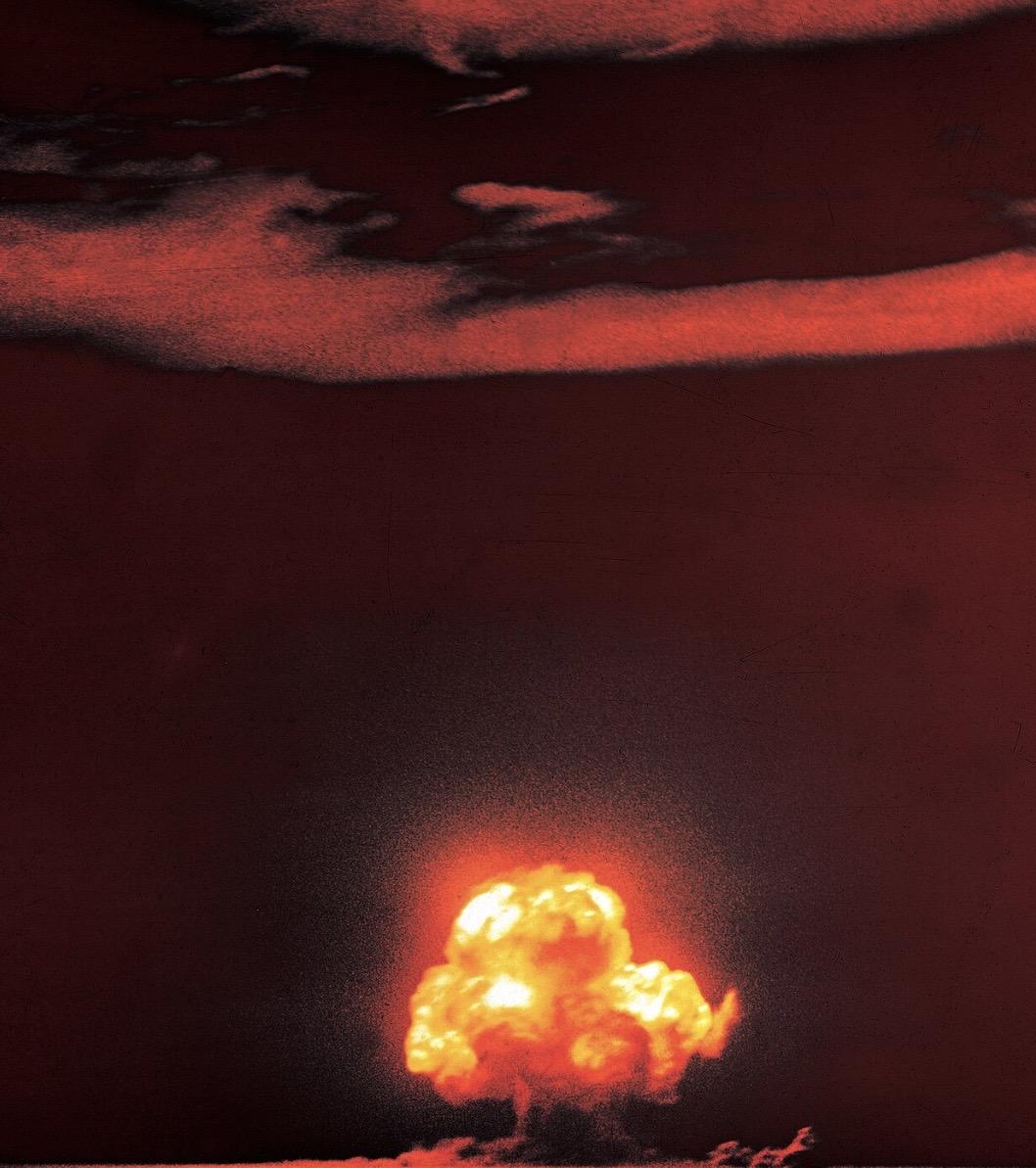
At 5.29 a.m. and 21 seconds, the electrical firing circuit activated the detonators surrounding the Gadget. The explosive lenses compressed the plutonium core, creating a supercritical mass and beginning an uncontrolled nuclear chain reaction. In a fraction of a second, the firing tower and much of the bomb were vaporised.
The first sign was an intensely bright flash that illuminated the desert more brilliantly than daylight. Witnesses many miles away reported seeing surrounding mountains lit as though by a giant camera flash. The fireball expanded rapidly, changing through brilliant shades of white, yellow, orange and red before rising from the ground. Seconds later, the shock wave swept across the desert, followed by the deep roar of the explosion.
The resulting mushroom cloud climbed tens of thousands of feet into the atmosphere. The heat melted sand and soil around the tower, producing a greenish, glass-like radioactive material that became known as trinitite. Fragments of trinitite were later collected as souvenirs before the authorities restricted their removal because of the remaining radioactive contamination.
The explosion produced an estimated yield of approximately 21 kilotons of TNT, considerably more powerful than some members of the project had expected. The success of the test proved that the complex plutonium implosion system worked. It also confirmed that the United States possessed a weapon of previously unimaginable destructive power.
The reactions of the witnesses varied greatly. Some cheered and celebrated because years of exhausting work had succeeded and because they believed the weapon might bring the war to a rapid conclusion. Others were stunned or deeply troubled by what they had helped create. Bainbridge reportedly turned to Oppenheimer after the explosion and made the bleak observation that those responsible would now be regarded with horror.
Oppenheimer later recalled that the sight of the explosion brought words from the Hindu scripture the Bhagavad Gita to his mind, particularly the passage commonly translated as, “Now I am become Death, the destroyer of worlds.” There is some uncertainty about whether he thought of those exact words at the instant of the test or connected them with Trinity later, but the quotation became permanently associated with both Oppenheimer and the birth of the atomic age.
The Trinity test took place only one day before President Harry S. Truman met British Prime Minister Winston Churchill and Soviet leader Joseph Stalin at the Potsdam Conference in defeated Germany. Truman was informed of the successful test in a coded message. Confirmation that the bomb worked strengthened American confidence during discussions about the final defeat of Japan and the political shape of the post-war world.
Although the original Manhattan Project had been driven partly by fears that Nazi Germany might develop an atomic bomb, Germany had surrendered on 8 May 1945. The war against Japan continued, however, and American leaders expected that an invasion of the Japanese home islands could result in enormous Allied and Japanese casualties. Supporters of using the bomb argued that demonstrating its destructive power against a city might force Japan to surrender without an invasion.
Others later argued that Japan was already approaching defeat, that a demonstration on an uninhabited site might have been attempted, or that the Soviet Union’s expected entry into the war against Japan could have helped force surrender without using atomic bombs against populated cities. These arguments have remained at the centre of historical debate. At the time, however, the successful Trinity test gave American leaders the practical ability to use the new weapon.
Only three weeks after Trinity, the uranium bomb Little Boy was dropped on Hiroshima on 6 August 1945. The plutonium implosion bomb Fat Man, based upon the design tested at Trinity, was dropped on Nagasaki on 9 August. Japan announced its acceptance of the Allied surrender terms on 15 August, and the formal surrender was signed aboard USS Missouri on 2 September 1945.
For many years the Trinity test was officially presented mainly as a scientific and military success, but its effects upon nearby civilians received far less attention. The test was conducted in wartime secrecy, and communities around the Tularosa Basin were not warned in advance or evacuated. Radioactive material was carried beyond the test area and settled over inhabited land, livestock, water supplies and farms. Some residents remembered ash-like material falling from the sky without knowing that it contained radioactive contamination.
The authorities initially issued a cover story claiming that a remote ammunition magazine containing high explosives and pyrotechnics had accidentally exploded. People living nearby were therefore not given clear information about possible exposure or advised to take protective measures. Generations of local residents, now widely known as Trinity downwinders, have since campaigned for recognition of illnesses and deaths they believe were connected to radioactive fallout from the test.
Trinity was important not merely because it proved that an atomic bomb could work, but because it permanently changed warfare, international politics and humanity’s relationship with science. It led directly into the atomic bombings of Japan, accelerated the development of nuclear weapons by other nations and contributed to the beginning of the Cold War arms race. Within a few years, weapons thousands of times more powerful than the Trinity device would be constructed.
The test also raised moral questions that remain unresolved. It demonstrated that scientific knowledge could provide mankind with the power to destroy entire cities in moments and perhaps civilisation itself. Nuclear weapons became instruments of deterrence, with nations arguing that possessing them prevented major wars, while at the same time creating the constant possibility of accidental or deliberate nuclear destruction.
Today, the point directly beneath the explosion is marked by a dark stone obelisk at the Trinity Site, now part of the White Sands Missile Range. The surrounding desert appears quiet and empty, but it remains one of the most historically significant places of the twentieth century. On 16 July 1945, a single flash over the New Mexico desert proved that the power locked within the atom could be released as a weapon. The Trinity test ended one chapter of scientific discovery and opened another in which humanity possessed, for the first time, the means to bring about destruction on a truly global scale.