Frog Skin Camo
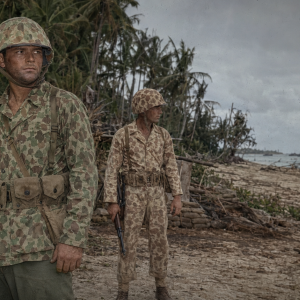
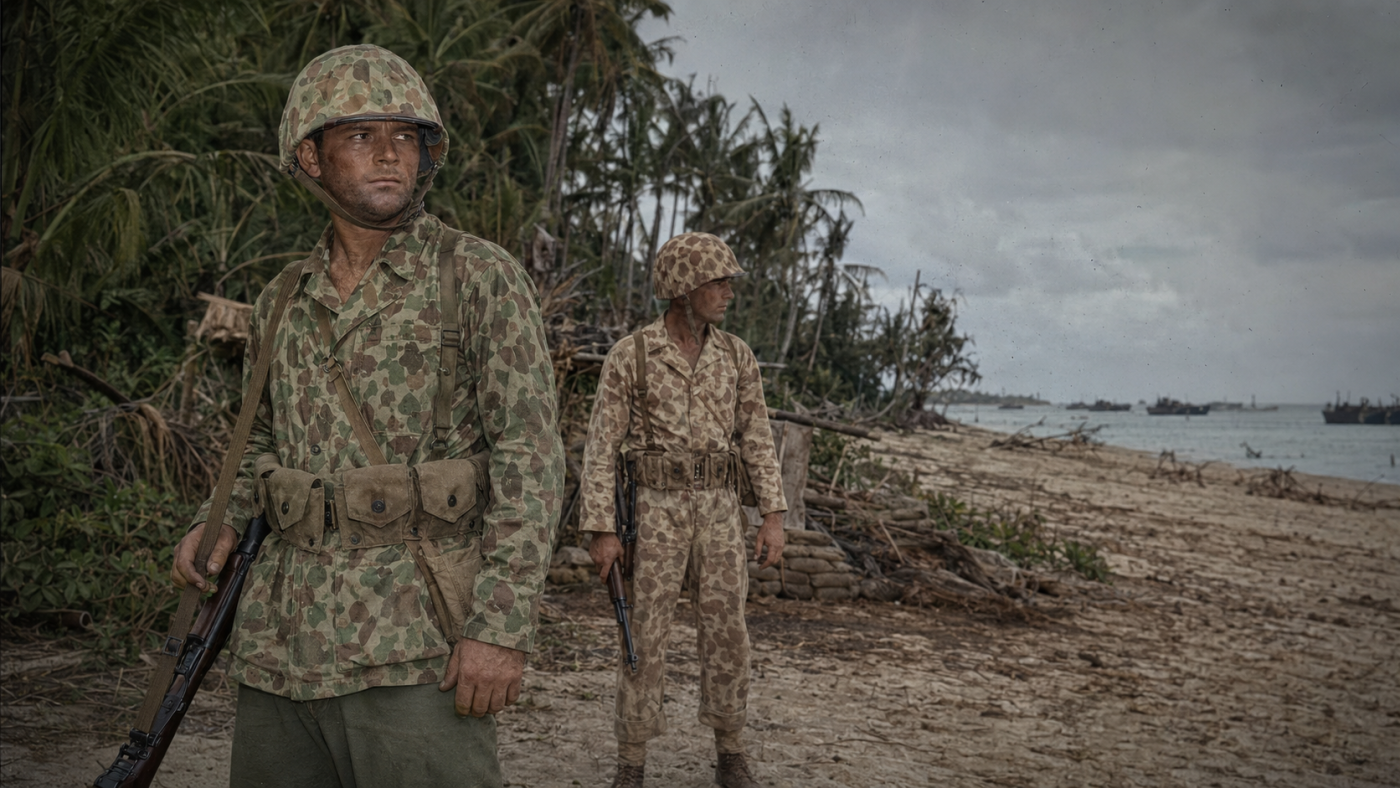
The distinctive camouflage worn by the American Marines in our photograph was one of the United States’ earliest serious attempts to conceal an entire fighting force with a specially designed combat uniform. Officially introduced during 1942, its irregular overlapping shapes quickly earned it the memorable nickname “frog skin”. It would become closely associated with the bitter island campaigns of the Pacific and establish many of the principles followed by later American camouflage designs.
The pattern is generally credited to Norvell Gillespie, a respected American horticulturist, landscape specialist and former gardening editor of Better Homes and Gardens magazine. Gillespie’s knowledge of plants, natural colours, light and shadow gave him an unusual understanding of how shapes could blend into vegetation. Working with the United States military, he helped create a disruptive design made up of rounded patches that broke up the recognisable outline of a soldier.
The resulting camouflage was printed onto hard-wearing cotton herringbone-twill material. Its most ingenious feature was that it was completely reversible. One side used greens, darker browns and black shapes intended for jungle and woodland, while the opposite face used lighter sand, tan and reddish-brown colours suited to beaches, dry ground and exposed coral islands. In theory, a Marine could turn his uniform inside out as the terrain changed, giving him two camouflage suits without adding extra weight to his equipment.
The first large-scale uniforms appeared in 1942 and were issued as jackets, trousers, coveralls and helmet covers. The original Marine Corps P42 uniform was followed by the improved P44 pattern, which incorporated larger pockets so ammunition, grenades and equipment could be carried without relying entirely upon traditional webbing. The cloth was strong and practical, although it could become extremely hot and uncomfortable in the tropical heat of the Pacific.
Frog-skin camouflage received its most famous combat use with the United States Marine Corps. It appeared during operations on islands including Bougainville, Tarawa, Saipan, Tinian and Peleliu, where Marines fought through dense jungle, shattered vegetation, coral beaches and dusty settlements. The broken patches of colour helped disguise movement and made the human outline more difficult to recognise, particularly when a soldier remained still among foliage or broken shadows.
Its effectiveness depended greatly upon the surroundings. The green face worked best in thick vegetation, while the brown side was useful on beaches and dry ground. On some islands, however, Marines could move from bright sand into dark jungle within minutes, and there was rarely time to reverse a uniform while under fire. Dirt, sweat, seawater and fading also altered the original colours, sometimes improving the camouflage by reducing its sharpness.
The United States Army briefly used camouflage uniforms in the European theatre during 1944, including among troops fighting in Normandy. The experiment was not widely continued. At a distance, the spotted American uniform could be mistaken for the patterned clothing worn by certain German Waffen-SS formations. Concerns about recognition and possible friendly-fire incidents helped persuade commanders that the standard olive-drab uniform was safer for American troops operating in Europe. Frog skin consequently became far more strongly identified with the Marines and the Pacific War.
The camouflage uniform’s principal period of front-line prominence was relatively short, mainly from 1942 until 1944, although examples continued to appear during the later stages of the war. The pattern itself enjoyed a much longer life. Reversible frog-skin helmet covers remained in American service after 1945, were widely seen during the Korean War and continued to appear into the early years of the Vietnam conflict. This gave the design a practical military life of approximately twenty years, depending upon the particular garment or piece of equipment being considered.
After the war, large quantities of surplus material and clothing entered the civilian market. American hunters found the pattern particularly suitable for woodland and marsh country, leading to the alternative nickname “duck hunter camouflage”. Commercial manufacturers produced numerous variations, and similar spotted designs were adopted or copied by military forces in several other countries.
Frog skin was not a perfect uniform. It was heavy when wet, hot in tropical conditions and could create problems of identification. Nevertheless, it represented an important change in American military thinking. Instead of relying entirely upon plain khaki or olive-drab clothing, its designers attempted to match the soldier directly to the colours and broken shapes of his surroundings.
Today, original frog-skin uniforms and helmet covers are highly prized by collectors, especially examples with clear wartime markings or documented Marine Corps service. More importantly, the pattern occupies a special place in military history. It was America’s first widely issued reversible camouflage combat uniform, a bold experiment born in 1942 that fought its way across the beaches and jungles of the Pacific and influenced American camouflage development for decades to come.