
Tankgewehr 198 Rifle
On 15 September 1916, British tanks went into action on the Somme, bringing a new and unsettling presence to the battlefield. Slow, noisy and prone to mechanical failure, they nevertheless offered a way through the barbed wire and machine-gun positions that had helped hold the Western Front in stalemate. For German infantry facing them, the immediate problem was how to stop an armoured vehicle with weapons intended largely for fighting men. Artillery could destroy tanks, but the infantry needed a weapon of its own, something that could be brought into position and used when a tank approached their defences.
Early German responses included armour-piercing ammunition for ordinary rifles and machine guns, but the increasing protection of Allied tanks demanded something more powerful. The British attack at Cambrai in November 1917 demonstrated the scale on which tanks could now be employed, adding urgency to the search for effective countermeasures. In 1918, the German Army introduced an extraordinary rifle built specifically to attack armour. Manufactured by Mauser and known as the Tankgewehr M1918, or T-Gewehr, it became the world’s first purpose-built anti-tank rifle.
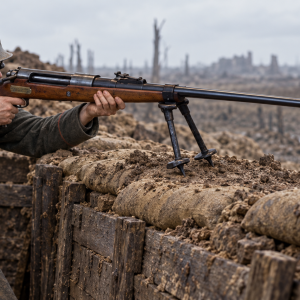
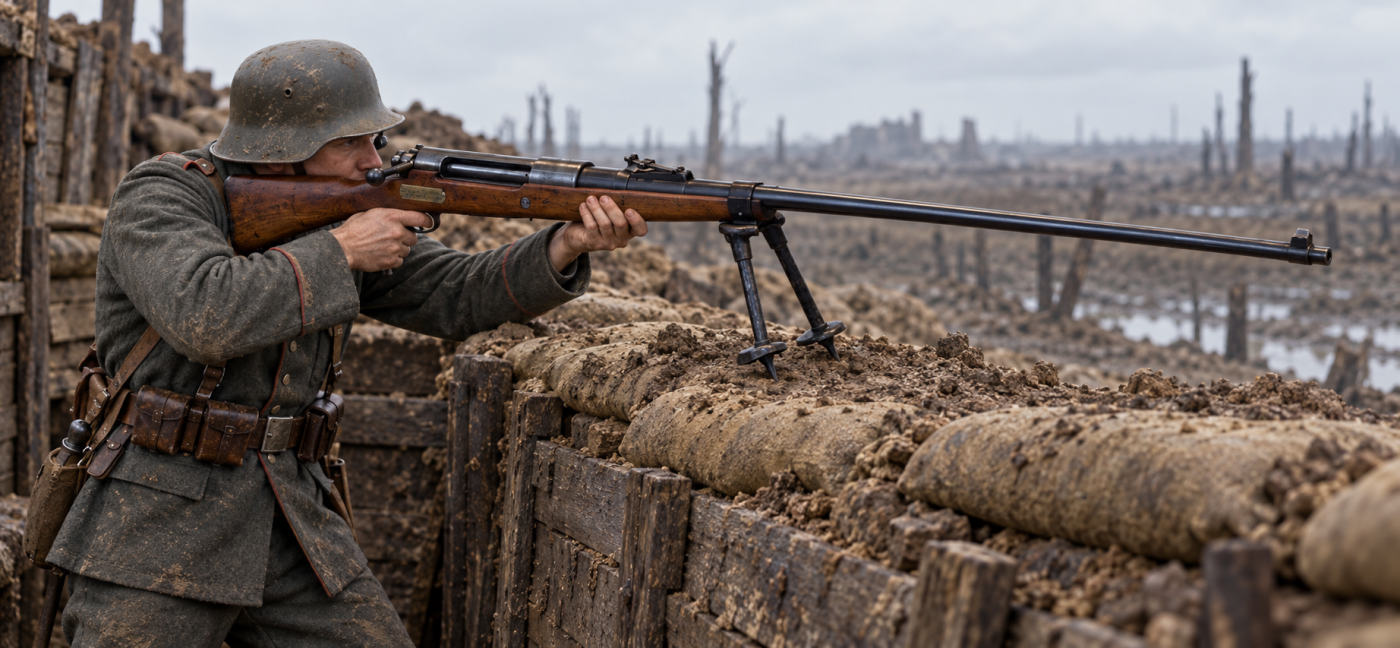
At first glance, the Tankgewehr looked like an infantry rifle enlarged beyond any practical proportion. Nearly 1.7 metres long and weighing around 17 kilograms, with published weights varying according to configuration, it was a considerable burden for the men who carried it. Its long barrel rested on a bipod, while a pronounced wooden pistol grip helped the firer manage the oversized weapon. The familiar outline concealed a specialised purpose, for this rifle had been built around a cartridge powerful enough to challenge the armour of contemporary tanks.
The 13.2 × 92 mm round carried an armour-piercing steel core and was substantially larger than the ammunition fired by the standard German infantry rifle. Its destructive effect depended on driving that core through steel plate. There was no explosive warhead to burst inside the vehicle; the projectile and the fragments produced as it struck the armour had to do the damage. The National Army Museum credits the weapon with penetrating 22 mm of armour at 100 metres, enough to threaten the protection fitted to many tanks of the period. Actual results depended on the range, the quality of the plate and the angle at which the bullet struck.
For the crew inside a tank, penetration could bring sudden injury or death into an already cramped and difficult working space. Pieces of armour broken from the inner surface could add to the damage caused by the bullet itself. Yet piercing the hull did not necessarily stop the machine. A round might pass through without striking a crew member or an essential component, leaving the tank capable of continuing its advance. The Tankgewehr gave German infantry a means of penetrating armour, but a successful hit offered no certainty that the approaching vehicle would be disabled.
The rifle was normally served by two men, sharing the work of carrying the equipment, observing the target and keeping the weapon in action. Its mechanism was straightforward: a manually operated bolt and a single cartridge loaded for each shot. There was no magazine, so every discharge had to be followed by another loading cycle. On a battlefield where a moving tank might offer only a brief opportunity, that limitation mattered. So did the recoil. Without a muzzle brake or a system to absorb the force, the rifle delivered a punishing blow to the firer’s shoulder, adding physical strain to the difficulty of handling such a large weapon under fire.
By the time the Tankgewehr reached the front, Allied attacks were increasingly combining tanks with infantry, artillery and aircraft. Its crews therefore faced more than the armoured vehicle in front of them. They had to work within a battle in which supporting troops and shellfire could make any firing position dangerous. The rifle provided another defensive weapon, but it could not by itself answer the growing effectiveness of these coordinated attacks.
Surviving examples preserve something of those final months of the war. One held by the National Army Museum was captured near Bapaume in 1918 by soldiers of the 4th Battalion, The Middlesex Regiment. Its enormous proportions remain striking, giving a clear impression of the load carried by its crew. The Tankgewehr occupied a brief but significant place in military history, showing how quickly the tank had forced its opponents to adapt. For the soldiers entrusted with it, that change took the form of a heavy rifle, a powerful cartridge and the uncertain task of trying to halt an armoured machine before it reached their position.