Stanisław Sosabowski and the 1st Independent Parachute Brigade
When Germany invaded Poland on 1 September 1939, Colonel Stanisław Sosabowski commanded the 21st Infantry Regiment, known as the ‘Children of Warsaw’. He was an experienced professional officer who had also taught at Poland’s military staff college. His regiment fought north of Warsaw before withdrawing to defend the capital’s eastern districts. On 17 September, the Soviet Union attacked Poland from the east. After Warsaw surrendered, Sosabowski escaped German captivity and joined the underground resistance. In November he left occupied Poland and travelled through Hungary to France. There he joined the Polish forces being rebuilt abroad. He served with the Polish 4th Infantry Division until the fall of France led to his evacuation to Britain in June 1940.
In Scotland, Sosabowski took command of the 4th Rifle Brigade. Its early duties included defending the coast against a possible German landing. During 1941, however, he began turning it into a parachute force. By the autumn it had developed into the 1st Polish Independent Parachute Brigade. The unit remained directly under the Polish Commander-in-Chief because it had a special purpose. Its soldiers were preparing to parachute into occupied Poland and support an uprising against the Germans. Their motto, ‘By the shortest road’, described the route by which they hoped to return home.
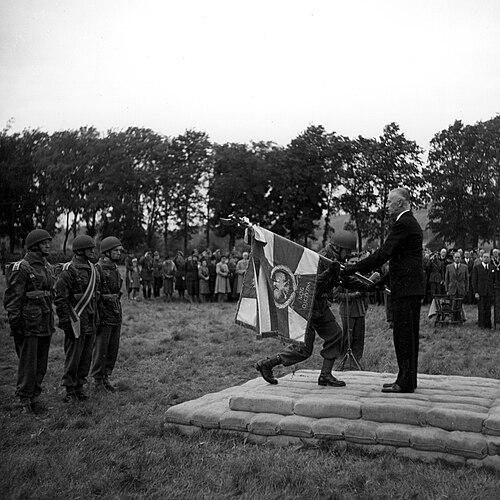
The brigade trained at Largo House in Fife, where the Poles built their own training facilities. An assault course, nicknamed the ‘Monkey Grove’, and a jumping tower helped prepare the men for parachute training at RAF Ringway near Manchester. Sosabowski completed parachute training himself and expected high standards from his soldiers. They wore British uniforms and airborne helmets, but Polish badges and markings showed their national identity. In June 1944 the brigade received its colours, made secretly in occupied Poland. The flag gave the men a direct link with the country they were preparing to fight for.
By then, the military and political situation had changed. The Red Army was advancing towards Poland, but relations between Stalin and the Polish government-in-exile in London had broken down. Stalin supported a rival Polish leadership. Meanwhile, the British wanted to use the brigade in the coming battles in western Europe. In June 1944 the Polish authorities agreed to make it available for Allied operations. When the Home Army began the Warsaw Uprising on 1 August, Polish leaders asked for the brigade’s help. Sosabowski also wanted to take his men to Warsaw. This was the kind of fighting for which they had spent years preparing.
The brigade was not released for deployment to Warsaw. Sending a whole brigade to Poland required enough transport aircraft, suitable landing grounds and a plan to keep the troops supplied. The distance from Britain made these problems much harder, and the brigade was already being drawn into British operational plans. Soviet policy created further difficulties. Stalin opposed the independent Polish authorities and the Home Army. For much of the uprising, he also refused to let Allied aircraft supplying Warsaw use Soviet-controlled airfields. Supply flights from Italy therefore faced long and dangerous return journeys. There was no agreed Allied plan that could turn the brigade’s original purpose into a workable operation. Its soldiers remained in Britain while Warsaw fought.
In September, the brigade was assigned to Operation Market Garden in the Netherlands. Field Marshal Bernard Montgomery planned to use airborne troops to capture a chain of bridges. Lieutenant-General Brian Horrocks’s XXX Corps would then advance along the road linking them. American airborne divisions would take the crossings farther south. Major-General Roy Urquhart’s British 1st Airborne Division, with the Polish brigade under its operational command, would capture the final crossings over the Lower Rhine at Arnhem. Lieutenant-General Frederick Browning’s British I Airborne Corps would coordinate the airborne forces. The plan depended on the ground troops reaching them quickly.
Sosabowski, promoted to general that June, had serious doubts. The British landing grounds were several miles from the Arnhem objectives. The troops would also arrive over several days, giving the Germans time to react before the whole force was assembled. He repeatedly asked for better information about German strength. These concerns challenged the belief that resistance would be limited and XXX Corps would advance quickly. His objections came from the military risks he could see. They did not mean that he knew exactly how the battle would develop.
Market Garden began on 17 September. Polish detachments carrying anti-tank guns, vehicles and other equipment arrived by glider north of the Rhine on 18 and 19 September. They became involved in the fighting around Oosterbeek. The main parachute landing was planned for 19 September, but bad weather delayed it. Limited aircraft and glider allocations had already split the brigade into separate groups. On 21 September Sosabowski finally landed with the main parachute contingent near Driel, south of the river.
By the time Sosabowski reached Driel, the British force at Arnhem bridge had been defeated. Most of Urquhart’s remaining troops were surrounded near Oosterbeek. The ferry that was supposed to carry the Poles across the Rhine was no longer available, and German troops held high ground overlooking the river. Sosabowski organised the defence of Driel, fought off German attacks and tried to obtain boats. About fifty Poles crossed during the night of 22–23 September. Roughly 150 followed the next night. German fire damaged the boats, and there were too few serviceable craft to move larger numbers. Those who reached Oosterbeek joined the British defence.
Plans for further crossings caused sharp arguments. At a meeting in Valburg on 24 September, Sosabowski questioned the proposed operation and the orders given to his battalions. British commanders also faced a difficult choice between sending more troops across and withdrawing the men already trapped there. A further crossing by British infantry failed to establish a secure position on the northern bank. During the night of 25–26 September, British and Canadian engineers brought the survivors out of Oosterbeek, including Polish troops. The brigade’s positions around Driel helped protect the southern side of the escape route.
Market Garden had failed for several connected reasons. Information about German forces, including SS armoured units near Arnhem, had not led to a realistic assessment of the danger. There were too few transport aircraft to carry all the airborne troops in one lift. Distant landing grounds and poor communications added to the problems. Bad weather delayed reinforcements and supplies, while German attacks repeatedly blocked the crowded road used by XXX Corps. The Polish brigade had not drawn up the plan and could not control these wider difficulties. Many had become serious before Sosabowski and his main force landed.
After the battle, however, senior British commanders directed harsh criticism at the Poles. On 16 October Montgomery told the Chief of the Imperial General Staff that the brigade had fought badly and had been unwilling to risk casualties. In a report dated 20 November, Browning questioned Sosabowski’s ability to command and recommended replacing him with a more cooperative officer. There had been real disagreements. Sosabowski could be blunt and difficult, especially when he believed a plan was unsound. But claims that the Poles lacked the will to fight were difficult to square with their repeated river crossings under fire and their defence of Driel.
This helps explain why later historians and Polish accounts have described Sosabowski as a scapegoat. Criticism of his behaviour drew attention away from larger failures in planning, intelligence and command. His brigade had little power to change those decisions. British airborne veterans also considered his treatment unfair. Nevertheless, under British pressure, the Polish authorities removed him from command in December 1944 and gave him responsibility for rear-area units. After more than three years of building and training the brigade, he had to leave it following a battle whose major decisions had been made elsewhere.
The brigade returned to Britain after Arnhem. It later served on occupation duties in northern Germany alongside the Polish 1st Armoured Division. Victory in 1945 did not bring the homecoming its soldiers had expected. Poland was now within the Soviet sphere of influence, and the independent government for which they had fought had not been restored. The brigade was disbanded in 1947, and many of its men remained abroad. Sosabowski stayed in Britain. After leaving military service, he earned his living as a factory storekeeper, far from the country he had hoped to help liberate.
Official recognition came much later. In 2006 the Netherlands awarded the brigade the Military William Order and honoured Sosabowski posthumously with the Bronze Lion. These awards recognised a contribution that had long been overshadowed by the arguments after Arnhem. The brigade had trained to reach Poland by the ‘shortest way’. Its only major airborne battle took place in the Netherlands, after which its commander was blamed for failures largely beyond his control.
Author: Tom Dankers, Historian - Arnhems Oorlogsmuseum 40-45
Historian - Photo:Czesław Datka, Public domain, via Wikimedia Commons