On this day in military history…
On 24 November 1941, HMS Dunedin was patrolling the Atlantic when two German torpedoes turned an ordinary afternoon at sea into a catastrophe. Within minutes, the British cruiser was sinking. For the men who escaped into the water, the struggle was only beginning. They faced three days adrift before rescue arrived, and most would not survive.
Dunedin was a Danae-class light cruiser, launched in 1918 and brought into service after the First World War. Although an ageing warship by 1941, she remained useful in a navy stretched across the world’s oceans. Earlier in her career she had served with the New Zealand Division of the Royal Navy and helped following the devastating Hawke’s Bay earthquake of 1931.
During the Second World War, her duties included patrols, convoy protection and intercepting enemy shipping. In March 1940, she helped secure the German merchant ship Hannover, which was subsequently converted into HMS Audacity, the Royal Navy’s first escort carrier. In June 1941, Dunedin also captured the German supply tanker Lothringen, aboard which valuable Enigma material was recovered.
By November, Dunedin was operating against the German network of raiders and supply ships in the Atlantic. These vessels sustained attacks on merchant shipping far from European waters. Hunting them meant covering enormous distances, often without the immediate support of other Allied warships.
On 24 November, Dunedin was steaming alone east of St Paul’s Rocks, off the coast of Brazil, under Captain Richard Stratford Lovatt. The German submarine U-124, commanded by Johann Mohr, sighted her while heading to rendezvous with the supply ship Python.
Dunedin was zigzagging, a precaution intended to complicate a submarine’s attack. Nevertheless, Mohr manoeuvred into position and fired three torpedoes at long range. Two struck the cruiser. One hit amidships, wrecking the main wireless station; the other exploded farther aft. The damage was overwhelming. Dunedin sank stern first in approximately seventeen minutes.
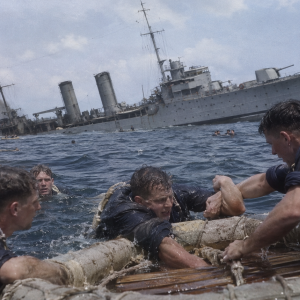
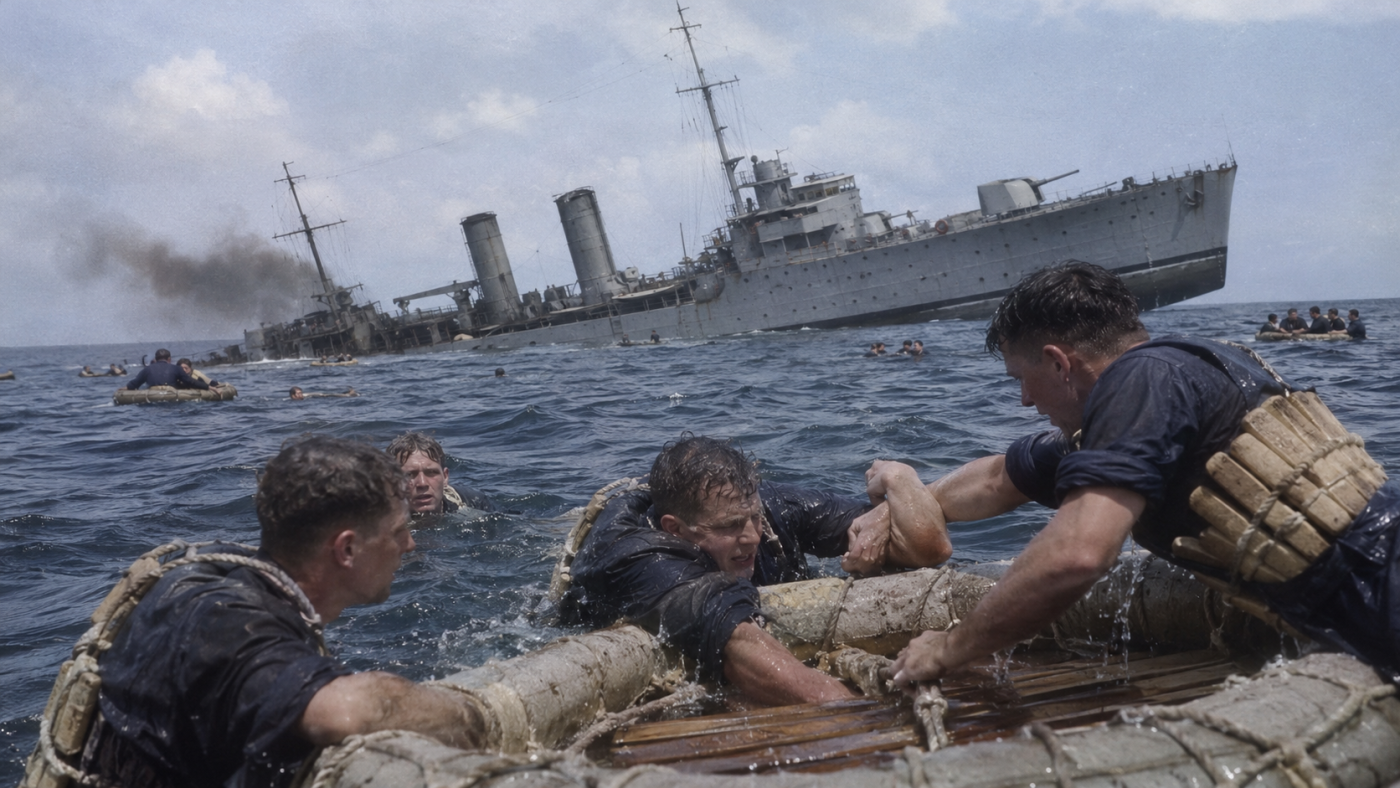
Around 250 men are believed to have escaped the ship, gathering on Carley floats or clinging to wreckage. These small emergency rafts offered little protection from the sea or the equatorial sun. U-124 surfaced near the survivors before departing, leaving them adrift.
The hours became days. Injured men weakened, thirst intensified and exhaustion made it increasingly difficult to hold on. Survivors faced drowning and shark attacks as their numbers steadily diminished. Escaping the sinking had brought no guarantee of survival.
On 27 November, the American merchant ship Nishmaha, sailing from Takoradi to Philadelphia, found the survivors. Her crew recovered 72 men. The contemporary Admiralty war diary recorded the rescue and the decision to land them at Trinidad, where some urgently needed medical attention.
For five of those rescued, help came too late. They died before reaching port, leaving just 67 survivors—four officers and 63 ratings—from a commonly recorded complement of 486. The loss is generally given as 419 men. Captain Lovatt was among those who never returned, along with 55 Royal Marines.
HMS Dunedin’s story captures the terrible isolation of war at sea. A cruiser could disappear in less than twenty minutes, yet the suffering of her crew could continue for days beyond the sight of land or friendly ships. Remembering her means remembering both those lost with the ship and those who endured the long wait for rescue.