The Scheldt and the Fight to Open Antwerp
In early September 1944, Allied armies were advancing through France and Belgium faster than their supply services could follow. The German defeat in Normandy had opened the way to a rapid pursuit, and on 4 September British troops captured Antwerp with its enormous port largely intact. The capture of one of Europe’s largest harbours promised a major improvement in Allied supply. Yet no Allied merchant convoy could reach it. Antwerp lay inland: ships arriving from the North Sea had to follow the Scheldt Estuary past shores still occupied by German troops. The docks had been captured, but their sea approaches remained closed.
Fuel, ammunition, food and replacement equipment still travelled hundreds of kilometres from Normandy and other supply bases. Lorries wore out on long journeys, while damaged railways restricted deliveries. A deep-water port close to the advancing armies could receive large cargoes and greatly shorten onward transport. Making Antwerp useful, however, required several steps: clearing the estuary’s shores, silencing its coastal guns, and sweeping the shipping channel for naval mines.
Allied priorities initially pulled in different directions. First Canadian Army was capturing the Channel ports when it received responsibility for opening Antwerp in mid-September. Meanwhile, Field Marshal Bernard Montgomery concentrated resources on Operation Market Garden, launched on 17 September to cross the Rhine through the Netherlands. During September, German General Gustav-Adolf von Zangen’s Fifteenth Army ferried tens of thousands of men across the estuary and withdrew them through South Beveland. Troops left behind could deny Antwerp to the Allies even without recovering the city. Market Garden’s failure left this problem unresolved.
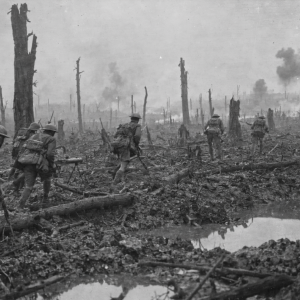
General Harry Crerar’s First Canadian Army faced this task with Canadian and other Allied formations. When illness took Crerar to Britain on 27 September, Lieutenant-General Guy Simonds took temporary command. The country ahead offered little room for a sweeping armoured advance. The flat polders were areas of drained lowland enclosed by dykes and divided by canals and ditches. Mud and extensive flooding narrowed the available routes still further. German machine guns, mines and artillery covered roads and raised embankments. Tanks could support infantry where the ground permitted, but often had little room to spread out or go around a strongpoint.
On 2 October the 2nd Canadian Infantry Division began its main advance north from Antwerp. Beyond the city lay Woensdrecht, commanding the entrance to the narrow land connection with South Beveland. Taking this area would cut the Germans’ land route to the peninsula and Walcheren beyond it. Resistance stiffened as German reinforcements, including the 6th Parachute Regiment, arrived. On 13 October the Canadian Black Watch suffered devastating losses attacking across open fields towards a railway embankment. Three days later, the Royal Hamilton Light Infantry seized Woensdrecht’s commanding ground behind a heavy barrage and held against counter-attacks. German positions nearby still blocked further movement.
By mid-October, following Eisenhower’s insistence, Montgomery had made opening Antwerp the main priority of his army group. The 4th Canadian Armoured Division, previously engaged south of the estuary, moved north of Antwerp and advanced towards Bergen op Zoom. Together with the wider offensive by I British Corps, this pressure threatened German positions inland and helped secure the flank of the Canadians preparing to turn west into South Beveland.
South of the estuary, a separate struggle had already begun. The Breskens Pocket extended across Dutch and Belgian territory between the Scheldt and the canal defences to its south. Major-General Knut Eberding’s German 64th Infantry Division held it with coastal troops and
substantial artillery. Its batteries helped block the shipping approaches. On 6 October, Major-General Daniel Spry’s 3rd Canadian Infantry Division opened Operation Switchback across the Leopold Canal.
The initial footholds offered barely enough room to survive. German counter-attacks pressed against them, while shelling disrupted supply and attempts to build bridges. Water seeped into shallow trenches; infantry sometimes fought at grenade range along the canal bank. On 9 October the division’s 9th Brigade opened another front, crossing the Braakman inlet in amphibious vehicles and landing near Hoofdplaat behind the main German defences. Buffaloes operated by British engineers carried troops across water that ordinary vehicles could not cross. Reinforcements followed, forcing Eberding to fight attacks from several directions.
The 3rd Canadian Infantry Division became known as the “Water Rats” during the Scheldt fighting. Its experience of amphibious warfare stretched back to the Normandy landings; now waterways and flooded fields again governed its operations. Progress remained slow and difficult: each defended *blocked text* could shelter another position, and artillery support could not remove every strongpoint. Breskens fell on 21 October, but resistance farther west continued. Eberding was captured on 1 November; Switchback was declared complete on 3 November. Bombardment and fighting had meanwhile devastated settlements and displaced civilians on both sides of the Dutch-Belgian border.
Before the pocket was fully cleared, operations north of the Scheldt had moved into South Beveland. Operation Vitality began on 24 October, with the 2nd Canadian Division attacking west along the narrow approach. Flooding, mines and anti-tank fire prevented a rapid advance. Another water obstacle, the Beveland Canal, lay ahead. On 26 October troops of the British 52nd (Lowland) Division crossed the estuary and landed on the peninsula’s southern shore, outflanking the canal defences. Canadian infantry crossed the canal as the pressure increased. By the end of October the Germans had withdrawn from South Beveland to Walcheren.
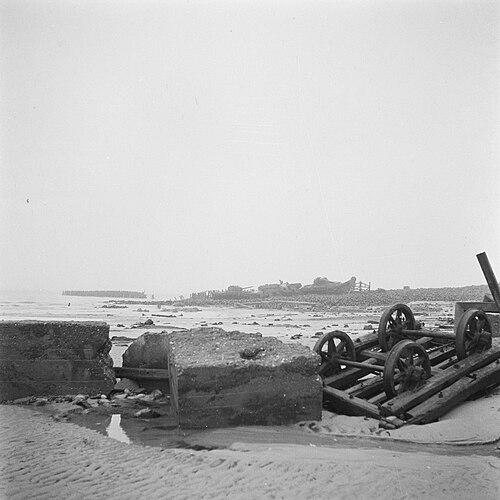
Walcheren’s coastal batteries guarded the estuary’s entrance. Its garrison, centred on Lieutenant-General Wilhelm Daser’s 70th Infantry Division, occupied concrete defences around the island’s rim. During October the Allies had deliberately transformed the battlefield. At Simonds’s urging, RAF bombers breached the sea *blocked text* at Westkapelle on 3 October and later attacked other sections. Flooding the low interior would isolate positions, slow German reinforcement and allow Allied amphibious vehicles to approach across the flooded land. Many coastal guns on higher ground could still fire. The bombing killed more than 150 civilians at Westkapelle, while the spreading salt water forced thousands from their homes and damaged farmland.
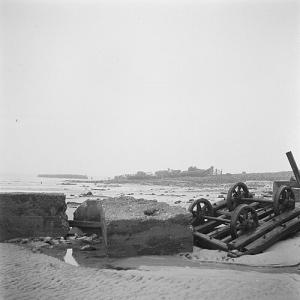
The eastern approach offered no easy solution. From 31 October, battalions of the 2nd Canadian Division attacked the narrow Walcheren Causeway under concentrated fire. A deep crater blocked vehicles, and the surrounding mudflats complicated attempts to go around it. Small Canadian parties reached the island but could not establish a secure, expanding bridgehead. British troops took over, and a later crossing of the Sloe channel south of the causeway finally opened another route inland.
The main amphibious assaults, Operation Infatuate, began on 1 November. No. 4 Commando crossed from Breskens to Vlissingen, known to the British as Flushing, followed by the 52nd Division’s 155th Brigade. Street fighting gradually cleared the town. At Westkapelle, Royal Marine commandos landed beside the breached *blocked text*, supported by specialised armour and naval gunfire. Surviving German batteries inflicted heavy losses on the supporting craft before
troops ashore could overcome them. French, Dutch, Belgian and Norwegian commandos also took part in the Walcheren operations. Although Canadians had borne the principal burden around the estuary, defeating this final fortress depended heavily on British infantry, commandos and naval forces.
Daser surrendered at Middelburg on 6 November, and organised resistance on Walcheren ended on 8 November. The cost reflected weeks of canal crossings and exposed infantry attacks against prepared positions. Between 1 October and 8 November, First Canadian Army recorded approximately 12,900 killed, wounded or missing across all its fronts, including the supporting operations inland. About 6,400 were Canadians.
Victory on land still did not make the channel safe. Allied minesweepers had begun work while the final fighting continued. Operation Calendar, the main clearance of the Scheldt shipping route, was completed on 26 November. The first Allied convoy reached Antwerp on 28 November, nearly three months after the city’s capture. Supplies could now arrive in quantity much closer to the front, although unloading, storage and transport to the armies still required considerable effort.
Antwerp became a major supply base for the later advance towards Germany. Its capture had taken remarkably little time; making the port usable required weeks of costly fighting through canals, flooded polders and fortified coastal positions. The Scheldt campaign mattered because it eased a supply problem made increasingly urgent by the speed of the Allied advance.
Author: Tom Dankers, Historian - Arnhems Oorlogsmuseum 40-45
Photograph: Fotograaf Onbekend / Anefo, CC0, via Wikimedia Commons