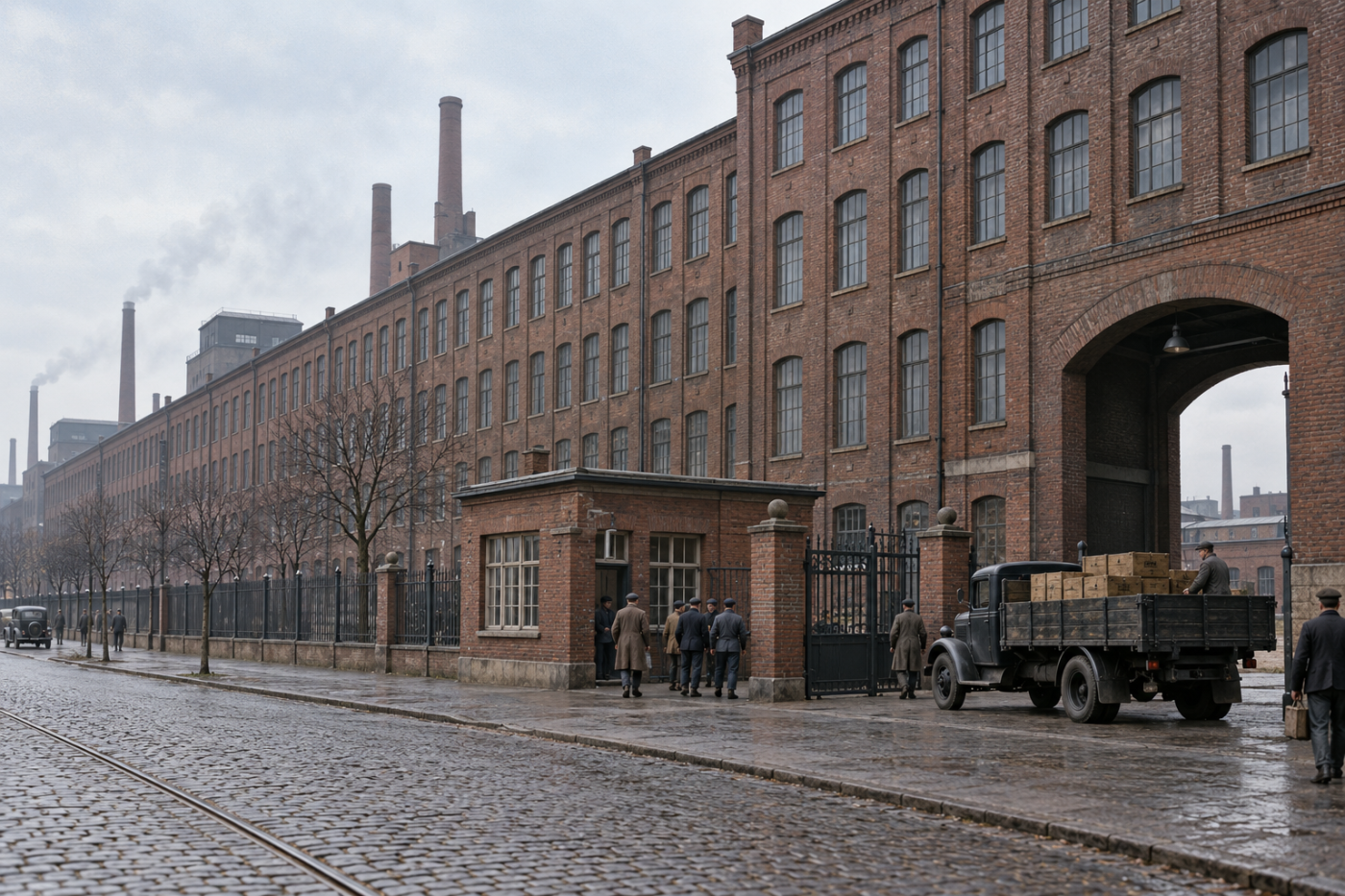
Polte Werke Factory
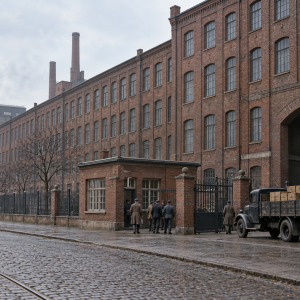
In Magdeburg, Polte-Werke was a familiar name in metalworking long before the Second World War. Engineer Eugen Polte bought a small foundry and fittings factory in the city in 1885. Within two years it was making grenade fuses, and a major order from the Prussian War Ministry in 1889 led the firm into cartridge cases, artillery shell cases and the machinery used to manufacture ammunition. Its business expanded during the First World War, when a new works was built to meet military demand. After the fighting ended, Polte briefly concentrated on civilian goods, particularly large industrial fittings. The company had the equipment and experience to make ammunition again when Germany began rearming in the 1930s.
Under the Nazi regime, Polte grew from a Magdeburg manufacturer into an armaments group with factories beyond the city. Its main operation included a fittings works, a rifle ammunition factory, an artillery shell case factory and a laboratory concerned with the materials used for cartridge and shell cases. Branches added further capacity. At Salzwedel, a subsidiary made infantry and anti-aircraft ammunition; at Grüneberg, production included infantry and 2 cm ammunition. Some works were established with state funds as Germany prepared for war. By 1945, the Polte name represented a network of factories whose output was needed on several fronts.
Ammunition manufacture depended on precision and repetition. Metal had to be formed into cases that would fit a particular weapon, withstand firing and work reliably when soldiers needed them. Presses, drills and lathes carried out different stages of production, while workers cleaned and treated the components. It was demanding factory work, much of it performed in long shifts. Polte supplied the less visible side of the German war effort: the cartridges and shell cases consumed in vast numbers whenever an army fought.
The workforce behind that production included German employees, foreign civilian labourers and prisoners of war, but increasingly it also included people held in concentration camps. During the war, Polte employed around 20,000 people in Magdeburg alone, many of them under coercion. The factory did more than accept prisoners sent by the SS. Its management sought additional labour, while representatives selected men from a concentration camp for work at the plant. Forced labour became part of how Polte maintained production as the war continued.
In June 1944, Polte and the SS established a camp for women across the road from the main Magdeburg works. Its position brought imprisonment into the middle of a residential district: the factory stood on one side of the street and the prisoners’ barracks on the other. More than 1,800 women were there by September, and the camp eventually held over 3,000. Many had been brought from Poland or the Soviet Union. Among them were Polish women deported after the crushing of the Warsaw Uprising. Later transports included Jewish women, principally from Poland and Hungary, who had already survived ghettos or other camps before reaching Magdeburg.
Their days were divided into shifts running from six in the morning until six in the evening, or through the night until morning. Women worked at shell case presses and carried out drilling, cleaning, lacquering and chemical treatment, often without suitable protection. Afterwards they returned to barracks with bare concrete floors, unglazed windows and little warmth. Washing facilities were limited, food was inadequate and disease spread. The company paid the SS a daily fee for the women’s labour. By March 1945, more than a hundred women were unfit for work each day. At least 18 died in the camp after September 1944, while others who could no longer work were sent away to Ravensbrück or Bergen-Belsen.
A separate men’s camp opened on the same site in November 1944. Its first large transport brought 500 Jewish prisoners from Stutthof, including men from Latvia who had already endured years of persecution. One of the prisoners was a boy of just twelve. The men were put to work on lathes and presses; some were treated as skilled workers, though they remained captives under guard. More prisoners arrived as Germany’s position deteriorated. At Polte’s Salzwedel branch, around 1,520 Jewish women were also forced to make ammunition in two twelve-hour shifts. There, as in Magdeburg, the drive to keep machines running depended on people who had no freedom to leave.
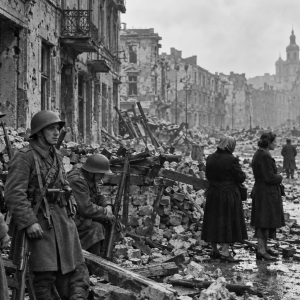
Heavy air raids on Magdeburg reduced production from January 1945. Some prisoners were then made to clear rubble or build defences as American troops approached. In April, parts of the SS guard force fled, and some inmates escaped into the ruined city. On 13 April, guards and Volkssturm men rounded up those who remained and forced them across the Elbe towards the Neue Welt sports ground. The prisoners came under American artillery fire, and guards shot at those who tried to reach safety. The exact number killed is unknown. Surviving men were driven towards Sachsenhausen and women towards Ravensbrück. At Salzwedel, the camp was not evacuated; American soldiers liberated its prisoners on 14 April.
After the war, Polte’s facilities were dismantled as reparations to the Soviet Union, and the remaining business later passed into state ownership. In Magdeburg, a surviving camp entrance gate on today’s Liebknechtstraße stands as a memorial. It recalls the people whose labour was hidden behind Polte’s ammunition production: the women and men made to keep working while the war, and their captivity, continued.