Naval Binoculars
The Giant Eyes of the Japanese Navy: The Fuji Meibo 25×150 Binoculars
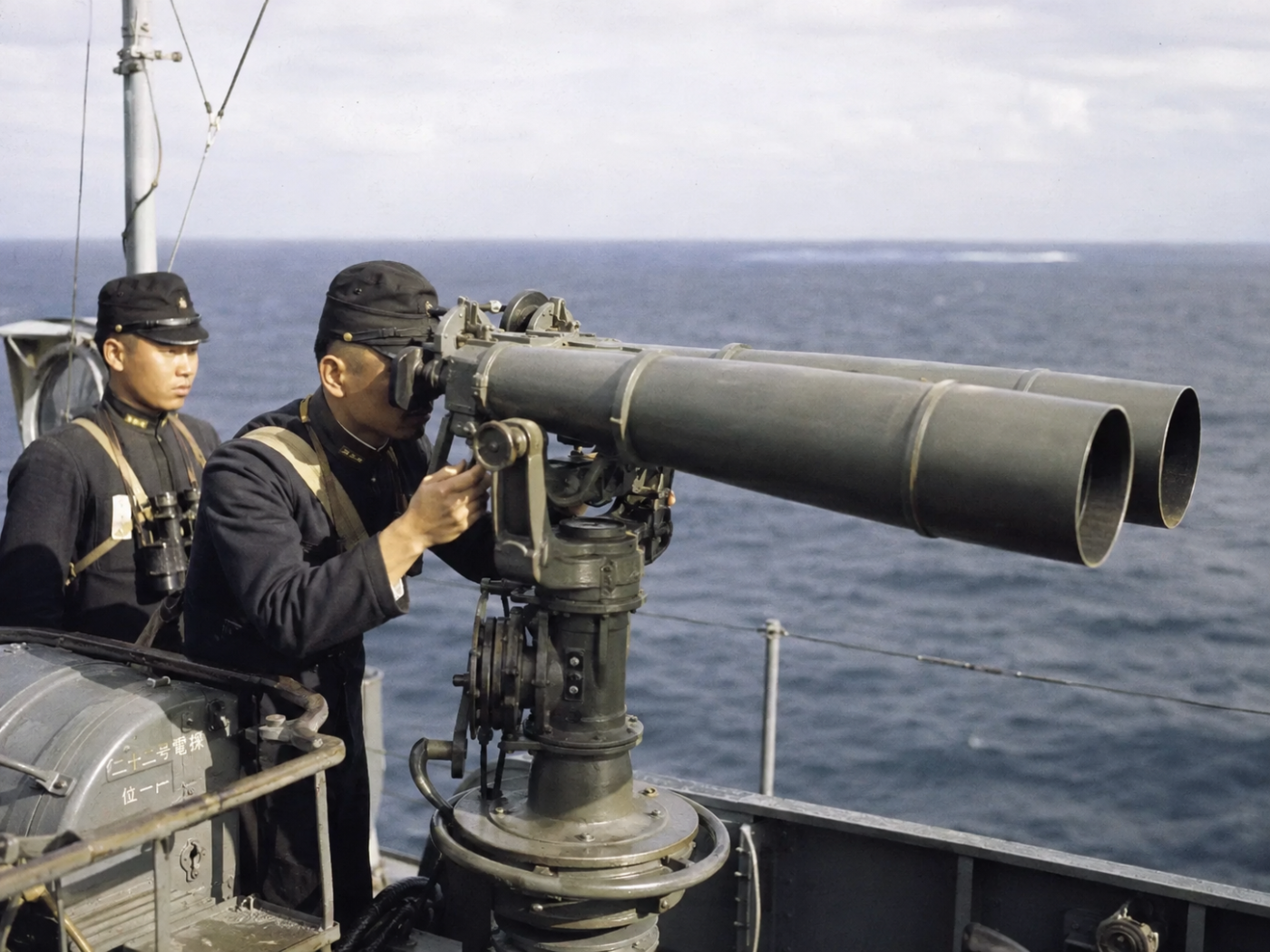
Few optical instruments possess the sheer presence of the enormous Japanese 25×150 naval binoculars. Standing on a heavy pedestal or tripod and measuring almost a metre in length, they look less like ordinary binoculars and more like a pair of naval guns. Their huge objective lenses, complicated internal prisms and finely engineered mounting system allowed an observer to search enormous areas of sea and sky from the bridge of a warship, coastal observation post or naval base.
They are frequently described today as Fuji Meibo Second World War binoculars, although this requires some explanation. The Fuji Meibo 25×150 commonly encountered by collectors was principally a post-war development, built in the same tradition as the giant binoculars used by the Imperial Japanese Navy. Fuji introduced its first Meibo binocular in 1947, while surviving Fuji Meibo 25×150 bridge binoculars are often dated to the 1950s or around 1960. During the war itself, Japan’s best-known giant naval binoculars were produced under names including Nikko, associated with Nippon Kogaku, and Toko, associated with Tokyo Kogaku. These wartime instruments established the pattern from which the later Fuji Meibo giants developed.
The designation 25×150 explains the instrument’s extraordinary power. The first number means that an object appeared approximately twenty-five times closer than it would to the naked eye. A ship standing twenty-five miles away would therefore appear, in terms of apparent size, roughly as it would at a distance of one mile. The second number refers to the diameter of each front objective lens, which measured an enormous 150 millimetres, or almost six inches.
The size of the objective lenses was every bit as important as the magnification. Large lenses gathered far more light than ordinary hand-held binoculars, producing a brighter image at dawn, at dusk and during poor weather. Each 150 mm lens had an area many times greater than that of a conventional 50 mm naval binocular, giving the observer a considerable advantage when searching for the faint silhouette of a ship, the smoke from a distant funnel, an aircraft against cloud or the brief white wake of a submarine’s periscope.
Dividing the 150 mm objective diameter by the 25-power magnification gives an exit pupil of six millimetres. This was particularly useful under low-light conditions because it delivered a broad column of light to the observer’s eye. A modern version of the 25×150 design has a field of view of approximately 2.7 degrees, although wartime and early post-war patterns could vary. At first this may appear narrow, but at long range it still covered a very large area of sea.
Unlike a telescope, the instrument allowed the observer to use both eyes. This reduced fatigue during prolonged watches, improved the ability to interpret shapes and gave a greater impression of depth and scale. On a warship where men might spend hours scanning an empty horizon, that comfort could be extremely important. The brain combines the two images naturally, making it easier to recognise a distant mast, aircraft or patch of smoke than when looking through a single optical tube.
Internally, the binoculars used a system of carefully ground lenses and prisms to turn the image the correct way up and deliver it to the eyepieces. Producing two large optical systems that remained perfectly aligned was exceptionally difficult. Even a slight difference between the left and right optical paths could cause eye strain, double vision or headaches. The alignment process, known as collimation, required considerable precision, especially in an instrument expected to survive the movement, vibration and shock of a warship.
Each eyepiece could normally be focused independently. This allowed an observer to compensate for differences between his eyes without constantly altering a central focusing mechanism. Once correctly adjusted, the binoculars could be used to examine targets from relatively close range out to the visible horizon. Removable rubber or metal eyecups helped exclude stray light and made it easier for the operator to hold his eyes in the correct position.
The immense size of the instrument meant that it could never be held by hand. The binocular body alone could weigh several tens of kilograms, while a wartime Toko 25×150 example has been reported at approximately 79 pounds before its mounting was included. The complete installation, with its pedestal, support arms and turning mechanism, was far heavier.
A robust gimbal mounting supported the optical body and allowed it to move smoothly in both elevation and direction. The operator could sweep from side to side across the horizon, elevate the instrument to follow an aircraft or lower it to investigate something nearer the surface of the water. Counterbalancing and carefully machined bearings allowed a surprisingly heavy instrument to be moved with relatively little effort.
Some models had straight-through eyepieces, while others used inclined or right-angled viewing arrangements. Inclined eyepieces made it easier to look upward without forcing the observer into an uncomfortable position. Right-angled sets were especially useful when following high-flying aircraft or when the installation had to be placed behind protective structure. Wartime Toko 25×150 binoculars are known with 90-degree eyepieces and a field of view of around 2.4 degrees.
On a battleship or cruiser, giant binoculars could be mounted on the bridge, signal platform, air-defence position or high in the ship’s superstructure. Height greatly increased the distance to the horizon. From the deck of a small vessel, the curvature of the Earth might hide a distant ship, but an observer placed high on the tower of a battleship could see much farther.
The binoculars were primarily searching and identification instruments rather than complete rangefinders. They could reveal a target and help determine its type, direction and movement, but accurate gunfire usually depended upon separate stereoscopic or coincidence rangefinders connected to the ship’s fire-control system. Nevertheless, locating the enemy was the essential first step. A rangefinder could not measure a target that the lookout had not yet found.
Observers looked for remarkably small clues. A faint mast might appear before the hull of an approaching ship rose above the horizon. Smoke could indicate the position and direction of a distant task force. At night, lookouts searched for flashes, silhouettes, signal lamps, fires and the pale trail of a ship’s wake. Against aircraft they watched for movement, changing reflections, formation shapes and the contrast between an airframe and the surrounding sky.
Japan placed particular importance on night fighting. Before the Pacific War, the Imperial Japanese Navy trained intensively for torpedo attacks carried out under darkness. Large-aperture binoculars suited this doctrine because they gave highly trained lookouts the best possible chance of detecting an enemy before the Japanese formation was itself seen.
Japanese warships carried several different sizes of binoculars. Smaller 7×50 and 10×70 instruments could be hand-held or placed on light mounts, while powerful fixed instruments included 15×80, 20×120 and 25×150 types. Japanese naval optical equipment also extended beyond the 150 mm class, with some exceptionally large instruments having objective lenses of 180 or even 200 mm. The 25×150 therefore was not necessarily the absolute largest binocular ever made by wartime Japan, but it belonged among the largest practical binoculars widely associated with naval observation.
A huge binocular was only as useful as the men operating it. Naval lookouts were trained to divide the horizon into sectors and search in an organised pattern rather than staring randomly across the sea. The instrument had to be moved slowly enough for small details to register. After checking one area, the observer shifted slightly, ensuring that no part of the assigned sector was overlooked.
Long periods at the eyepieces were physically and mentally exhausting. A lookout had to distinguish genuine objects from cloud, spray, floating wreckage, reflections and visual disturbances caused by heat. At extreme ranges, atmospheric haze could distort the image, while the rise and fall of the ship continuously moved the horizon. Salt spray, rain and condensation created further difficulties.
The large objective lenses required protection. Metal caps were fitted over the front of the binoculars when they were not in use, while some sets had shades or extensions around the objectives to reduce glare and shield the glass. The exposed surfaces were vulnerable to salt, wind-blown grit and accidental damage, and the mechanical joints needed regular cleaning and lubrication.
Optical glass also faced serious wartime limitations. Modern binoculars commonly use sophisticated multi-layer coatings to improve light transmission and reduce internal reflection. Many early giant binoculars were uncoated or used comparatively basic coatings. Despite this, the immense objectives and high standard of Japanese lens grinding could still produce a remarkably bright and detailed image.
The housing was built to withstand naval service. Thick castings protected the prisms and lenses, while seals reduced the entry of moisture and dust. Even so, maintaining such a complicated instrument aboard a ship was difficult. A severe impact, nearby gun blast or mechanical shock could disturb the collimation. Moisture entering the body could cause fogging, fungal growth or corrosion.
The concussion from a battleship’s main armament was an obvious threat. When heavy guns fired, the pressure wave could shake exposed equipment and injure personnel standing in the wrong place. Optical instruments were therefore mounted in carefully chosen positions and secured when necessary. Gunfire, vibration from engines and the constant movement of the vessel all placed stress on the binoculars.
Giant optics also formed part of Japan’s coastal defence system. From fortified islands, harbour entrances and elevated observation posts, observers could watch shipping routes and report the approach of enemy vessels. Used from a stable land mounting, the binoculars avoided the constant motion experienced aboard ship and could provide exceptionally detailed long-range views.
They were also useful for observing aircraft, directing searchlights and supporting anti-aircraft defence. A large instrument could help identify the number, height and direction of approaching aircraft long before smaller details became visible to the unaided eye. Information from observation stations could then be passed by telephone or signal to gun batteries, command posts and nearby ships.
Japanese industry devoted considerable resources to military optics. Rangefinders, gun sights, periscopes, cameras and binoculars required high-quality optical glass together with precision machining. Nippon Kogaku, the company that later became famous as Nikon, had already developed considerable experience in military optical equipment. Tokyo Kogaku, later known for the Topcon name, was another major wartime producer.
Fuji’s involvement in precision optics developed during the war years. Fujifilm’s corporate history records that it acquired the operations of Enomoto Kogaku Seiki Manufacturing Company and established Fuji Photo Optical in March 1944. Its first post-war binocular appeared in 1947 under the Meibo name. The word Meibo became associated with well-made Japanese binoculars before the Fujinon name gained wider international recognition.
The later Fuji Meibo 25×150 was therefore part of a direct Japanese tradition of building enormous professional binoculars for ships, ports, coastguards and long-range observation. Its appearance strongly resembled wartime naval instruments, which explains why restored examples are frequently labelled as Second World War equipment. However, individual sets must be judged by their serial numbers, maker’s plates, markings, construction and documented history.
A Fuji Meibo nameplate alone should not be accepted as proof that a set served aboard a Japanese warship during the Pacific War. Auction records identify Fuji Meibo 25×150 bridge binoculars dating from around 1960, while other examples are described as approximately 1950s production built to a wartime-derived pattern. Genuine wartime examples are more likely to carry Nikko, Toko or other period military markings.
At the end of the war, large numbers of Japanese military binoculars were captured by Allied forces. Some were removed from ships, naval bases, coastal positions and abandoned installations throughout the Pacific. A surviving pair of Japanese Nikko “big-eye” binoculars in the collection of the United States Naval History and Heritage Command was captured during the fighting around Leyte in 1944.
Transporting the largest sets home was not easy, and many were destroyed, scrapped or stripped of their optics. Those that survived sometimes spent decades in dockyards, private collections, museums, seaside observation points or industrial buildings. Their military paint was occasionally removed and the metal polished, creating the gleaming brass or aluminium appearance seen on many decorative examples today.
Although polished examples are visually impressive, they no longer show how the instruments would normally have appeared in service. Naval binoculars were usually finished in practical colours intended to resist corrosion and reduce reflections. Depending upon period and application, this could include black, grey or greenish paint. Bright polished metal would have produced unwanted glare and made the observer’s position more visible.
Today, the largest surviving sets are highly desirable objects. Their value depends heavily upon originality, optical condition, manufacturer, serial number and the survival of the original mounting. An instrument with clear wartime markings, untouched paint and documented naval provenance is historically more important than a heavily polished post-war example, even when the latter appears more dramatic.
The optical condition is particularly important. Scratched or separated lenses can be difficult to replace, and internal fungal damage may permanently mark the glass. A set that has lost its collimation requires specialist work. Because the two optical paths must remain aligned at high magnification, repair is far more complicated than servicing an ordinary pair of binoculars.
Even after more than seventy years, a well-preserved instrument can provide an astonishing view. The image is bright, the magnification powerful and the sense of using both eyes quite different from looking through a telescope. For this reason, giant Japanese binoculars have also become popular with astronomers, who use them to observe the Moon, star fields, nebulae and comets.
Fuji continued to refine the design after the war, and the later Fujinon 25×150 series became internationally respected for maritime, security and astronomical observation. Modern versions retained the basic combination of twenty-five-power magnification and enormous 150 mm objectives while adding improved coatings, waterproofing and better optical glass. Fujinon catalogues have promoted the design for professional shipping, coastguard duties, border observation and use at night.
The giant 25×150 binocular stands as evidence of the importance of human observation before radar became completely dominant. Radar could reveal that something was present, but an experienced man using powerful optics still had to decide whether the contact was a merchant ship, destroyer, aircraft, submarine or harmless feature of the sea.
Mounted high above the deck, the observer and his binoculars became part of the ship’s detection system. What he saw could bring a fleet to action stations, alter course, launch aircraft or prepare the guns. A faint shape appearing in those enormous lenses might be the first warning of an approaching enemy.
Although the Fuji Meibo version was largely a product of the post-war period, it preserved one of the most striking achievements of Japanese wartime optical engineering. Its immense lenses, precision construction and monumental mounting reflected a period when naval battles could depend upon which lookout first detected a speck of smoke or the tip of a mast on the distant horizon.
Whether encountered in original military paint, restored condition or polished as a spectacular display piece, the 25×150 remains one of the most imposing binocular instruments ever built. It was not simply an oversized pair of binoculars. It was a twin naval telescope, a precision surveillance instrument and the descendant of the giant eyes that watched over Japan’s fleets during the Second World War.