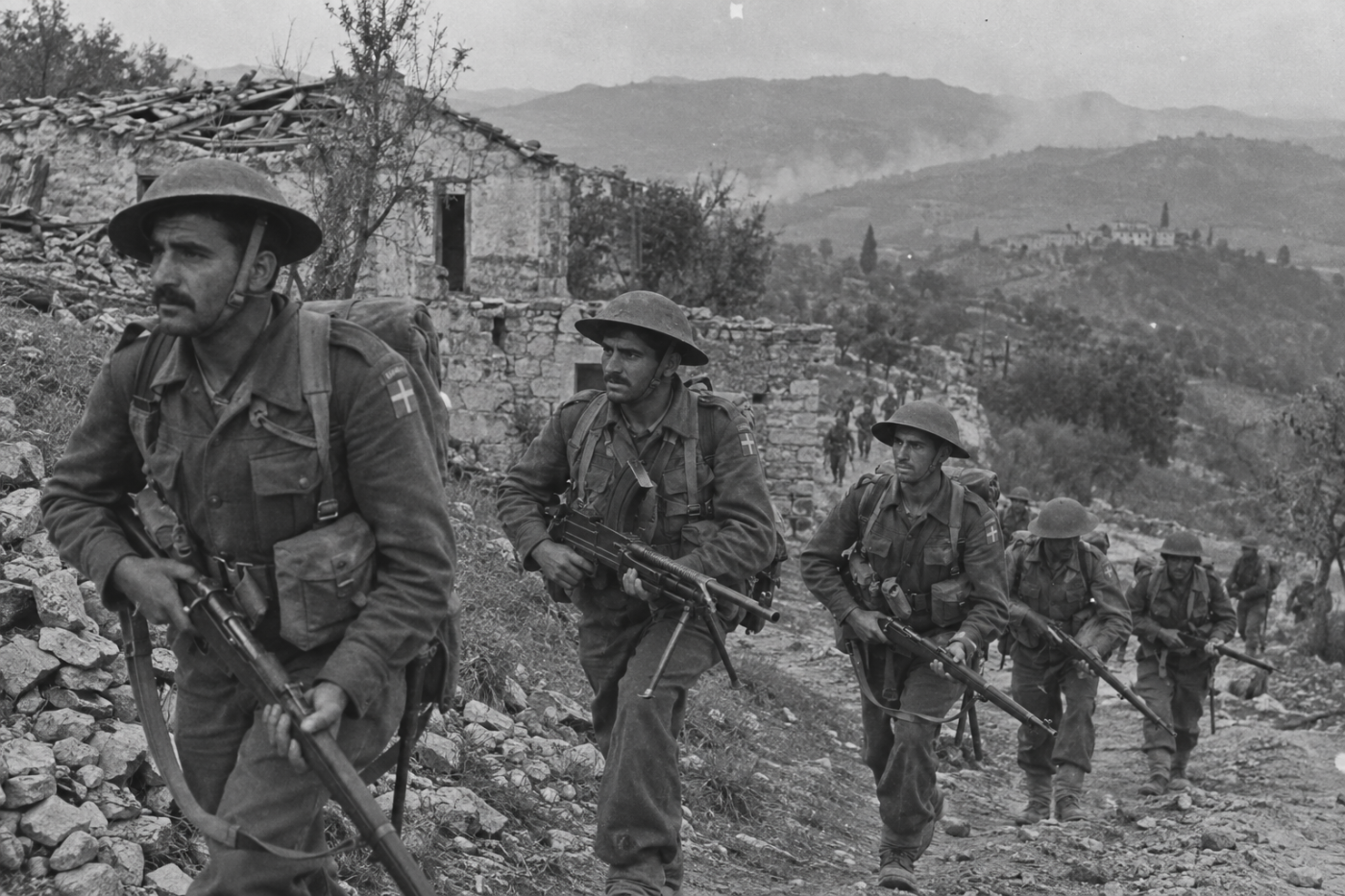
Greek Mountain Troops
The 3rd Greek Mountain Brigade was one of the most distinguished Greek formations to serve with the Allies during the Second World War. Formed in the Middle East during the final year of the conflict, its men were trained as mountain infantry before being sent to Italy, where they fought through heavily fortified German positions and earned the permanent title of the “Rimini Brigade”. Following the German invasion and occupation of Greece in 1941, elements of the Greek armed forces escaped to Egypt and continued fighting alongside the British. Greek soldiers, sailors and airmen served across the Middle East, North Africa and the Mediterranean, but their forces became increasingly divided by the political struggle between royalist, republican and communist supporters.
In April 1944, sections of the Greek armed forces in the Middle East mutinied amid demands that the resistance movement inside occupied Greece should have a greater role in the country’s future. The revolt was suppressed with British assistance, after which many existing Greek units were disbanded or reorganised. From the soldiers and officers considered reliable enough to continue fighting, the Greek government-in-exile created the 3rd Greek Mountain Brigade. The order establishing the unit was issued on 9 June 1944 and Colonel Thrasyvoulos Tsakalotos, an experienced professional officer who would later become one of the most important commanders in the post-war Greek Army, was placed in command.
The brigade was assembled rapidly before moving to the British Mountain Warfare Training Centre near Tripoli in Lebanon. Its intensive training began on 22 June and continued until 28 July 1944, by which time it numbered approximately 3,377 officers and men. It contained three infantry battalions, a field artillery regiment, engineers, signals, medical personnel, military police and the transport and supply units required to support it in battle. Its members were carefully selected, strongly disciplined and loyal to the Greek government-in-exile. Their training was demanding, but for many the coming campaign in Italy would be their first experience of sustained front-line combat as part of the newly formed brigade.
On 11 August 1944, the men sailed from Haifa and landed at Taranto in southern Italy before travelling north to join the British Eighth Army, which was preparing to attack the Gothic Line. This formidable German defensive system stretched across northern Italy and consisted of prepared positions, minefields, trenches, anti-tank obstacles and fortified villages. The Greeks were attached to I Canadian Corps and operated alongside Canadian and New Zealand troops. Their principal objective was Rimini, an important city on the Adriatic coast controlling one of the main routes into the Po Valley. Its approaches were defended by experienced German troops, including men of the 1st Parachute Division, who had already earned a fearsome reputation during the fighting in Italy.
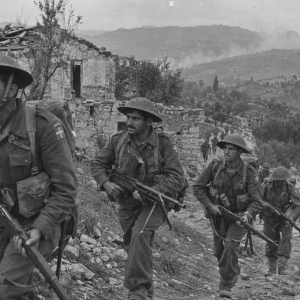
The brigade entered the front line during the night of 8–9 September 1944, taking over positions near Riccione. Greek patrols immediately began encountering German forces across ground broken by rivers, drainage ditches, vineyards, hedgerows and isolated farm buildings, many of which had been converted into strongpoints. During the fighting around San Lorenzo, Monaldini and Monticelli, the Greeks attacked determined German positions under heavy mortar and machine-gun fire. Supported by Allied artillery, Canadian infantry and New Zealand Sherman tanks, they gradually forced their way forward, although the struggle was costly and some Greek companies lost a considerable proportion of their strength during their first major actions.
On 15 September, the brigade began its assault towards Rimini airfield. The 1st Battalion attacked across the Marano River while the 2nd advanced near the Via Flaminia and the 3rd fought through the Casalecchio area. German paratroopers defended houses, churches and prepared positions around the airfield, while anti-tank guns, Panzerschreck rockets and static Panther tank turrets covered the approaches. The Greek infantry repeatedly advanced through intense fire, sometimes becoming separated from their supporting armour. Houses and farm buildings had to be cleared individually, while mines blocked the routes forward. Close cooperation with the New Zealand tanks eventually enabled the brigade to break into the German positions and secure the airfield.
The Greeks then continued towards Rimini itself. The German defenders had suffered heavily and were in danger of being outflanked by the wider Canadian advance, forcing them to withdraw during the night of 20 September to new positions beyond the Marecchia River. On the morning of 21 September, men of the brigade’s 2nd Battalion entered the devastated city. A formal protocol recording Rimini’s surrender to the Greek forces was signed and the Greek flag was raised during a ceremony attended by representatives of the Canadian and New Zealand units that had supported the advance.
The capture of Rimini was not achieved by the Greeks alone, but their contribution had been substantial. They had broken through several layers of prepared defences, captured the airfield and fought their way into the city against some of Germany’s most experienced troops. The commander of the British Eighth Army, Lieutenant-General Sir Oliver Leese, described the wider struggle for Rimini as one of the hardest battles faced by his army, comparing its severity with El Alamein, Mareth and the Gustav Line.
The brigade’s campaign did not end at Rimini. After a short period of rest, it returned to the line and advanced northwards alongside the New Zealanders. On 27 September, its 1st Battalion crossed the Uso River, advanced approximately eight kilometres and captured Bellaria before reaching positions near the historic Rubicon. The brigade remained in Italy during October, holding its ground and repelling local German attacks. Its achievements came at a heavy price, with 116 men killed, including ten officers, and another 316 wounded. In recognition of its conduct, it was awarded the honorary title “Rimini Brigade”, a name that became permanently associated with the formation.
In early November 1944, the brigade embarked at Taranto and returned to liberated Greece, arriving in Athens on 9 November. However, the end of the German occupation did not bring peace, as political tension between the Greek government and the communist-led EAM-ELAS resistance movement was rapidly moving towards armed confrontation. The future of the brigade became one of the country’s most controversial issues. While demands were made for the disarmament of resistance forces, the government intended to retain the 3rd Mountain Brigade and the Greek Sacred Band as the nucleus of a new national army. EAM regarded the brigade as a strongly royalist formation backed by Britain, while its supporters saw it as a disciplined regular unit that had fought successfully against the Germans.
When fighting erupted in Athens in December 1944 during the events known as the Dekemvriana, the brigade defended its positions around Goudi against powerful ELAS attacks. Supported by British armour and other government forces, its soldiers held their ground and later participated in operations to regain control of the capital. These actions made the brigade an important force during the opening confrontation of the bitter struggle that eventually developed into the Greek Civil War.
The original 3rd Greek Mountain Brigade was formally disbanded during 1945 as the Greek Army was reorganised. Many of its officers and men were absorbed into the rebuilt national forces, with several later serving during the Civil War. Tsakalotos rose to senior command and played a leading part in the government victory over the communist Democratic Army of Greece. Although the wartime formation ceased to exist, its name and traditions survived. The modern Hellenic Army’s 3rd Mechanised Infantry Brigade carries the honorary title “Rimini”, while the Greek Military Cemetery at Riccione, where more than one hundred Greek soldiers lie buried, remains a lasting memorial to their sacrifice. Created during a period of military collapse and political division, the brigade existed for only a short time, yet its achievements in Italy secured it a distinguished place in Greek military history.