Extortion 17 crash
On 6 August 2011 the war in Afghanistan suffered one of its most devastating single incidents when a United States Army CH-47D Chinook helicopter, using the call sign Extortion 17, was shot down in the Tangi Valley of Wardak Province. Every person aboard the aircraft was killed. Thirty American servicemen, seven Afghan commandos and an Afghan civilian interpreter died, together with a United States military working dog. The loss of 30 Americans made Extortion 17 the deadliest single incident for United States forces during the entire war in Afghanistan and the greatest single loss of life in the history of United States Naval Special Warfare. The disaster was particularly shocking because many of the men aboard belonged to some of America's most highly trained special operations units. Seventeen of the dead were United States Navy SEALs, including 15 members of the Naval Special Warfare Development Group, commonly known as DEVGRU or SEAL Team Six. Also aboard were Naval Special Warfare support personnel, three United States Air Force special tactics personnel and the five-man Army Chinook crew, alongside the Afghan commandos and interpreter. The concentration of so many highly trained men aboard one aircraft meant that a single successful enemy attack caused a catastrophic loss that was felt throughout the American special operations community.
Extortion 17 was not initially intended to be the centrepiece of the operation that night. American forces had received intelligence suggesting that an important Taliban commander, Qari Tahir, was operating in the Tangi Valley, approximately 50 miles from Kabul. The valley had long been regarded as dangerous territory. It was narrow in places, surrounded by high ground and contained compounds and buildings from which insurgents could observe or attack aircraft moving through the valley. During the evening of 5 August, a force consisting principally of United States Army Rangers and Afghan forces was inserted into the area to conduct an operation against the Taliban network. The mission was supported by a formidable collection of American air assets, including AH-64 Apache attack helicopters, an AC-130 gunship and airborne surveillance platforms such as the MQ-9 Predator. As the Rangers moved into the area, surveillance aircraft detected a group of suspected insurgents apparently moving away from them. American forces engaged some of the fleeing fighters, but others continued moving through the valley. The commanders on the ground believed that additional troops could help intercept the escaping insurgents before they disappeared into the surrounding terrain, and a quick reaction force was therefore prepared. It contained Navy SEALs and other special operations personnel who could rapidly reinforce the Rangers and attempt to cut off the escaping Taliban fighters.
Two CH-47D Chinooks were involved, using the call signs Extortion 16 and Extortion 17. At approximately 2.22am on 6 August they took off for the Tangi Valley. Extortion 17 carried the reinforcement force while the second Chinook accompanied it. The pilots did not simply follow the same route used by the helicopters earlier in the operation. In an attempt to make their arrival less predictable, they approached the valley from a different direction, circling around the mountains before descending to low altitude for the final approach to the selected landing zone. It was a dark night with virtually no moonlight. For the Chinook crew this could provide an element of concealment, but the geography of the valley also created enormous difficulties. Near the intended landing area the valley narrowed dramatically. Mountains and buildings restricted the possible approach routes and an incoming Chinook, particularly during the final stages of landing, could become extremely vulnerable.
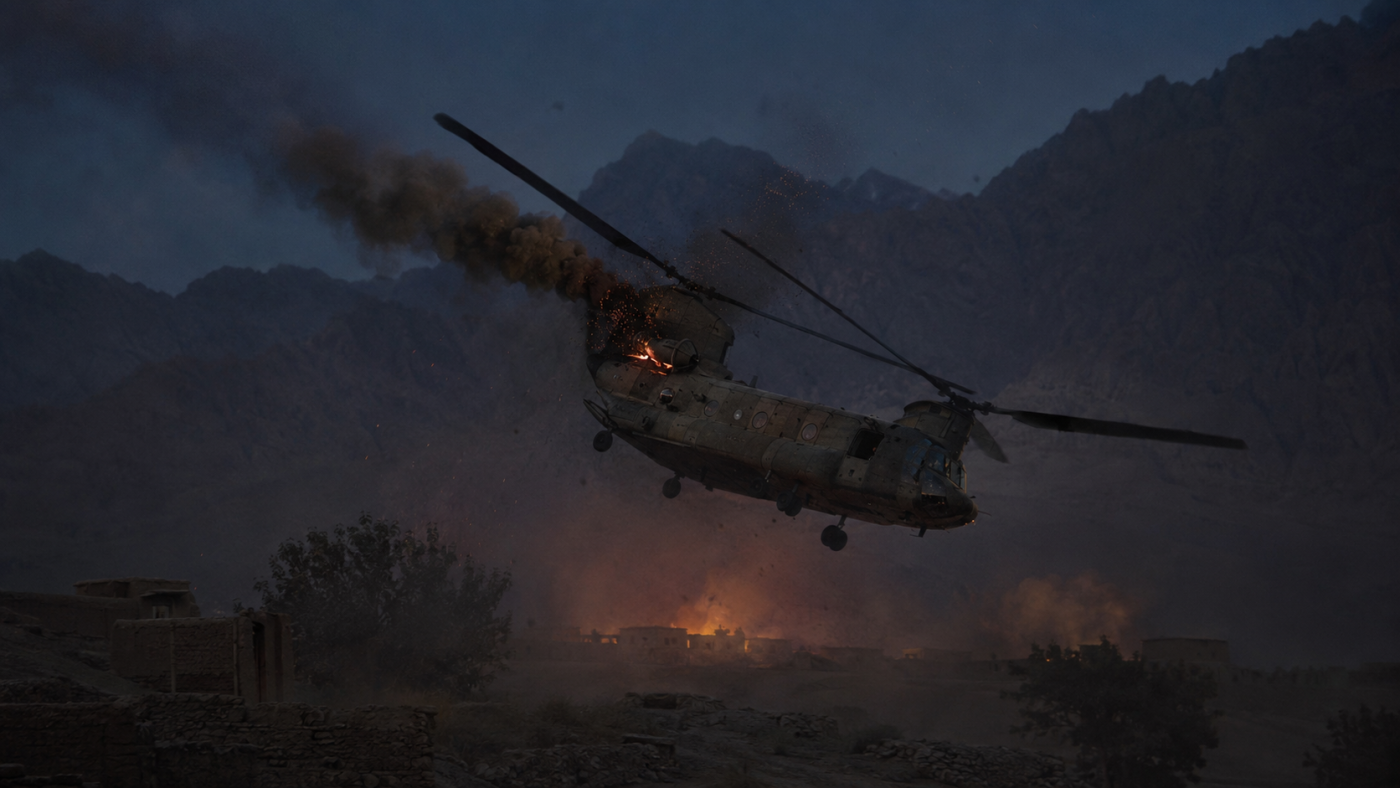
Waiting near the approach were Taliban fighters. According to evidence subsequently presented by the United States Department of Defense, insurgents had concealed themselves in or on a building on the western side of the valley. Their position was extraordinarily dangerous for an approaching helicopter. At one point the valley was only around 200 metres wide, effectively funnelling a low-flying aircraft past the building occupied by the Taliban fighters. The insurgents had not been detected beforehand by the Apache helicopters, Predator surveillance aircraft or AC-130 supporting the operation. As Extortion 17 slowed during its approach to the landing zone, the Taliban fighters opened fire with rocket-propelled grenades. Investigators concluded that two or three RPGs were fired at close range. One of them struck the helicopter's rotor system, and the effect was catastrophic. The RPG struck one of the Chinook's rotor blades, causing the aircraft to lose its ability to remain in controlled flight. At the moment it was hit the heavily loaded helicopter was travelling low and preparing to land, leaving its pilots almost no opportunity to react. Evidence discussed during later congressional hearings suggested that the crew had less than a second in which to recognise the attack and attempt evasive action. In practical terms there was nothing the pilots could have done. A Chinook carrying dozens of men and their equipment could not instantly change direction after being struck in such a critical part of its rotor system.
The helicopter crashed almost immediately into the valley below and there were no survivors. The impact destroyed much of the aircraft, with parts of the rotor system and wreckage thrown across the area. The main fuselage came to rest in or near a creek bed. Recovery operations began immediately and continued for several days. Making the situation even more difficult, a sudden flash flood later swept through part of the crash site and moved some pieces of wreckage downstream. The scale of the human loss became apparent as the identities of those aboard were established. Among the 30 American servicemen were 17 Navy SEALs. Fifteen belonged to DEVGRU's Gold Squadron, while two were SEALs from another Naval Special Warfare unit. Other Navy personnel aboard provided specialist support, including communications and explosive ordnance expertise. Three United States Air Force special tactics personnel were also killed: two Pararescuemen and a Combat Controller from the 24th Special Tactics Squadron. The five-man Army aviation crew also died: Chief Warrant Officer David Carter, Chief Warrant Officer Bryan Nichols, Staff Sergeant Patrick Hamburger, Sergeant Alexander Bennett and Specialist Spencer Duncan. Seven Afghan National Army commandos and an Afghan interpreter died alongside them, as did a military working dog.
For Naval Special Warfare the disaster was unprecedented. Never before had so many members of the community been lost in a single incident. For the wider American military, Extortion 17 represented the largest loss of American life in one event during Operation Enduring Freedom in Afghanistan. Because DEVGRU had carried out the raid that killed Osama bin Laden only three months earlier, the presence of SEAL Team Six personnel aboard Extortion 17 immediately attracted enormous public attention. This led to a persistent misconception that the SEALs killed aboard the Chinook were the same men who had carried out the bin Laden raid in Abbottabad, Pakistan. That was not the case. Although both belonged to DEVGRU, the men killed on Extortion 17 were principally from Gold Squadron, whereas the Abbottabad assault had involved personnel from another DEVGRU squadron. The connection between the two events was therefore organisational rather than the commonly repeated claim that the bin Laden assault team had subsequently been wiped out.
The sheer number of elite troops killed in a single helicopter also generated difficult questions from families, members of Congress and military analysts. Why had so many special operations personnel been placed aboard one aircraft? Why was an ordinary Army CH-47D used rather than the highly modified MH-47 used by the 160th Special Operations Aviation Regiment? Why had the insurgents not been detected? Was the landing zone sufficiently secure, and should more firepower have been used before sending Extortion 17 into the valley? These questions became the subject of considerable scrutiny. The official investigation concluded that the CH-47D and its crew were suitable for the mission and that the pilots had planned their approach using accepted tactics. Investigators also concluded that substituting an MH-47 special operations Chinook would probably not have saved the aircraft. Although an MH-47 contains sophisticated navigation, communications and defensive equipment, these systems cannot provide guaranteed protection against a simple unguided RPG. Countermeasure systems designed to defeat radar-guided or heat-seeking missiles cannot make an RPG suddenly turn away. The projectile that struck Extortion 17 was essentially a ballistic weapon fired at short range at an aircraft passing directly in front of the shooter.
The circumstances demonstrated one of the uncomfortable realities of helicopter warfare. Even enormously sophisticated military forces remain vulnerable to comparatively cheap weapons when helicopters must fly slowly and close to the ground. A fighter aircraft travelling hundreds of miles per hour at altitude is an extremely difficult target for an RPG gunner, but a transport helicopter hovering or slowing to land in a confined valley is very different. The Taliban fighters responsible had positioned themselves where the geography gave them an opportunity. The Chinook's final approach brought it through a narrow corridor and, for several seconds, presented the insurgents with a large target. An RPG launcher costs a tiny fraction of the value of a Chinook and requires none of the sophisticated guidance technology associated with modern anti-aircraft missiles, yet under the right circumstances it can be devastating. A lucky or well-aimed hit against a critical rotor component can destroy an aircraft regardless of the experience of its crew or the quality of the troops it carries.
There were also allegations that Extortion 17 had flown into a deliberate ambush or that the Taliban had somehow received advance warning of the helicopter's arrival. Some families of those killed questioned aspects of the investigation and continued to seek further explanations in the years after the tragedy. These concerns eventually reached the United States Congress. In February 2014 the House Committee on Oversight and Government Reform's Subcommittee on National Security held a hearing specifically examining Extortion 17. Officials were questioned about the aircraft used, air support, intelligence, the route into the valley, recovery operations and the circumstances of the shoot-down. Despite the speculation that surrounded the disaster, the official investigation found no evidence establishing that American or Afghan personnel deliberately disclosed the aircraft's route or landing zone to the Taliban. The accepted conclusion remained that insurgents were in a position from which they were able to engage the helicopter as it approached.
Coalition forces immediately began hunting the Taliban fighters believed responsible. Four days after the loss of Extortion 17, the International Security Assistance Force announced that intelligence had located Taliban leader Mullah Mohibullah and the insurgent believed to have fired the RPG associated with the shoot-down. The men were tracked to a wooded area in Chak district of Wardak Province. After coalition forces determined that civilians were not in the immediate target area, an air strike was called in. Mullah Mohibullah, the suspected RPG gunner and several Taliban associates were reported killed. The strike provided a measure of military retaliation, but it could never compensate for what had been lost aboard the Chinook.
Extortion 17 also demonstrated that the loss of a single aircraft could remove a remarkable concentration of experience from a fighting force. The men aboard were not simply 30 American servicemen gathered together at random. Many had undergone years of selection, specialist training and combat experience. DEVGRU operators represented some of the most intensively trained personnel in the American armed forces. Air Force Pararescuemen and Combat Controllers were similarly specialised. The Chinook crew possessed considerable aviation experience, while the support specialists provided capabilities essential to complex special operations. Replacing aircraft and equipment was possible. Replacing that level of accumulated experience was not.
There was a painful historical comparison as well. Six years earlier, during Operation Red Wings on 28 June 2005, another Chinook carrying special operations personnel had been struck by an RPG in Afghanistan. That aircraft, an MH-47D known by the call sign Turbine 33, crashed and killed all 16 men aboard, including eight Navy SEALs. Extortion 17 was an even greater tragedy. Once again a large transport helicopter carrying a highly trained reinforcement force had been caught during the vulnerable period of its approach, and once again a single RPG strike produced catastrophic results. The loss forced military planners to continue examining helicopter survivability against weapons that were extremely difficult to counter electronically. Following Extortion 17 the United States military studied additional survivability measures and introduced numerous upgrades to rotary-wing aircraft, but officials acknowledged that there was no simple technological device capable of guaranteeing protection against an unguided RPG fired at close range.
The tragedy therefore remains an important lesson in the limitations of technology on the modern battlefield. Extortion 17 was surrounded by some of the most advanced military equipment available. Predator surveillance aircraft watched from the air. Apache attack helicopters and an AC-130 gunship supported troops operating in the valley. Highly trained intelligence specialists were involved and the soldiers being transported belonged to some of the world's most capable special operations units. Yet several Taliban fighters concealed in a building with relatively simple weapons were still able to exploit a fleeting opportunity. That is one reason the Extortion 17 disaster continues to be studied and remembered. It was not a conventional battle involving hundreds of casualties spread across hours or days. The decisive moment lasted only seconds. An RPG was fired, a rotor blade was struck and one of the most capable groups of special operations personnel ever assembled aboard a single aircraft was lost.
For the families, comrades and units of those who died, the consequences lasted far longer. Memorials to the men of Extortion 17 have subsequently been established and commemorative events continue to mark 6 August. Within the United States Navy SEAL community the date carries particular significance because of the unprecedented scale of the loss. The names behind the statistics are what ultimately matter. They were pilots, aircrew, SEALs, special warfare specialists, Pararescuemen, a Combat Controller, Afghan commandos and an interpreter. They came from different units and different backgrounds but were brought together by a single mission in the darkness over Afghanistan. Their objective had been to reinforce fellow troops who were already operating on the ground and prevent an enemy force from escaping. Instead, Extortion 17 became one of the defining tragedies of America's twenty-year war in Afghanistan.
Thirty Americans and eight Afghans climbed aboard the Chinook expecting another combat mission. Within a short time every one of them was dead. The destruction of Extortion 17 remains the greatest single-incident loss of American military personnel during the Afghanistan war and one of the darkest days in the history of modern special operations. More than a decade later, the events in that narrow Afghan valley continue to demonstrate both the extraordinary risks accepted by troops conducting helicopter-borne operations and the brutal reality that, in warfare, even the most highly trained men supported by the most sophisticated technology can be lost in a matter of seconds.