
On this day in military history…
At 6.20am on 20 November 1917, British artillery opened fire near Cambrai in northern France. Across the misty battlefield, tanks advanced towards the German defences, with infantry following through the gaps they made. There had been no prolonged preliminary bombardment to advertise the attack. Within hours, positions belonging to the formidable Hindenburg Line had been penetrated, prisoners were streaming towards the British rear and an extraordinary opportunity appeared to be opening.
The Cambrai offensive became one of the most important experiments in warfare during the First World War. It was not the first occasion on which tanks had fought: British tanks had made their combat debut at Flers-Courcelette on the Somme on 15 September 1916. Cambrai demonstrated their potential when concentrated on suitable ground and coordinated with artillery, infantry and aircraft. Yet its promising beginning was followed by costly fighting and a powerful German counterattack.
By late 1917, the British Army had endured another exhausting year. The fighting around Ypres, culminating in the capture of Passchendaele, had consumed enormous resources. Mud and shell holes had repeatedly limited the usefulness of tanks. Near Cambrai, however, the relatively undamaged chalk country offered firmer ground. The German-held town was also an important railway centre, protected by a defensive system of trenches, wire and fortified positions.
General Sir Julian Byng’s Third Army conducted the offensive with Field Marshal Sir Douglas Haig’s approval. Brigadier-General Hugh Elles, commanding the Tank Corps in France, and his chief staff officer, Lieutenant-Colonel J. F. C. Fuller, had advocated concentrating tanks in a surprise operation. Ideas for a limited raid developed into a more ambitious attack intended to penetrate the German defences and create an opportunity for exploitation. This expansion of the operation would expose a serious weakness: the British did not possess sufficient reserves to turn every possible opening into a sustained breakthrough.
The artillery plan was fundamental. Brigadier-General Henry Hugh Tudor was an important advocate of using carefully calculated fire without the usual preliminary ranging shots. Accurate surveys, information about German positions and calculations allowing for gun performance and weather made it possible to engage targets with much less warning. More than 1,000 guns and howitzers supported the operation. Their task included suppressing German batteries and strongpoints while protecting the advance. Cambrai’s surprise depended as much on the gunners’ preparation as on the appearance of tanks.
The British assembled approximately 476 tanks for the operation, commonly divided into 378 fighting tanks and the remainder serving supporting roles. These totals should not be read as 476 armed machines all attacking abreast. Considerable effort went into concealing the concentration, moving vehicles forward and training infantry to work with them. Aircraft helped mask the noise of the approaching tanks. Elles personally accompanied the attack in a tank named Hilda, giving his men a striking example of leadership at the front.
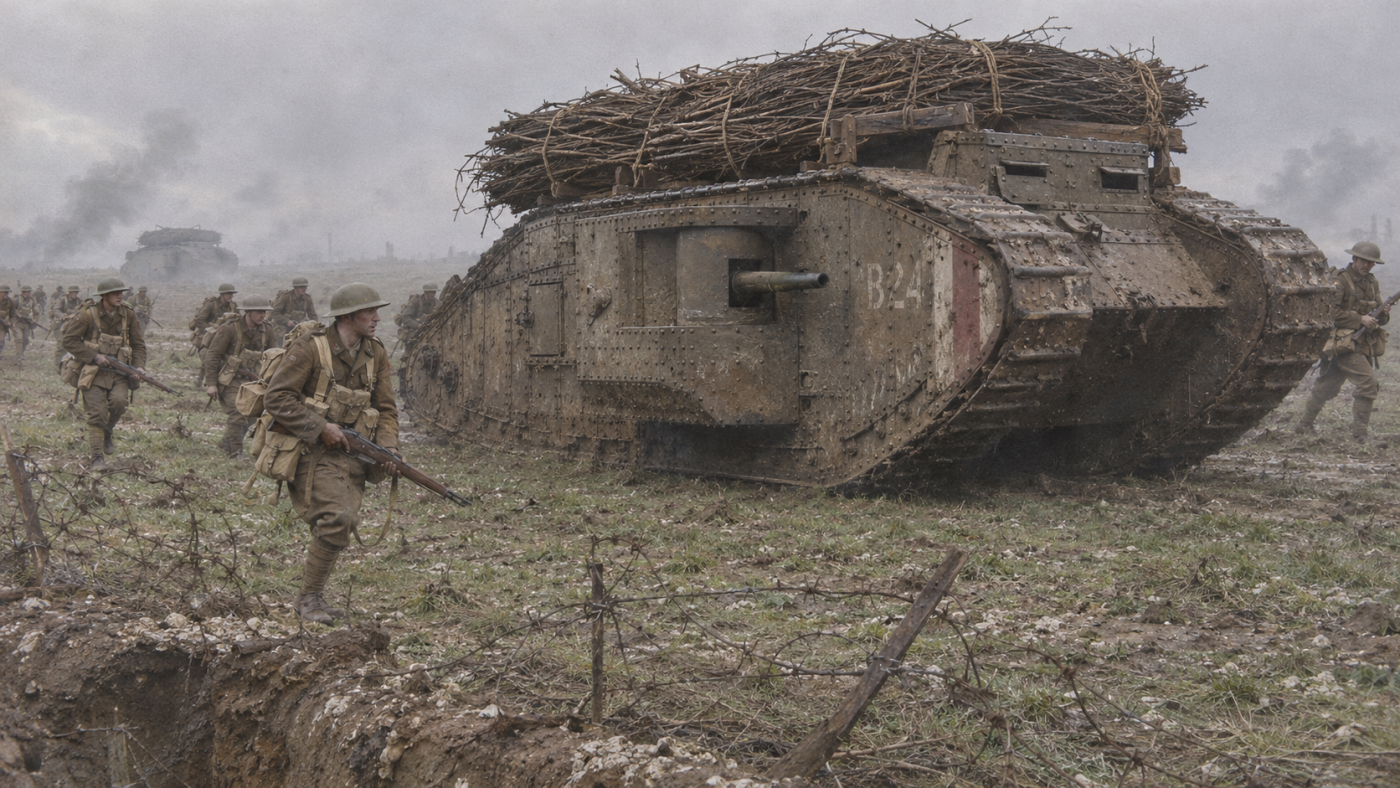
One particularly practical preparation addressed the width of German trenches. Many tanks carried fascines: large bundles of brushwood secured above their hulls. Crews could release these into a trench to provide a crossing. Tanks could also crush routes through barbed wire and fire on positions that threatened the following infantry. These methods offered a way through obstacles that had previously demanded prolonged shelling and repeated assaults.
For the tank crews, this was dangerous work. Armour offered protection, but it did not make the men inside invulnerable. The noise, restricted visibility and demands of operating the machinery complicated every action. Hits on the armour could produce dangerous fragments inside the vehicle. Protective face masks, incorporating steel eye protection and chain mail, were issued to reduce some of these injuries. A tank immobilised beneath enemy guns could rapidly become a trap.
The opening advance achieved remarkable results. British formations broke through stretches of the German defensive system and captured villages including Havrincourt, Ribécourt and Marcoing. In some sectors the advance reached several miles, an exceptional distance by the standards of recent Western Front fighting. Thousands of Germans were captured. The sudden combination of artillery fire, tanks and infantry disrupted defenders who had little time to understand the scale of the assault.
Nevertheless, resistance varied sharply across the battlefield. At Flesquières Ridge, German field guns engaged the slow-moving tanks with direct fire. Some batteries had practised anti-tank tactics, and their position made them especially dangerous. The tanks suffered heavy losses and the advance of the 51st (Highland) Division was delayed. Difficulties in cooperation between infantry and armour contributed to the problem, although explanations that place all responsibility on one commander oversimplify a complicated action.
Flesquières also produced the celebrated story of a lone German gunner destroying numerous tanks. The account grew in later retelling, but the evidence does not securely support the familiar version of one man single-handedly stopping the attack. What is clear is that several German gun positions inflicted substantial losses. The episode demonstrated that tanks required close support and that determined artillerymen could defeat them.
On the British right, the St Quentin Canal presented another obstacle. Problems at the crossings around Masnières and Marcoing restricted the movement of forces needed to exploit the advance. The Royal Newfoundland Regiment fought at Masnières, while a squadron of the Canadian Fort Garry Horse crossed the canal and operated beyond it before withdrawing. Such actions showed the determination of individual units, but they did not create the open route required for a wider cavalry breakthrough.
As the initial shock faded, the British position became more difficult. Tanks had been knocked out, broken down or become stuck; surviving crews were exhausted. German reinforcements arrived, and communications became harder to maintain as units moved beyond their starting positions. Infantry, artillery, ammunition and supplies all had to come forward. The ability to rupture a defensive line had been demonstrated, but sustaining the advance demanded resources and coordination that the attackers could not consistently provide.
British attention increasingly shifted towards Bourlon Ridge and Bourlon Wood, whose high ground mattered to the security of the newly captured area. Attacks launched on 23 November led to bitter fighting in the wood and surrounding villages. Close combat, artillery fire and repeated counterattacks steadily drained the formations involved. The offensive that had begun with surprise and rapid movement was becoming another struggle for limited pieces of ground.
On 30 November, the Germans launched their major counteroffensive. Artillery fire supported infantry using infiltration tactics, with assault troops seeking weak points and bypassing some centres of resistance to isolate them. The southern attack made rapid progress, reaching Gouzeaucourt and threatening the British salient. Around Bourlon, determined defence and concentrated British artillery made the German advance more difficult. Reinforcements and local counterattacks helped prevent an even more serious collapse.
The fighting included extraordinary individual courage. Near Moeuvres, Captain Allastair McReady-Diarmid of the 17th Middlesex Regiment led counterattacks on 30 November and 1 December, helping recover threatened positions. He was killed during the fighting and received a posthumous Victoria Cross. His actions were one example of the leadership and endurance demanded as exhausted British units struggled to contain the German assault.
The British subsequently withdrew from exposed positions, including the Bourlon area. By 7 December, the main fighting had ended. Some gains remained around the northern part of the battlefield, while German advances in the south had taken ground beyond the original British line. Cambrai itself remained in German hands. The operation had failed to achieve a decisive breakthrough, despite the scale of its initial success.
Casualty estimates vary, but British losses were approximately 44,000–45,000 killed, wounded, missing or captured, with German losses commonly estimated at roughly 41,000–45,000. These figures represent total casualties, not deaths alone. The cost turned the early promise of Cambrai into a sobering reminder that tactical innovation could still lead to prolonged and expensive fighting.
Cambrai nevertheless helped secure the tank’s place in the British Army. It showed that even powerful trench defences could be penetrated quickly when armour, infantry, artillery and aircraft acted together. It also exposed the importance of reserves, reliable communications, supply and the timely consolidation of success. These lessons contributed to the more effective combined operations of 1918.
A surviving link to the battle is Deborah, a British Mark IV tank knocked out near Flesquières. Buried for decades, it was recovered in November 1998 after research established its location. Its damaged hull offers a physical reminder of the men who fought inside these pioneering machines. Alongside the cemeteries and memorials of the Cambrai battlefield, it preserves the human story behind an offensive that revealed both the possibilities of armoured warfare and the terrible price of learning how to use it.